Showing posts with label augmented reality. Show all posts

6.10.2011

WEEKEND READING: June 4-10, 2011

Sylvan Terrace, one of my favorite sites of "urban delight" in Manhattan
This week was like a big traffic jam of awesome in the urban-o-sphere. No time for dithering introductions, on to the good stuff.

ITEM ONE: David Roberts wraps up his five-part series on great places at Grist with a post on urban delight, taking time to note both the suburbs' relative inadequacy in this realm and Bjarke Ingels' unstoppable charge toward architectural legend.

ITEM TWO: The tenth issue of MAS Context takes on the meaty subject of Conflict in urban environments.

ITEM THREE: Speaking of conflict, Maisonneuve looks at the violence in many video games and wonders whether urban AR gaming might make for more dangerous cities (thanks to an Anonymous commenter for sharing this link on Wednesday's post!)

ITEM FOUR: Meanwhile, SimCity creator Will Wright shares his insights about the relationship between playing and learning, and how about people actually engage with video games (nutshell: the violence a'int so bad, folks).

ITEM FIVE: Nicolas Nova suggests a design studio for locative media that would be centered on visualizing the bizarrely partitioned city at the heart of China Miéville's novel The City and The City. Now that, I've gotta see.

ITEM SIX: Springwise writes of an innovative new app that crowdsources geodata to predict when the next train or bus will arrive. (WANT)

ITEM SEVEN: Urban Omnibus interviews David Giles, lead author of the Center for an Urban Future's new report on the prominence and related power of the design sector in New York City.

Enjoy the reading, and stay cool this weekend!

6.07.2011

Where's the Discussion on Urban AR Gaming?

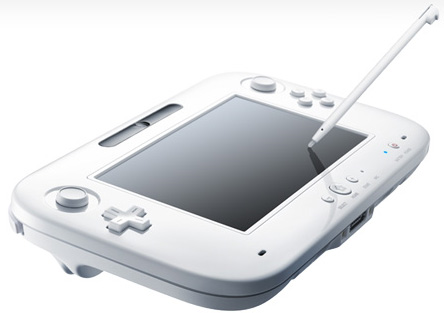
Image from Fast Company
Especially interesting in light of Monday's post: Fast Company reports today on Nintendo's new Wii U controller, proclaiming that "living room entertainment just got one step closer to having a true three-dimensional virtual environment." It seems implicit in this statement that the author believes video games to be the provenance of the virtual world; that to have an immersive game environment, one needs to be completely transported by interacting with a screen, rather than the screen modifying the true, four-dimensional environment that the player already exists in.

I've long found it perplexing that, while there is plenty of discussion and debate about video games, and plenty of hype around augmented reality, I very, very rarely come across any account (written, spoken, or otherwise) about augmented reality games that are simply layered over the world that we inhabit. Often, when I do, they're presented in broad strokes, as a far-off possibility: "we'll deal with that when we get there."

There have been a few notable exceptions (see: Cory Doctorow's Little Brother, Dan Hill's The Street As Platform) but on the whole, there doesn't seem to be much discourse around this subject and its enormous potential to change the way that we interact with our cities. Perhaps the technology just really seems too far off to people, though I've personally seen at least one AR application that could easily be retrofitted for geo-locative video games tomorrow in action. Or perhaps I just haven't looked hard enough; if that's the case, and you know of some great resources for reading about/discussing AR gaming (especially in urban environments), please share!

6.06.2011

On Video Games, Urbanism, and the Future of Creativity

Image from Wikimedia Commons
Last summer, Newsweek reported that researchers had identified an unnerving trend: American childrens' scores on creativity tests (a la the Torrance Test) were, for the first time since they started being administered in the late 1950s, starting to drop. The article's authors, Po Bronson and Ashley Merryman, identified two likely factors in creating this downward turn, one being the increasing standardization of school curricula and the lack of deliberate creativity development in classrooms. Calling for a revival of such development, Bronson and Merryman wrote:
What’s common about successful programs is they alternate maximum divergent thinking with bouts of intense convergent thinking, through several stages. Real improvement doesn’t happen in a weekend workshop. But when applied to the everyday process of work or school, brain function improves.
I was struck the other day by a distinct echo of this statement in a post by LiftLAB collaborator Nicolas Nova about recent video games with which he'd been impressed. Writing about the game Superbrothers, Nova explains:
This combination of players’ interactions with “sound, music & audiovisual style” underpinned by a basic narrative and very low-key dialogues made me tick. More specifically, I am impressed by the rhythm of the game, which is sometimes super slow/contemplative and sometimes very quick/nervous in combat.
Bronson and Merryman's second major cause of the creativity slump in American kids was the increase in time spent plopped in front of the TV playing video games, but Nova's description of the rhythm and structure of Superbrothers highlights an interesting alternative: video games are uniquely positioned to serve as vehicles for creativity development. Players engage in a video games with long-format storylines over extended periods of time. Many games have immersive environments that are fun to explore outside of plot-focused action (I'm thinking, here, of classic games from my youth like Chrono Trigger and Earthbound, though there are no doubt newer examples). This means that players alternate between different modes of thinking: slower, self-paced exploration (divergent) and goal-oriented tasks (convergent).

The digital worlds in which video games take place also require the suspension of disbelief, and we have all been pretty well-trained to oblige. Real people don't double in size when eating mushrooms, but while playing Super Mario Bros., few question that occurrence. In the aforementioned Earthbound, players battle everything from zombies and sea monsters to a possessed circus tent and Dali's clock (no joke). When we're in gameplay mode, none of this seems out of the ordinary. We are ready to except non-traditional ways of thinking and, I'd argue, are primed to develop our own.

The good news for cities is that video games are increasingly being played on smaller and smaller screens. More recently, we've seen games that have begun to incorporate real-world geography, with episodic content that is tied to the exploration of actual places, as well as current events. Smartphones and handheld game consoles that make the original Gameboy look as technologically advanced a platform as a pencil and paper are increasingly ubiquitous, and they can be used to change the way that we see the world around us. The myriad public places that make up a neighborhood--parks, squares, streets, shops, libraries--could easily become 'levels' with various tasks assigned to them.

Using a Nintendo DS or a Droid phone, we could walk on a street we'd been down a thousand times and be prompted by a game to stop for the very first to look around and explore our surroundings. Designer Michael Wolff describes the creative process as requiring three muscles that must be exercised regularly: curiosity and appreciation, which together enable imagination. Video games already exercise the first two of these muscles; locating games within the context of a world that we recognize and understand allows them to encourage imagination that could actually improve the places in which those games are set.

As video games become tied to physical places (which has the added benefit, by the way, of getting players off the couch) the complexity of dense urban environments offers a distinct advantage: New York's Union Square or Shanghai's Bund are the Xbox 360s to the suburbs' Atari. According to one collective in Zagreb, "Augmented Reality promises to transform all points on the map into unlimited spaces that can be exploited for self-expression by anyone." In today's socially-oriented mashup culture, the rise of games that enable players not only to explore, but to impact their environment and share their interventions, as well as build on the creativity of players who came before them, seems inevitable.

Charles Landry wrote that “A creative city is a place where people feel they can fulfill themselves, there are opportunities. Things get done.” Video games offer plenty of opportunities to get things done and obtain a sense of fulfillment; location-based games that are designed to develop players' creative faculties present an opportunity to create a truly symbiotic relationship, developing inventive populations while simultaneously enriching the gaming experience. Leisure is important in any urban environment--and there's no reason that it can't be used to build a city up.

6.03.2011

WEEKEND READING: May 28-June 3, 2011


That's a Wordle of the top ten words from the 50 items that were in my starred folder on Google Reader when I started putting together this post. The order is totally random...and vaguely poetic, no? In other news: how is it time for Weekend Reading again?? Where did this week go? Anyway...

ITEM ONE: Over at the IfUD, we've launched the By the City / For the City design competition, inviting designers, artists, and architects around the world to respond to one (or more!) of the 500+ ideas New Yorkers shared for improving their city. Check out the site at the former link, then register here!

ITEM TWO: Loved Marcus Westbury's article on crowdfunding in The Age. In fact, love everything I've read by this guy. Renew Newcastle is truly amazing. (via @unsungsongs)

ITEM THREE: The Urbanophile features a guest post by Where alum Drew Austin on digitally-tracked taxi cabs as "spandrels," providing data that, as a happy accident, can improve the flow of our cities.

ITEM FOUR: Urbanscale takes an eye-opening swipe at Augmented Reality (and makes promises about some very exciting-sounding upcoming posts). Especially salient point: at least for the foreseeable future, AR actually diminishes the urban environment rather than...well, augmenting it by providing incorrect, incomplete, and commercially-skewed versions of the city.

ITEM FIVE: Matias and Rahul re-post an article that casts a wary eye toward the flavor of the week in silver bullet slum saviors, the $300 House, over at Airoots.

ITEM SIX: The Pop-Up City catalogs some great urban games. Apparently there is one called "Farmville for Real," which is especially interesting given this

ITEM SEVEN: Rhizome points us to New Scientist's May issue on digital archiving and legacy. Your expiration date is now: infinity.

It was my birthday on Wednesday. Drink an extra one for me this weekend. I won't know that you did it, but I'll appreciate it nonetheless.

3.24.2009

Earbud Urbanism


I was walking down the in downtown Chicago recently wearing my white earbuds, loud tunes pumping out of my iPod into my head, and it got me thinking. When you have earbuds in, it's almost as if the music is inside your head. It overtakes your thoughts. Ok, maybe not completely, but it would be hard to deny the fact that what we listen to affects our mood and our perception of our surroundings.

On this walk, I started to become aware of how many people were walking around with one of their five senses -- hearing -- completely disconnected from their environment, and I thought to myself: how does this disconnection alter our perception of the urban condition as we experience it? I wonder how many urban designers take into consideration the fact that people are walking around detached from their environment, being highly influenced by a source that the designers themselves cannot control. Personal technology is taking over how we interpret our surroundings and changing the way we feel about places, and this should be considered as we move further and further into interactive technologies.

So, imagine: your music is playing in your ears, and you're walking down the street with a certain demeanor dictated by the recent events in your life, the weather, and of course your music; what's the last thing you notice? Advertisements. Ironically, the ads placed all around the city to get you to buy devices with white earbuds are suddenly ineffective, blending into the grey zone of focus deprivation caused by the mood enhancing device sending electrical waves to your brain. In the end, it is the corporation, the large companies that build and control our urban experiences. Storefronts are often completely detached from the context of the buildings they are plugged into, creating a street level experience dictated more by the corporate retailers than the architect or planner. So it is fair to say that these businesses have a significant stake in our urban experience, and will not keep pumping money into failing advertising mediums but will instead resort to new mediums, capitalizing on our newfound technological dependency.

I can imagine, in the near future, holding your electronic device up to a window display and downloading music from a record store. The technology is already here; its just a matter of how that tech is eventually used as a marketing tool that will change the way we experience the city and our daily life. Instead of billboards, there will be giant digital displays. Using the technology showcased in the Mini ad a while back, called "augmented reality,"  these displays will reflect you as you walk by, but will project a certain brand of clothing onto your image, detecting your body size and instantly altering the clothing image to fit you using a complex algorithm. These displays will show you in real-time with a Snickers and a Coke in your hand asking "Why Wait?"

So I wonder: how much of what we experience is predetermined by a planner, an architect, or a corporation, and how much of it is dependent on sources we create and introduce ourselves? My guess is that we will increasingly be adding our own sources and corporations will tap into this and use it to promote their agendas, thereby creating a new urban condition.  Earbud Urbanism, anyone?  


(Photos from Apple and Designboom. The original full-sized color version can be viewed by clicking the photo.)