Showing posts with label architecture. Show all posts

1.22.2012

Kaleidoscopic New York

More fun with the Stereographic Street View hack. As it turns out, you can do a lot more than just make those cute little mini-planets. Long, low buildings, for example, can be fun to play around with. Here we are at Industry City in Sunset Park, Brooklyn:


And, up at Viñoly's razzle-dazzle-y Hall of Justice in the Bronx:


Skyscrapers are fun for the same reason. Here's Manhattan's GM Building (and Apple's famous Cube store):


And Long Island City's Citi Tower, warped into something of a crooked frame:


In fact, with the right site, these stereographic images can start to look like legit abstract art:


And then, of course, there's the straight-up kaleidoscopic stuff. Here's the old American Banknote Building in Hunts Point:


One of the covered sections of the High Line, near 14th Street:


Under the 1 tracks up in Kingsbridge:


Pier Luigi Nervi's magnificently weird bus terminal in Washington Heights:


Inside the Met (three cheers for Street View inside major museums!)


And last, but certainly not least, on the Brooklyn Bridge:


If anybody plays around with this thing and finds some more worth sharing, please do!

1.21.2012

Stereographic New York

Thanks to Brainpicker for alerting me to the presence of what may be the best Google Maps hack I've seen yet, Stereographic Street View. Now I know what I'm going to be doing for pretty much the rest of my life. Some early successes:

Under the Queensboro Bridge in LIC:


Then on down to Soho:


And Flatbush. The uniformity of public housing blocks makes for some really great stereographic images:


And speaking of uniform residential architecture, Fort Greene's Portland Avenue lends itself well to this format:


As does the Greystones block of 80th Street in Jackson Heights, Queens:


Then, on to fun with interestingly-shaped landmarks. The Bronx's Kingsbridge Armory:


The Newtown Creek Wastewater Treatment Plant in Greenpoint:


The New Museum:


The Whit:


And the Gugg:


The patchy quality of much of Google's Street View imagery means that a lot of stuff gets a little blurry around the edges, but the site is still terrifyingly addictive. If you enjoyed this post, stop back tomorrow for some more abstract fare...

7.24.2011

What Color is Your Favorite Architect?

Oh joy, thecolorof works for architects, too! There are some fascinating results--so many, in fact, that you'll have to travel beyond the jump, as I don't want them mobbing the Where homepage, heh.

7.06.2011

On Stolen Towns, Cities as Brands, and Public vs. Private Visions

Image by Flickr user philipbouchard
Revisiting a few posts that I wrote for Next American City a couple of years ago via more recent news items:

From Neighborhoods as Brands (March 2008):  
Think about places in American cities that have a special cultural power.  Now export them to a brownfield site one or two thousand miles away...New Orleans’ French Quarter could become one of America’s most popular exports.  There could be one in Shanghai, one in Jakarta, one in Abu Dhabi, one in Zagreb, and another on the outskirts of Khartoum.  These would not be theme parks, but fully-populated, 24-hour neighborhoods selling a lifestyle of jazz, street dancing, and easy living.
More recently, Der Speigel brought us news that Chinese officials have surprised residents of the Austrian town of Hallstatt by deciding to copy the entire town back east, brick for brick. Jokes about China's lasseiz faire attitude toward Western copyrights (particularly those of the intellectual variety) got tired years ago, but this latest news feels like a fresh pain. UNESCO is, hilariously, trying to determine the legality of this--as if they'll have any power at all to stop the copy from being built. What can be done?

In a country where they're building cities faster than they can fill them, it hardly seems surprising that a few would borrow heavily from existing, well-loved places, and Spiegel notes the existence of a scattering of Euro-themed suburbs near Shanghai. But while it's one thing to choose to export a place, seeing developers--from any part of the world--up and jacking a whole town should raise eyebrows. Imagine people on the other side of the world eating in a clone of your favorite restaurant, living in the bizzarro version of the apartment just above yours, listening to the kids playing handball in a counterfeit of the park outside your side window.

Then again, try as they might, Starbucks' store designers can't make a London shop feel that different from one in Chicago. That is to say, the places that we inhabit in globalized cities are already feeling like copies of copies. If the Hallstatt story has anything to teach us perhaps it's that it's better for cities to get out in front of this trend and start marketing their strongest neighborhoods to Chinese developers as blueprints. Within China itself, developers are starting to market entire neighborhood types within the same cities--what Ad Age Global refers to as "Cities in a Box." Better for Boston that those developers specialize in Beacon Hills instead of Bunds...assuming, of course, that Boston can be involved somehow.

All of this raises the issue of whether or not the people who inhabit a place have any inherent right to its built form. Indeed, it raises the issue of whether or not a place has a right to itself, in many ways. So I'll re-pose the question from that original NAC post: In the glocalized world, does any place belong to any one group, or does everywhere belong to everyone?

-----

Also, from A Vision For Detroit (April 2010):
If there is the political will and the financial might in Detroit to privately fund a light rail line (which would take a miracle in almost any American city, much less one with Motown’s reputation), there should certainly be enough energy to create a broad, forward-thinking vision for the region to tie various initiatives together into a narrative that the whole city can rally behind.  Detroit has everyone’s attention; now it’s time for the city to decide what story it’s going to tell.
Now, just over a year later, the WSJ is reporting that all is not well in the Motor City, as the Bing administration wrestles with the Kresge Foundation to determine whose job it is to plot that storyline. The city says that it appreciates Kresge's cash, but can do just fine developing the vision to guide its own revitalization, thank you. Kresge begs to differ, with its suburb-based president Rip Rapson arguing that new ideas from outside the entrenched political system are desperately needed.

No matter which camp you fall into, it's certainly a fascinating read. With Kresge pulling out of critical projects like Detroit Works and the M1 light rail line, it may behoove Bing to acknowledge that Detroit's record, when it comes to city-led revitalization projects, leaves something to be desired; ceding a bit of control might not be the worst thing to ever happen to the city. You could call Kresge's new-found reticence fickle, or even extortive, but if the foundation doesn't believe that the city's long-term plans will allow their investments to have a lasting impact, they have every right to withhold.

That's not to say that citizens shouldn't have a say in what happens to their city, and Kresge would do well to be as clear as is humanly possible about what it is they'd like to see happen in order to build public support. Being a private foundation does not absolve you of responsibility to communicate with the public whose lives you'd like to improve. 2¢ from an outsider.

6.10.2011

WEEKEND READING: June 4-10, 2011

Sylvan Terrace, one of my favorite sites of "urban delight" in Manhattan
This week was like a big traffic jam of awesome in the urban-o-sphere. No time for dithering introductions, on to the good stuff.

ITEM ONE: David Roberts wraps up his five-part series on great places at Grist with a post on urban delight, taking time to note both the suburbs' relative inadequacy in this realm and Bjarke Ingels' unstoppable charge toward architectural legend.

ITEM TWO: The tenth issue of MAS Context takes on the meaty subject of Conflict in urban environments.

ITEM THREE: Speaking of conflict, Maisonneuve looks at the violence in many video games and wonders whether urban AR gaming might make for more dangerous cities (thanks to an Anonymous commenter for sharing this link on Wednesday's post!)

ITEM FOUR: Meanwhile, SimCity creator Will Wright shares his insights about the relationship between playing and learning, and how about people actually engage with video games (nutshell: the violence a'int so bad, folks).

ITEM FIVE: Nicolas Nova suggests a design studio for locative media that would be centered on visualizing the bizarrely partitioned city at the heart of China Miéville's novel The City and The City. Now that, I've gotta see.

ITEM SIX: Springwise writes of an innovative new app that crowdsources geodata to predict when the next train or bus will arrive. (WANT)

ITEM SEVEN: Urban Omnibus interviews David Giles, lead author of the Center for an Urban Future's new report on the prominence and related power of the design sector in New York City.

Enjoy the reading, and stay cool this weekend!

5.09.2009

Sitte in a Digital World

Photo of the Piazza dei Signori VicenzaCamillo Sitte thoughtfully explained the interior qualities of his favorite public spaces. Though generally open to the sky, they were surrounded by varied building types and furnished with stairways, arches, and sculptures. They were intimate and often irregular, with engaging views on all sides. He lamented the abandonment of plazas as daily life moved increasingly indoors.

Today life moves increasingly online, but the places we inhabit -- whether physical or virtual -- are no less important. Even looking out the window affects our state of mind. This is hard to measure, but it's fairly clear when we feel comfortable, depressed, inspired, fearful, or healthy in response to our surroundings.

Sitte envisioned outdoor space that didn't feel desolate. When we think of The Great Outdoors, we usually mean forests, mountains, rivers -- not cities. But in many ways forests have more in common with cities than with prairies or deserts. Drawing of the Piazza dei Signori from City Planning According to Artistic Principles, by Camillo SitteThey are full of proximate activity, and contain many unique places. I wonder how cities might eventually be considered part of The Great Outdoors.

It would be a stretch to think of online places in Sitte's terms, unless we include video games. Many games offer convincing and imaginative environments. They might help us understand the way people interact with physical spaces before building them. Although it doesn't seem possible to get a feel for a place before it is built, studying people's use of virtual settings can inform key decisions. This sounds expensive, but could save money in the long run.

Whether physical, virtual, or somewhere in between, environments affect the quality of our lives. Considering the factors that contribute to positive experiences, as Sitte did, is of great value. His observations have inspired generations of architects, planners, and concerned citizens to create and preserve beloved places.

(Photo of the Piazza dei Signori Vicenza from Flickr user Albert dj; Drawing scanned from p. 378 of Camillo Sitte: The Birth of Modern City Planning, by George R. Collins and Christiane C. Collins)

4.24.2009

Review: Buckminster Fuller at the MCA


In a corner of the soaring lobby of Chicago's Museum of Contemporary Art sits an inconspicuous screen cycling though a series of quotes. "Don't fight forces," one suggests, "use them." A few seconds later: "Do more with less." And then: "Real wealth is ideas plus energy." These are the words of Buckminster Fuller, the great American thinker and designer famous for his geodesic domes and his pragmatic idealism. Fuller was a colorful man, and extraordinarily wealthy if measured by his own standard: his thoughts were abundant and bright, and his energy seemingly boundless. In the exhibit Buckminster Fuller: Starting With the Universe, the MCA has crafted an impressive overview of Fuller's life and work that brings into focus his prescient worldview and, more importantly, the thought process behind it.

It was after his failure as a businessman and the death of his daughter in 1927 that Fuller resolved to turn his life into an experiment to see how much one man could contribute to society in a lifetime, labeling himself "Guinea Pig B." The exhibit opens with several rooms filled with a diverse selection of objects that recount the beginning of this experiment. Models, drawings, maps, notebooks, and other objects show the evolution of Fuller's early work into his development of the World Game and the Dymaxion map during and after World War II.

Fuller prided himself on his comprehensive thinking; he approached each problem as part of a larger system of problems. Humanity's great challenges were all interlinked, and to consider solutions for one, it was necessary to consider the others simultaneously. Nowhere in the Starting With the Universe is Bucky's way of thinking on display more clearly than in the two rooms that detail the evolution of the Dymaxion Map into the development of the geodesic dome. It was his work on creating a map that eliminated the distortion of the planet's land masses that led to Fuller's fascination with polyhedrons. His engineer's brain latched onto the structural integrity of the icosahedron form that his map created when folded into a "globe," and by the 1950s he was working with his students at the legendary Black Mountain College in Asheville, NC, on developing the dome that would define the later part of his career.

Interestingly, it is a rather inconspicuously-placed video of Fuller at the mid-point of the exhibit that offers the clearest glimpse of how his industrious mind processed information about the world. His demonstration of how a flexible polyhedric structure shifts form is underlined by his emphasis on its uniform contraction and expansion. Throughout his life, Fuller worked on devising comprehensive solutions to myriad problems; his fascination with a flexible structure in which each part was equally responsive to all of the others is hardly inconsequential.

Beyond the geodesic dome, the maturation of which is explored in the second half of the MCA show, Bucky Fuller is arguably best remembered for his prescience. His ideas about environmentalism and the consequences of man's actions on the planet presage the contemporary Green movement by decades; he is also remembered for his early conceptualization of the internet and his musings on the growing importance of mass communications. Fuller understood everything as being part of a system, a network. In Buckminster Fuller: Starting With the Universe, the MCA has created an exhibit that presents Fuller's as a visionary worldview that remains relevant more than twenty years after the great thinker's death. Like any good museum exhibit, this one makes the visitor re-think they way that they look at the world. Bucky would be proud.

----
Buckminster Fuller: Starting With the Universe is on display at the Museum of Contemporary Art in Chicago until June 21st, 2009. For more information about the museum and its other exhibits, click here.


(Photos from ArchNewsNow, OSEarth, and PentaMil.)

4.18.2009

Tending to Cities

Photo of the Plaza de la Constitucion de Oaxaca (Zocalo)Does it matter how a city or neighborhood looks? Many would say it does, though much less than, say, health or safety. So if it matters to some extent, what makes a place visually attractive? Are there any common characteristics, or is it only in the eye of the beholder?

Maybe "looks" is the wrong word. How about the way a place feels? This would include all the senses -- the different variables that make an area appealing. Of course, people have unique tastes and I don't know if there are any qualities loved by everyone. However, there are places generally considered attractive. They are usually in wealthier districts, but should extend to poorer communities as well. If we work towards achieving this throughout our cities, without displacing low-income groups, we might look back some day and wonder how we ever lived in some of the neglected areas we know today.

Maybe we can start by identifying the places people value most, why they are valued, and how to preserve them. (I'm not sure how best to do this. A popular vote doesn't seem practical, but maybe it would work. I wonder which areas would win out? Greenwich Village, for example, or Times Square?). We could go through a similar process for areas that people find unappealing, focusing on improvement. This might be considered a form of public participation in city planning. At the very least we would find out if there are any shared values among urban populations. If this kind of study reveals anything useful, it might inform the design of new places.

Photo of PittsburghA recent article on preservation in Pittsburgh shows how the adaptive reuse of urban areas can be an effective means of environmental sustainability. Cities are environments, and great urban settings should be valued and protected in a way similar to national parks. This is not a call to restrict new designs, but we can work to make sure the results are worth preserving. Setting standards for the quality of building materials might help. Design standards are another possibility, although that seems kind of arbitrary and stifling to creativity.

I wonder if there could be periodic review processes for all planned and existing development, assessing its contribution to the urban environment and how it might be improved. These reviews could address aesthetics as well as health and safety issues. Public funds might be used to make improvements. Sometimes small changes can make a big difference. A new paint job or facade can transform an area with minimal destruction of existing buildings. In other cases, shoddy construction can be removed to make way for something better. Would we be able to agree on what improvements to make? Who would be involved in the review process? How would we deal with the legal issues surrounding private property? There are many reasons why this would be difficult or impossible, but it would be great to set up a continuous process of developing healthy and attractive environments.

(Photo of Plaza de la Constitucion de Oaxaca (Zocalo) from The Project for Public Places. Photo of Pittsburgh from Statepa.org)

3.27.2009

Thinking Outside of the Box on the National Mall


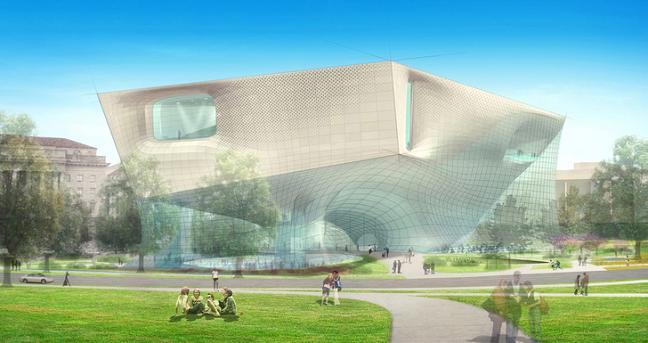
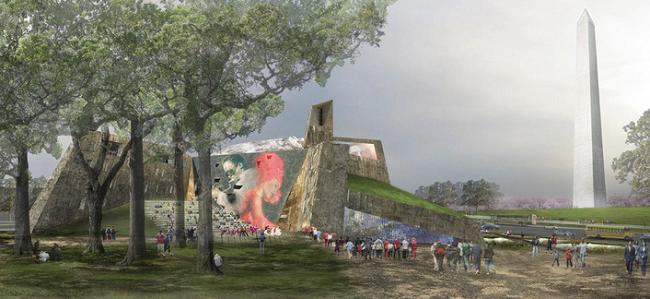
Submissions have just been unveiled this afternoon for six innovative entries in a competition to design the planned Smithsonian Museum of African American History and Culture, a $500 million project scheduled to open in 2015. The six competing teams are: Devrouax & Purnell with Pei Cobb Freed & Partners; Foster and Partners with URS; Diller Scofidio + Renfro with KlingStubbins; the Freelon Group, Adjaye Associates and David Brody Bond with SmithGroup; Moshe Safie and Associates with Sultan Campbell Britt & Associates, and Moody Nolan with Antoine Predock Architect.

Above is a rendering of Diller Scofidio + Renfro and KlingStubbins's avant garde submission; a rendering of Moody Nolan and Antoine Predock's proposal is below. Looks like the Smithsonian -- a fairly traditional institution, when it comes to architecture -- is planning to give the National Mall a bit of archi-juice. And we thought the National Museum of the American Indian's building was a departure!

It's always refreshing when, once in a blue moon, all of the entries in a competition are genuinely interesting, no?

(Photos from the Washington Post.)

1.09.2009

Thoughts on How Cities Change

Photo of Triphammer Falls at Cornell University in Ithaca, NYThese ideas came to mind while reading Bruno Latour (especially), as well as Donna Haraway, Matthew Gandy, Sarah Whatmore, and Eric Swyngedouw. I’d like to write them out before I forget, and I wonder if they are useful for considering how cities change.

Main idea: Cities change through socio-political relationships between living and nonliving things.

Elements interact and combine to bring about different outcomes, as when molecules come together to form a human being (the outcome doesn’t have to be consciously pursued), or when humans construct a building to provide shelter Photo of Rolling Home, by Charles Miller(the combined elements don't have to be completely attached). These combinations are based on more or less cooperative social relationships. In other words, elements participate in diverse forms of associative groupings.

The building materials in the example above don't have a choice in the matter, which is where the political (power relations and governance) comes in. It is through politics that combined action takes place. Power is based on the ability to incorporate necessary elements to realize objectives.

Photo of Martin Luther KingFor example, the winner of a democratic election comes to power by communicating a vision that attracts the most voters. Power can also be taken by force, as when people combine with superior weaponry to accomplish their goals. Groups form through communication, cooperation, and coercion. They exist at many levels, and are not limited to people. Nonhumans communicate nonverbally. The sound of a rockslide tells animals to make way. Flowers attract pollinators with pleasing colors and scents. Nonhumans also cooperate and dominate, even if not through conscious decisions. They interact with or without humans through social and political processes.

These ideas seem useful for understanding how cities change over time, and for finding ways to direct this change toward a common good. Mutually beneficial relationships tend to be the most lasting. Photo of kids playing in a fountainHowever, using wood to provide shelter isn't beneficial to the trees that get cut down. This is where it is necessary to prioritize. While our survival depends on a degree of anthropocentrism, we can still work to understand and reduce harm to others as much as possible. This is an ethical responsibility, and it strengthens our wellbeing. We can develop innovative policies and technologies that result in cohesive solutions to urban problems. The more people and things that benefit from these solutions, the more likely they will sustain.

The authors mentioned above have changed the way I think about cities. While this is not a summary of their ideas, it is very much inspired by them. They helped me look at nature (including cities) as interactive processes of change. I hope others will share their thoughts or add things that I’ve missed.

(Photo of Triphammer Falls from Panoramio user dmcguirk; "Rolling Home, Rockaway Beach, New York, 1933" taken by Charles Miller and scanned from a postcard; Photo of Martin Luther King from blakehuggins.com; Photo of kids playing in a fountain from jandtenterprises.com)

12.05.2008

Revisiting The Radiant City


A note accompanies this photo in Le Corbusier’s The Radiant City (1933):

“outside our apartments in the Radiant City: we come home from work and change; our friends are there waiting. High spirits, physical activity. And then we can go on to think about the 'serious' things afterwards."

I can see myself now, coming home after a long day's work and running the steeplechase with my neighbors. :) Le Corbusier’s plans, while at times charmingly unrealistic, are also blamed for inspiring the spread of giant housing projects in cities around the world. But is there enduring value in his thinking?

Two possibilities come to mind: 1) his embrace of new technology to improve living conditions, and 2) his use of space to minimize the ground cover of buildings.

As for technology, Le Corbusier tended to adopt ideas of mass production uncritically. However, his thoughts on prefabricated structures have great potential. As evident in the recent exhibition Home Delivery: Fabricating the Modern Dwelling, the featured houses in Dwell Magazine, and the assembly of LivingHomes, prefab architecture is coming into its own. What if we could design our own houses from components displayed online? Would this result in monstrosities or homes well-adapted to our needs? Could this be a way of realizing some of the building ideas in Christopher Alexander’s Pattern Language?

While Le Corbusier's use of space wouldn't work for everyone, tall buildings on pilotis with roof gardens would minimize the acreage occupied by our homes. This could bring benefits associated with energy efficiency, biodiversity, carbon sequestration, and (provided that amenities are within walking distance) reduced dependence on automobiles. I don't suggest that everyone should live in this kind of building, and the architecture could use rethinking; still the idea of freeing up space for agriculture, forests, and recreation sounds promising.

Although we might not find spontaneous track meets in our yards, I think Le Corbusier was on to something.

(Photo of runners scanned from The Radiant City. Photo of the Swiss Pavillion from www.culture.gouv.fr)

10.29.2008

Can Buildings Learn?

How Buildings Learn, by Stewart Brand, is a perceptive study of how the built environment changes over time. Brand draws insight from historic and contemporary buildings to explain why some remain useful and/or well-loved, while others become obsolete. He compliments his examples with wonderful images throughout the book.

Brand points out the double meaning in the word “building” (both noun and verb, action and result) to explain that architecture is not a fixed entity. Thus buildings can evolve toward greater complementarity with their occupants and surroundings. Brand recommends that building processes incorporate this notion of continuous adaptation and improvement with time.

Throughout the book, buildings are discussed in ecological terms. Brand relates “low road” and “high road” development to r- and K- selected species. The low road is associated with rapid cycles of adaptive use and reuse (such as an industrial warehouse converted to a restaurant, then a bar, then apartments). The high road refers to incremental change over generations (such as a mansion cared for lovingly and eventually preserved as a museum). A combination of both approaches can bring about multifaceted environments that are both attractive and useful.

Brand finds that “age plus adaptivity is what makes buildings come to be loved. The building learns from its occupants, and they learn from it.” People modify the built environment, and in the process discover ways of making buildings last. If the longterm use of buildings is an effective means of conserving resources, the ideas presented in How Buildings Learn have much to contribute to sustainable development.

There is a six-part BBC series on How Buildings Learn posted for free viewing on Google Video (see links to each part below).

1 of 6 - "Flow"
http://video.google.com/videoplay?docid=8639555925486210852

2 of 6 - "The Low Road"
http://video.google.com/videoplay?docid=5088653796598486022

3 of 6 - "Built for Change"
http://video.google.com/videoplay?docid=6141960341438553915

4 of 6 - "Unreal Estate"
http://video.google.com/videoplay?docid=-8761299882173964035

5 of 6 - "The Romance of Maintenance"
http://video.google.com/videoplay?docid=5407846553590755822

6 of 6 - "Shearing Layers"
http://video.google.com/videoplay?docid=2283224496826631552

(Photo included with permission from William Bernthal. The original full-sized version can be viewed by clicking the photo.)