Showing posts with label pollution. Show all posts

5.23.2009

Transition States

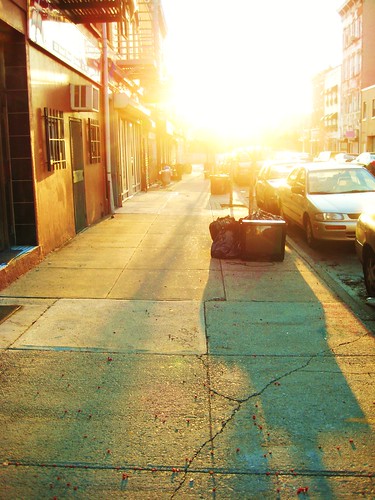
Photo of transitional space in Harlem, by Camilo Jose VergaraDevelopment, use, abandonment, reuse, demolition, redevelopment. Transition states. It seems that everything is in transition, but here I'd like to focus on the span of time between clearly defined places like factories and forests.

Development includes combining separate elements into new forms, like making something out of legos. Materials are assembled into buildings, which in turn form cities. This may fulfill a need or function based on reactions to things that came before. In this sense, new things embody the past.

When a thing no longer serves its purpose, it is often abandoned. At this point it can be reused in its current form, reassembled into something new, or destroyed. But it can never really be destroyed. Nearly imperceptible parts remain in circulation. They integrate with other things. They may haunt us in ways more tangible than the ways we haunt places. Smoke can be like a ghost that haunts us.

Photo of plants growing on an abandoned houseIf left abandoned, things are said to return to nature. Not that they ever left, but they can again be transformed into something else. There is a period of transition. For a building, this may be when weeds start to grow around and within it, or when other life forms make it their home. Eventually it may be enveloped by a forest.

Plants are often considered therapeutic, like Mandela's prison garden. They are also zoned and regulated. We put them in our cubicles, malls, streets, airports, and they represent healthier locations. Why are the places we work not healthy in their own right? How did the real or perceived separation between healthy environments and work environments come about? What was the transition like? And how do we alter the resulting state?Photo of Nelson Mandela in his prison garden

We might consider what happens to the things we develop and abandon. Ideally they are reclaimed, reassembled, or disposed of with care. This is how we prevent a haunted world. Maybe this will help us improve the quality of work sites, or even change the nature of our work. As unhealthy places are abandoned, there is hope for transition. What will this transition be like?

In animation, creating a transition requires a momentary destination state. Maybe we can learn from this. If we envision a solution to each problem that confronts us, clearly defining our origin and destination, we should find improved transitions. Many people are doing this through ecologically oriented design, entrepreneurship, policy, architecture, education, activism, engineering, and other pursuits. Inclusive planning can help us work towards well conceived destination states. We'll still face the unexpected, but we can keep experimenting and solving problems as we move closer to where we hope to be.

(Credits: Photo of transitional space in Harlem by Camilo Jose Vergara of Invincible Cities. Photo of plants growing on an abandoned house from Houses of Tung Ping Chau. Photo of Nelson Mandela in his prison garden from City Farmer News.)

6.23.2008

Wisdom of the Buck

In honor of the Buckminster Fuller Institute's week of events honoring their namesake (take note, New Yorkers), a quote from the architectural luminary:

"Pollution is nothing but the resources we are not harvesting. We allow them to disperse because we've been ignorant of their value."
-- B. Fuller


More @ core77.

4.01.2008

Blogedanken Public Poll

Here are my favorite entries from each of the six Blogedanken participants who submitted full responses. Take a quick read-through, pick the one you think is the most interesting, and vote in the public poll at the bottom of the post. One-two-three, and by April 10th we'll have a winner! That person will then recieve a copy of Hyperborder, courtesy of PA Press.

Patrixbanx
(Portland, Maine, USA)
It sure would be nice to have a suburban commuter rail network in southern Maine. It would be even nicer if the commuter rail stations weren’t sited in the middle of vast parking lots, especially closer to the urban core. So why not allow development to cluster around those stops, like say Morrill’s Corner? And by development, I mean dense development. We’ll need to reform our zoning to encourage such growth, of course – not just by creating incentives for density but by creating disincentives for sprawl as well. Oh, and remember – this is Maine, a land that get’s pretty damn cold over the course of our long winters, and global warming hasn’t turned us into South Carolina just yet. Yet I hear tell of other cities even further north that are colder and get more snow than us, yet still manage to have a vibrant street life even in depressing old February. We gots to have that. I don’t know how exactly but if we’re going to discourage driving so we can have more walkable and transit oriented neighborhoods, we might as well make the streets of Portland a pleasant place to be in the depths of winter – bike and pedestrian friendly snow clearance, warm transit shelters, fun festivals, whatever it takes.

Medea
(Medellin, Colombia)
24 hour public transportation makes shifts easier to stagger, so bus drivers are not competing with each other in hazardous maneuvers. Every bus and taxi driver will receive mandatory drivers ed and courses on politeness and good manners. If they are rude or customers complain, their punishment won´t be a fine, but they´ll have to do public service hours cleaning the riverbanks.

M.B.
(Mexico City, DF, Mexico)
As a way of improving safety and bridging the gap between the city core and the bulging periphery, the city has launched a Defense of Modern Ruins program, stringing together blighted sights that range from industrial sights to downtrodden art-déco buildings to bureaucratic baroque whales. The program includes low-rent housing schemes, urban wilderness tours and itinerant party circuits.

T H Rive
(Victoria, BC, Canada)
Wireless capable crosswalks.
Edit: *apologies for the absolute shortness of mine. explanation: The crosswalk I was requesting was the ones that go green on ALL sides so that diagonal crossing is validated. It's quicker. The wireless part was more outdoor, cafe oriented Etc green wireless spaces. The result of the mixup?>> Wireless Crosswalks. Still a good idea. (4/1/08 5:38 PM)

Dan Lorentz
(Lexington, Kentucky, USA)
Organize a strong city-wide neighborhood group to promote mixed-use planning that supports street-level vitality, and make the first priority of that group the reweaving of the city's street web to create more corners for mixed-use development.

Petersigrist
(Cambridge, England, UK)
Hovering leisure boats with transparent roofs and floors, which hover about twenty feet in the air and provide lifts around town above underwater gardens with glass walls at street level as well as terraces, balconies, shops, and restaurants that open onto the streets and river


Remember: vote or die! (Hah. Always wanted to use that in context).