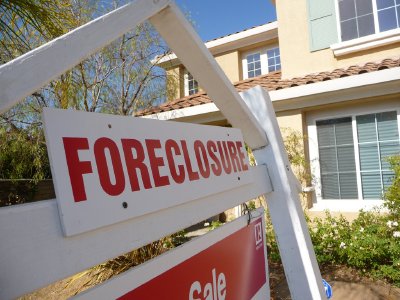
You've probably noticed a recurring theme throughout this series: the state of the economy sucks, and we need to learn how to deal with it. Nowhere is this more apparent than in the foreclosure crisis that is engulfing the United States, where many people have lost their homes or are very close to losing them. In Toledo, Ohio,
Congresswoman Marcy Kaptur has publicly told residents facing foreclosure to simply stay put and not leave their foreclosed homes, forcing the bank to file paperwork and produce the note of ownership. There is a
program in Miami that is working to move homeless families into recently foreclosed homes.
Squatting is nothing new, but the fact that government officials are basically encouraging it and, in some cases, creating programs for it somehow makes it seem more acceptable than it once was. Squatting has typically been an act of necessity for the poorest of the poor: there is nowhere else to go, so you find an abandoned house and make it your own. It has certainly never been considered an option for the middle class American, until now. So what happens when a society or a government begins to recognize squatting as a real option -- not just for the poor, but the middle class as well?

With this mainstream acceptance, the more opportunistic among us will go for the gold: mansion-squatting. Even the wealthy are getting hit with foreclosures, leaving mansions of the Mc- variety as well as sprawling Hamptons estates vacant.
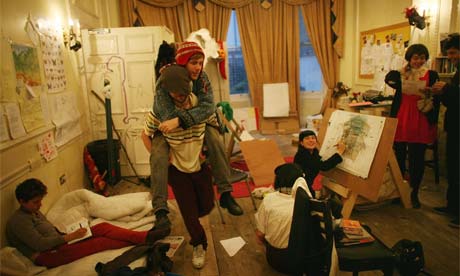
One art collective in London known as Da! took up residence in a 30-room mansion on Upper Grosvenor Street, one of the UK's most expensive neighborhoods. They lived in the house for nearly a month before attracting media attention. Surely, this would be difficult to pull off in many of the suburban gated communities or tight-knit small towns, because neighbors, worried about their homes' worth, would quickly call the cops. However, in cities like Detroit, Pittsburgh, and Buffalo, where the once-prevalent upper crust is now long gone, mansions sit vacant by the dozens, with prices lower than most suburban atomic ranches. It's easy to see, in places like these, people just moving in and creating a new life. Who is going to stop them? In these neighborhoods, residents are just happy to see a new face on the block!

A great deal trendier than the opulent mansion, though equally desired, is the warehouse loft. Though the warehouse loft has been in the public eye since the 1970s, it became a real estate frenzy at the start of the new millennium. Developers began making "soft lofts," and authentic exposed brick and beams became luxuries. Poor and homeless people have taken up residence in abandoned warehouses as long as such buildings have existed; the fact that raw warehouse lofts have become such a hip environment to reside in is a clear trend toward the aesthetic appeal of poverty. Which brings me to the interior design movement that has been growing in the US known as
Boho Mod, or Bohemian Modern. Basically, it's a mix of classic furniture and thrift store finds. If you open up any
Urban Outfitters catalog from the last 4 years you'll see what I'm talking about.
It appears that younger generations are turning away from the notion that everything has to be new, toward a more sustainable vision based on using what we already have and what is readily available.

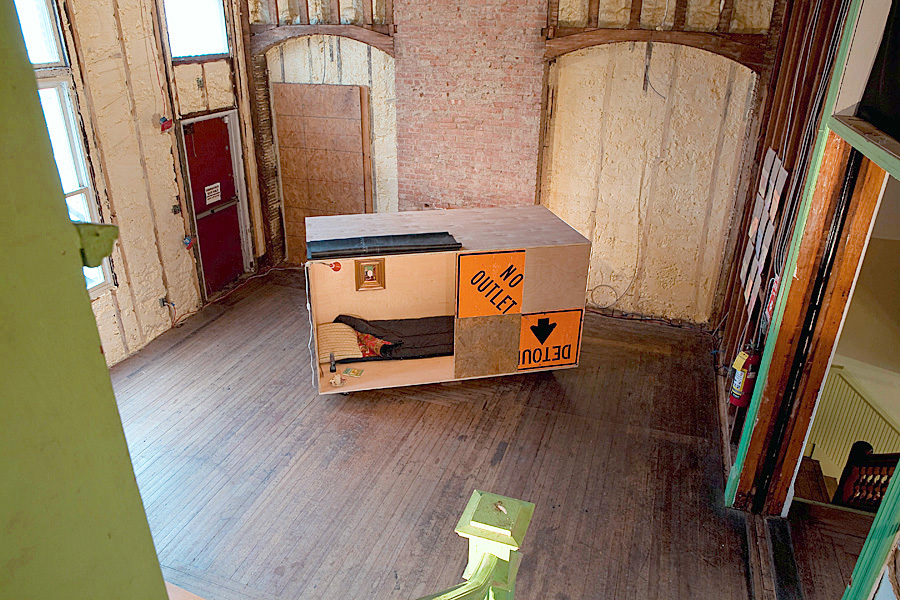
One might say that living in a warehouse isn't the same as living in a warehouse loft, and they would be right. However, artist James Westwater is working to change that with his
Homeless Chateau. This tiny wooden room provides a bit of privacy and elegance for the abandoned warehouse dweller. Maybe we all don't want to live in a box, or even in a warehouse, but the fact that so much attention is being paid to the concept is evidence enough that people are taking more and more interest in the aesthetics of poverty.
And it's not just artists and developers, architects have taken a keen interest as well. Architect
Teddy Cruz has designed a multi use housing model for Hudson New York which draws heavily from the favelas of Tijuana.
"Where others saw poverty and decay, he saw the seeds of a vibrant social and architectural model, one that could be harnessed to invigorate numbingly uniform suburban communities just across the border." -NYTimes

For one reason or another, the aesthetics of poverty have slowly begun to permeate mass culture. Whether through an innovative housing model, a warehouse loft, or an abandoned mansion, there is something compelling about using what we have and turning that abandoned space into something functional and beautiful. Though many of these ideas remain tied to certain subcultures and demographics, the amount of media attention they have gained over the last decade certainly suggests that the masses are at least curious.
 Posh to be Poor? IntroductionPosh to be Poor? TransportationPosh to be Poor? Food(Photos from Wisebread, The Guardian, Domino, James Westwater, and the NY Times. The original full-sized versions can be viewed by clicking the photos.)