Showing posts with label Marc Couillais. Show all posts

7.24.2009

The Attraction fo Free


Everyone likes to get free stuff, even when it's junk -- like brochures and keychains at a trade show, or a reusable bag from your local market. Retailers and businesses give out free things as a marketing ploy, to build rapport and disseminate information. Another form of free comes in the newspaper ads, with the buy one get one free coupon, or the holiday giveaways (think Black Friday.) These giveaways are designed to attract patrons to a certain retail location in hopes that they will spend more moeny, come back more often, and essentially support the business. It seems to work as my mailbox is inundated with these coupons nearly everyday.

So, with my tabletop covered in coupons and freebie offers, I began to think, how can Rustbelt cities and cities with declining populations use the idea of free to attract new residents. The goals seem similar, stores need people to come in and buy their assorted goods while cities need to attract people to come and start businesses, raise families, and pay city taxes. Perhaps these cities could create marketing campaigns targeting young creative entrepreneurs by offering buildings, land, space, tax breaks. After all, the Rustbelt is, if nothing else, is rich in land and space, just look at Flint.

There exists a whole class of creatives out there who would love to start their own businesses but can't due to the burden of large overhead costs especially in business hubs like NYC or Chicago. Rustbelt cities in conjunction with the internet's world wide marketplace offer very low overhead costs. However, in order to make these individuals pack their bags and move to a new city that they know little about and attempt to form some type of business, they need incentive. Businesses take time to start, and by offering entrepreneurs free rent, you are granting them time to learn the city, be inspired by the city, and establish their own business' in the city.


The real power of a program like this comes in the formation of a community. Once the idea catches on and creatives begin to take to he plunge into the Rustbelt, stronger and stronger creative communities will form attracting more and more people to the city. This can be seen in the reformation of the DUMBO neighborhood in NYC from a burnt out, unattractive block, into a vibrant community of artists and professionals. David Walentas, a NY developer bought up a huge portion of the Dumbo neighborhood in the late 90's then enticed an array of artists to take up residence by offering free rent for an extended period of time. The artists attracted the professionals and soon the neighborhood was bustling with a diverse group of New Yorkers. So the question is, can this work on a national if not global scale with the Rustbelt and other declining cities?


(Photo from icanhascheezburger, Corine Vermeulen-Smith, and NYT The original full-sized color version can be viewed by clicking the photo.)

7.04.2009

Suburbs Survival

Cities have been getting a lot of attention lately with the majority of earth's population residing in dense urban cores for the first time in history. There seems to be a growing consensus that cities are the way forward and that suburbs should burn in hell for destroying out beautiful countrysides, our farmlands, and promoting unsustainable lifestyles. So how do we resurrect the suburb or make it better? Are we planning on disassembling them and using the material to build new urban dwellings or are they going to become abandoned and sit empty? Is there a way to think about the burbs differently that will lead to a new lifestyle or a renewed sustainable energy?


To survive long-term, the suburbs will likely have to become more community oriented and organized. This century thus far has proved to be about social and sustainable movements. Two movements the suburbs can embrace to improve their chances of retaining and attracting citizens are intense car sharing programs, and intense community farm programs.

Typically, neighborhoods center around some type of public space, whether that be a park, an elementary school, or another type of community-oriented structure. These centers could act as transport hubs, where car share programs are initiated. Programs like carpoolconnect.com can help people find rides and coordinate with neighbors to accomplish errands and daily tasks. Perhaps it seems extreme, but if the suburbs want to kick their negative wrap, they are going to have to show they can compete with cities on transportation and social interaction.


Suburban farming has become a big thing as well. Though urban farming has attracted much of the attention because of its extreme conditions, many suburbanites have been converting their yards into mini-farms and, in some cases, turning a profit. Many organizations have popped up to promote the transformation of turf lawns to lush homestead farms, most famously Fritz Haeg's Edible Estates. His organization has inspired a new breed of farm and a new brand of agriculture. Companies are beginning to form around the country with the intention to lease and cultivate neighborhood lawns. Weekly neighborhood farmers markets could be held at the community center with the majority of produce and added value products coming from within the neighborhood.

When it comes down to it, the suburbs need to bolster their sense of community interaction in all areas of their citizens daily life from transportation methods to food choices to live/work arrangements. The suburbs aren't going to just disappear, so hopefully in the next few years we as a society will develop some new suburban living models worth promoting.


(Photo from The Shift Home and the author. The original full-sized color version can be viewed by clicking the photo.)

6.15.2009

The Urban Path


Human navigation is a key component in the organization and form our cities take on. Whether we choose to walk, bike, take public transport, or drive, we are making choices that shape our experience of the city and that will transform the city itself over time. Two great examples of this are taking shape in New York right now: the opening of the High Line park and the pedestrianization of Times Square. Both show how infrastructure and space can be transformed over time based on the alternating use and neglect of transient spaces. As we move forward in a period of increasing transportation curiosity and alternate means of transport, these physical experiments become very relevant and thought-provoking. Everyone is eagerly anticipating billions of dollars for infrastructure investment and reconfiguration, but what kind of infrastructure changes should we really seek? Wider bridges and highways, more bike lanes, light rail, pedestrian access?


Alongside these physical experiments lie also a set of mapping or tracking statement experiments which aim to bring attention to the ways in which people use space and how they use that space. One is the Contrail project which aims to apply a line of chalk behind bikers, like a constant skidmark tracing their path throughout the cityscape. On a large scale this could reveal some very interesting patterns as well as draw attention to the number of bikes that actually occupy the roads. It might even encourage people to break out the old two wheeler and go for a spin. In addition to this hack like experiment there is an increasing amount of gps devices floating around our city sidewalks and roadways, all of which can generate useful information about how our current infrastructure is being used. Hopefully, when it really comes time to invest, the powers that be will heed these experiments and gather appropiate information to make informed decisions about the ways in which people will move over the next 50 years...


(Photo from Gothamist and Make. The original full-sized color version can be viewed by clicking the photo.)

2.10.2009

Posh to be Poor? Housing

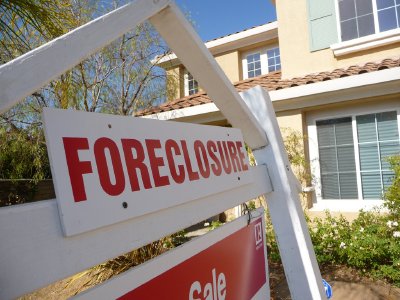
You've probably noticed a recurring theme throughout this series: the state of the economy sucks, and we need to learn how to deal with it. Nowhere is this more apparent than in the foreclosure crisis that is engulfing the United States, where many people have lost their homes or are very close to losing them. In Toledo, Ohio, Congresswoman Marcy Kaptur has publicly told residents facing foreclosure to simply stay put and not leave their foreclosed homes, forcing the bank to file paperwork and produce the note of ownership. There is a program in Miami that is working to move homeless families into recently foreclosed homes.

Squatting is nothing new, but the fact that government officials are basically encouraging it and, in some cases, creating programs for it somehow makes it seem more acceptable than it once was. Squatting has typically been an act of necessity for the poorest of the poor: there is nowhere else to go, so you find an abandoned house and make it your own. It has certainly never been considered an option for the middle class American, until now. So what happens when a society or a government begins to recognize squatting as a real option -- not just for the poor, but the middle class as well?

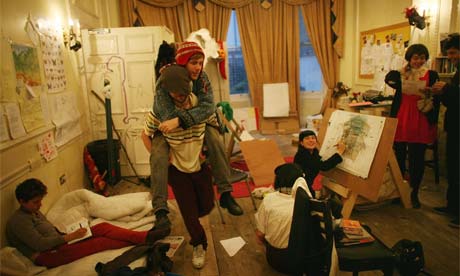
With this mainstream acceptance, the more opportunistic among us will go for the gold: mansion-squatting. Even the wealthy are getting hit with foreclosures, leaving mansions of the Mc- variety as well as sprawling Hamptons estates vacant. One art collective in London known as Da! took up residence in a 30-room mansion on Upper Grosvenor Street, one of the UK's most expensive neighborhoods. They lived in the house for nearly a month before attracting media attention. Surely, this would be difficult to pull off in many of the suburban gated communities or tight-knit small towns, because neighbors, worried about their homes' worth, would quickly call the cops. However, in cities like Detroit, Pittsburgh, and Buffalo, where the once-prevalent upper crust is now long gone, mansions sit vacant by the dozens, with prices lower than most suburban atomic ranches. It's easy to see, in places like these, people just moving in and creating a new life. Who is going to stop them? In these neighborhoods, residents are just happy to see a new face on the block!

A great deal trendier than the opulent mansion, though equally desired, is the warehouse loft. Though the warehouse loft has been in the public eye since the 1970s, it became a real estate frenzy at the start of the new millennium. Developers began making "soft lofts," and authentic exposed brick and beams became luxuries. Poor and homeless people have taken up residence in abandoned warehouses as long as such buildings have existed; the fact that raw warehouse lofts have become such a hip environment to reside in is a clear trend toward the aesthetic appeal of poverty. Which brings me to the interior design movement that has been growing in the US known as Boho Mod, or Bohemian Modern. Basically, it's a mix of classic furniture and thrift store finds. If you open up any Urban Outfitters catalog from the last 4 years you'll see what I'm talking about. It appears that younger generations are turning away from the notion that everything has to be new, toward a more sustainable vision based on using what we already have and what is readily available.

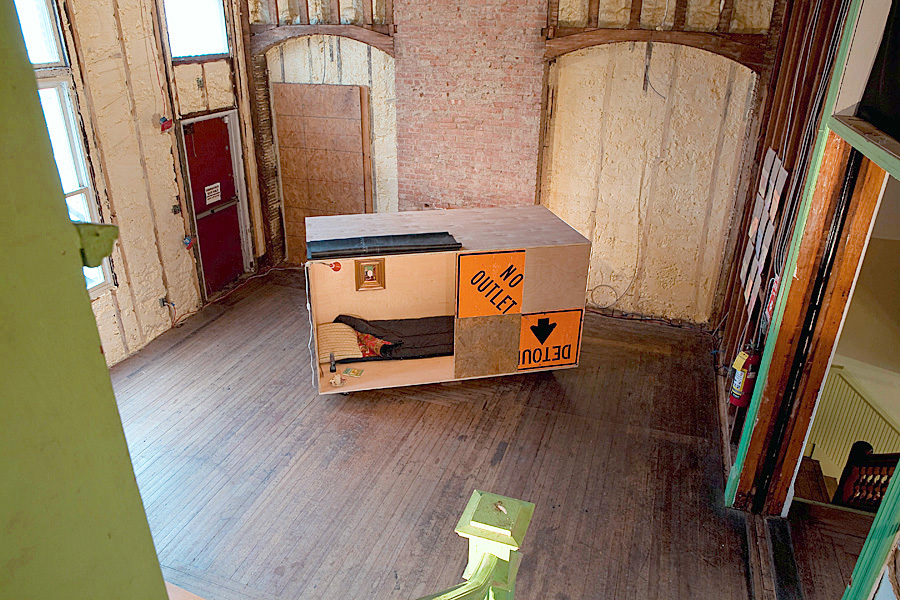
One might say that living in a warehouse isn't the same as living in a warehouse loft, and they would be right. However, artist James Westwater is working to change that with his Homeless Chateau. This tiny wooden room provides a bit of privacy and elegance for the abandoned warehouse dweller. Maybe we all don't want to live in a box, or even in a warehouse, but the fact that so much attention is being paid to the concept is evidence enough that people are taking more and more interest in the aesthetics of poverty.

And it's not just artists and developers, architects have taken a keen interest as well. Architect Teddy Cruz has designed a multi use housing model for Hudson New York which draws heavily from the favelas of Tijuana.

"Where others saw poverty and decay, he saw the seeds of a vibrant social and architectural model, one that could be harnessed to invigorate numbingly uniform suburban communities just across the border." -NYTimes


For one reason or another, the aesthetics of poverty have slowly begun to permeate mass culture. Whether through an innovative housing model, a warehouse loft, or an abandoned mansion, there is something compelling about using what we have and turning that abandoned space into something functional and beautiful. Though many of these ideas remain tied to certain subcultures and demographics, the amount of media attention they have gained over the last decade certainly suggests that the masses are at least curious.

Posh to be Poor? Introduction
Posh to be Poor? Transportation
Posh to be Poor? Food

(Photos from Wisebread, The Guardian, Domino, James Westwater, and the NY Times. The original full-sized versions can be viewed by clicking the photos.)

1.22.2009

Posh to be Poor? Transportation

Over the last few years there has been a surge away from motorcar transportation towards public transportation and the bicycle. This can in part be attributed to the sustainable movement as well as the growth of our urban cores. In 2008, the number of people living in cities eclipsed rural dwellers for the first time. As cities become more dense, the efficiency of traffic becomes increasingly important and for residents, it becomes faster to take public transportation. Now, aside from public transportation, the bicycle is also seeing a boom in popularity as a primary mode of transportation for many city dwellers.


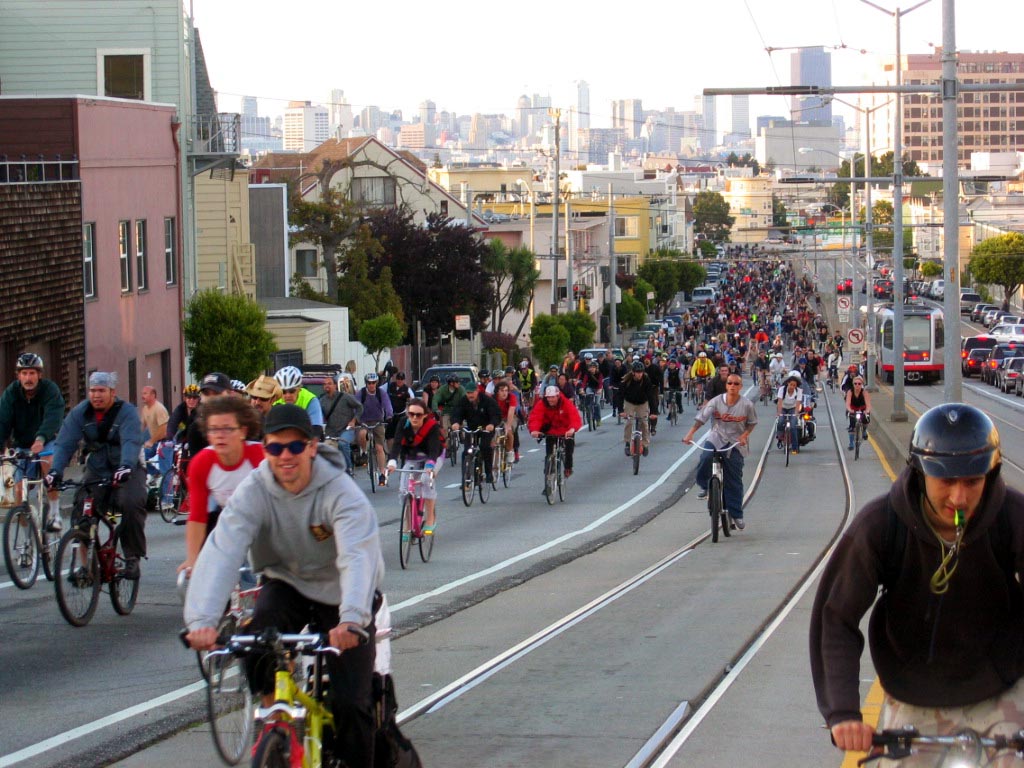
The bicycle is rapidly becoming the popular mode of transportation in large urban cores. It is cheap, you can find a decent used bike for 25 bucks that will get you around the city fairly well. Bikes are easy to maintain and aren't subject to expensive repairs as they age. No need to buy insurance either, or fill up on gas. These qualities make it a very attractive option for those who are strapped for cash. Also, it is environmentally friendly due to the lack of emissions and lower embodied energy than the automobile. So, this is an important turning point as people begin to look away from a more expensive, more convenient mode of transportation, to one that is significantly more affordable. In fact, New York city saw a 35% increase in people biking to work in 2008. Unlike public transportation though, biking has become a trend with thriving organizations such as Critical Mass advocating for increased ridership. It has become cool to ride a bike as demonstrated by the many celebs recently caught on 2 wheels. Lance Armstrong may have sparked a national movement toward road bikes, but the many bike messengers roaming our urban cores have sparked a fixed gear revolution. Once seen as tacky or radical, the bike messenger style has invaded western culture influencing clothing, style (messenger bag anyone??), and heck, transportation!


So why does this mean it's becoming posh to be poor? Well, because it's a move away from expensive transportation options, toward more affordable and accessible option. It's a move away from $30,000 SUV's toward $125 bikes (these are both averages of course.) Low income residence take public transit, they ride bikes, and they hop trains; 3 methods of transportation that will see a steep increase in 2009. As we enter into an age of frugality, where we find pleasure in the simple aspects of life, people will worry less about luxury and more about experience, an idea which has grown in prominence over the past few years.


Posh to be Poor? Introduction

(Photo from Treehugger The original full-sized color version can be viewed by clicking the photo.)
(Photo from SFGate The original full-sized color version can be viewed by clicking the photo.)
(Photo from Wikipedia The original full-sized color version can be viewed by clicking the photo.)
1.20.2009

Posh to be Poor?


I've been reading a lot of articles lately, and as wrong as it may sound, it seems as though poor is the new black in the Western World. Now I don't mean more people are becoming poor, because that's obviously true, but it seems that lately a lot of professionals have drawn inspiration from the condition. For example, the Times ran an article about architect Teddy Cruz and his social housing experiment in the Hudson River Valley. The development, which features a modern day mesh of architectural elements, draws inspiration and, at times, form, directly from favelas.


Another prime example is seen in the press that a group of British artists received when they essentially hijacked a vacant multi-million dollar mansion. Late last year, the artist collective Da! moved their group into 18 Upper Grosvenor Street, one of London's more exclusive neighborhoods. They lived and worked here for at least a month with no word from the owners and no word from the cops. I can see this becoming a trend in America, with so many mansions going into foreclosure or sitting on the open market. Perhaps there will be a slight role reversal, where the homeless end up taking over these huge mansions because nobody can afford them or to maintain them. I mean, you can already get 3000 sq ft of 1920's craftsmanship for under 100k in Detroit, why even waste your time with money anymore? Just move in! Some cities are even working on programs to move the homeless into foreclosed homes, according to Fox News. If you want a mansion for nothing, now just may be your chance.

Finally, one of my favorite artists/designers just released a transportable abode for the homeless. I know this has been an ongoing project in every architecture school in the world for the last 50 years, but nobody does it quite like James Westwater. There is something compelling about his project, "homeless chateau," and the idea of living in a rectangular prism in an abandoned warehouse. How different is this from living in a warehouse loft? Having neither heat nor electricity would be rough, but you're not paying $3000 a month. Anyways, I'm not really suggesting these are real lifestyle choices that will become widely popular anytime soon; I'm simply suggesting these ideas are growing in popularity.

In order to dig further into this idea that we are being inspired by the conditions of being poor -- conditions that will increasingly affect the middle class worldwide -- I will investigate 3 divisions of urban planning which directly connect to choices in lifestyle and are dictated by income. Those divisions are Transportation, Food, and Shelter. Over the next 2 weeks I will dive into each category and explore the trends that are leading to a more frugal lifestyle for citizens of big cities.


(Photo from NYT, Gurdian, and James Westwater. The original full-sized color version can be viewed by clicking the photo.)

12.18.2008

Demand for Recyclables

Alright, there’s been a lot of talk going around the blogosphere lately about the recycling epidemic forming in the United States. Basically, if you haven’t already heard, the United States sends a majority of their recyclables over seas to China to be processed into new materials, however, because of the global economic crisis prices for recyclables have plummeted leaving the United States with a growing pile of trash. So yes, this is a problem, but seriously, don’t you think it’s an even bigger problem that we create so much waste we have to ship it overseas?


Maybe it's time we begin to look at our recyclables as a raw material rather than a waste product. Many designers from around the world have been creating beautiful products made from post consumer products. Take for instance the Campana Brothers or Piet Hein Eek, both creating beautiful furniture from reused materials and both happen to be outside of the United States. Perhaps it's time for US designers to start looking at these waste materials as a material to work with rather than ignore. The alternative craft movement in the US have been quick to use found materials as it is economically attractive due to the fact that waste is generally free. Also, the use of waste materials is an evironmentally sustainable idea, cutting down on the mining, processing, and shipping of raw materials.

Aside from the alternative craft movement, there have been a few grassroots movements to use our waste as a raw material and divert malterials from being barged overseas or dumped in a landfill. Tiny Texas House has been carefully deconstructing houses in their region and building new prefab houses out of the materials. For me this just makes sense, and apparently it is working from an economic perspective as well.


So what is really stopping these ideas sound really great, and seem to make so much sense, what is stopping them from really taking off? Well there are 2 real issues. First, economic feasibility, Tiny Texas Houses works however they are only producing a very small amount of homes a year and aimed at a particular market who are willing to pay a high price for sustainability. The production of houses is a very refined process and the mining and transporting of materials is rigorously efficient. Maticulously taking down houses and preserving the material is a much slower process and therefore costs more money. New processes and networks need to be put in place before these ideas can really take off. These can come in the form of online networks or informal networks. Ebay and Craigslist are 2 online networks that have done a great deal for reuse. Think about how many items have been listed on craigslist that would most likely have found the landfill 10 years ago? Informal networks can work too, for instance the scrap industry, where legitimate, (and sometimes illegitimate) scrappers pick up reusable materials and sell them to scrap yards for a small profit.


Second, a paradigm shift will have to occur in which the general public changes their opinion on the value of our recyclables. Big name designers don't fool around with used materials because they presume their consumers will not appreciate used materials over new ones. This is why reuse is still a niche market. It is important to note however, that reuse is gaining steam and many companies, such as Frietag, maker of recycled messenger bags, have made enormous strides in changing the perception of used materials. The best way to infiltrate popular opinion is to hit the authorities in consumer products. When Macy's, Bloomingdales and Barneys start selling reuse, soon to follow will be all the small retailers scattered across the nation. But in order for reused goods to get there, there needs to be a good amount of quality designs using these materials to choose from. Maybe we need a national design challenge or something.


(Photo from TreeHugger. The original full-sized color version can be viewed by clicking the photo.)
(Photo from DesignCrack. The original full-sized color version can be viewed by clicking the photo.)
(Photo from TinyTexasHouses. The original full-sized color version can be viewed by clicking the photo.)
(Photo from TreeHugger. The original full-sized color version can be viewed by clicking the photo.)

12.10.2008

The Cow and How We Use Our Resources


This past summer, I was perusing the aisles of my local, or perhaps regional IKEA store when I happened upon a heaping pile of cow skins, more acceptably called hides. At first, I was amazed, just at the sheer idea that this huge hide used to be part of a living animal. I thought of the Corb chair and lounger, once made of cowhide and how in a sense it was a very modern decoration. But then I looked at the display for what it was: a giant heap of cowhides. This isn’t Nieman Marcus or Bloomingdale's Home; this is IKEA, an operation that sells huge amounts of furniture and home accessories on the mass market. If there are 100 cowhides in just this one IKEA, there must be hundreds of thousands around IKEAs worldwide, and it just hit me as kind of a shock -- wow, that’s a lot of cow. I know that we slaughter some 35 million cows a year for food, and that’s a really crazy number to digest (pun only slightly intended) but we are desensitized to this because we don’t see it and our meals hardly represent their once active past. The cowhide, on the other hand, is directly linked to our visual representation of this animal and therefore triggers a more sentimental reaction. Add to that the skin is to be used as a rug, which people walk on; it just doesn’t seem right.

The next question to ask is: where did these skins actually come from, because here lies the real issue. If the skins are from animals that are doomed to begin with, for food production, and the skin would otherwise be wasted, then is it a good thing to use our animal resources to the greatest possible extent? In addition, how does the social perception of animals change if we are selling cowhides at America’s new favorite furniture retailer? It’s interesting to look at how we use our resources, whether it be coal or cows, and the social perceptions that go along with that can have a lot of baring on what people believe is the right way to live.

Great little debate going on over at Apartment Therapy.


(Photo from Apartment Therapy. The original full-sized color version can be viewed by clicking the photo.)
(Photo from Lindsay's Photography. The original full-sized color version can be viewed by clicking the photo.)

11.07.2008

reUsing the Economy

Recently, I wrote a short spot on scrappers and trashers. It focused on 2 professions, the first belonging largely to illegal immigrants trying to make a living under the radar by picking up scrap metal and selling it to recycling yards, the later focuses on a new industry aimed at vacating foreclosed homes by literally trashing all that remains from the previous inhabitants, including TV's, personal items, and furniture. It went on to compare the two and pose the question, what is right and what it wrong? What is socially accepted, and what is environmentally responsible?

Today, I present to you a third option. An option that I believe reflects the inherent sustainability and opportunity that is present in these times of economic hardship. Richard Bryant is a 62 year old widowed man living in Detroit Michigan. He runs a resale shop out of the ramshackle house next door, selling used good from foreclosed homes and abandoned homes of the deceased. Every two weeks or so Bryant will get a call from a real estate agent who will offer him all the remains from a newly vacated home so long as he clears the house. He then picks up the goods and brings them back to the house next door as new stock for his flourishing resale shop.

Reuse is such a beautiful thing, and to realize that, one must only surpass the stigma that everything good must be new. Braynt has capitalized on this beauty, and those who realize it, will too capitalize by finding great materials at a price simply incomparable to any other. It doesn't require sacrificing quality (often the opposite), it doesn't require parts made by slaves, it simply requires one to disregard a persistent social stigma. And when you buy a reused clock for instance, you can rest assured that you are saving a perfectly good clock from the landfill, that you are saving a new clock from being made (theoretically), and that your clock has a history and a story unlike any other.

The benefits and appeal of reuse are no surprise to those who value the environment, but the real relevance of Bryant's story comes from it's place in today's economic crisis. It fits the bill calling for a new green economy by celebrating wholeheartedly the ideals of reuse. It provides goods at a price which can be obtained by all, including those who have lost their jobs in recent months. Everything is found locally, and transportation is kept to a minimum. But the best part of this story is the fact that Bryant has created his own business, his own initiative, just out of the dilapidated house next door. Without an ounce of business experience, but the drive to keep busy, Bryant grew a grassroots business from the ground up. In the meantime, he has created a life that he is happy with, and unwilling to leave. He provides a truly sustainable service to the community, and operations like these, I believe, lead to stronger, healthier communities and economies. In a time of economic hardship, Bryant has found hope and opportunity in what was previously seen as waste.

(Photo from detroitblog. The original full-sized color version can be viewed by clicking the photo.)

11.06.2008

An Era of Inspiration

I just wanted to remind everybody, that yes, Obama has won the presidential nomination of the United States of America, but it is not over. Our problems are not solved. It is up to us to follow his lead and create change within this nation and throughout this world. We, as citizens of this Earth must come together and collaborate to the best of our abilities to find new solutions, create new networks, and solve the problems that stand in our way. President Elect Obama has great drive to see this country succeed, and to heal relations within the world community, but perhaps his greatest achievement will be inspiring the masses to create change. As he reminded every citizen of this great country in his acceptance speech this Tuesday, it is the citizens of this great nation that have spoken for change, and it will be up to us to create it. We have not crossed the finished lines, we have simply just begun. We must spread ideas and come together in action to make change. To make change in our urban core, to make change in our economy, to make changes in our devastated environments, it is up to us. Barack Obama has shown us that we can be heard, now lets show him we believe by taking the same energy we harnessed to get him elected and using it to create change in our neighborhoods, in our cities, in our world. It is the dawn of a new era, and an inspired era it will be .

11.03.2008

A Tall Order for Poverty

I've been hearing a lot lately about the increasing density of our cities, especially in developing countries like India, Nigeria, and China. It's a sort of conundrum because when we think about dense cities, we tend to think of tall cities. Lagos and Mumbai are far from tall cities and their populations are set to exceed record numbers in the next 5 to 10 years. With huge amounts of impoverished citizens living in 3rd world conditions, and density going through the roof, some suggest building tall is the answer. It's really a quite interesting notion that brings to mind a lot of interesting questions regardless of how realistic the situation may be.

How would it work? Social housing has long been an issue for big cities and rarely have we found extremely successful models. So how do you take a problem, we already don't know how to solve, and try to apply it to the high-rise? It's a really complex issue, though Ken Yeang has some interesting theories about tall buildings and how they work. Though not directly related, he speaks of tall building design as urban design, flipped vertical, which might be an appropriate approach to a problem such as this.

Also, What implications might this have on the tall building typologies? What sort of social hierarchy would a project like this create? I mean, in today's high rise condo markets, everyone knows the higher up you go, the more you pay. Well how does that work when people can barely afford to live? Who gets the top floor? Perhaps the upper levels could be dedicated to community activities, or communal spaces, and the bottom floors committed to food services and shopping, with the middle strictly residential. Or would we have mixed income high rises, similar to the overwhelmingly successful Lafayette Park by Mies van der Rohe in Detroit?

And what would a project like this do for the social status associated with living in tall buildings? Furthermore, what happens if these high-rises that seem to be going up like hot cakes suddenly aren't selling? I mean, in an economy like ours right now this doesn't sound so unreasonable. The idea of social high-rise may not be realistic or eminent, however it may be in the future if it could be done right.

What are your thoughts?.


(Photo from Flickr user mihir. The original full-sized color version can be viewed by clicking the photo.)
(Photo from Flickr user ChicagoEye. The original full-sized color version can be viewed by clicking the photo.)