1.22.2012

Kaleidoscopic New York

More fun with the Stereographic Street View hack. As it turns out, you can do a lot more than just make those cute little mini-planets. Long, low buildings, for example, can be fun to play around with. Here we are at Industry City in Sunset Park, Brooklyn:


And, up at Viñoly's razzle-dazzle-y Hall of Justice in the Bronx:


Skyscrapers are fun for the same reason. Here's Manhattan's GM Building (and Apple's famous Cube store):


And Long Island City's Citi Tower, warped into something of a crooked frame:


In fact, with the right site, these stereographic images can start to look like legit abstract art:


And then, of course, there's the straight-up kaleidoscopic stuff. Here's the old American Banknote Building in Hunts Point:


One of the covered sections of the High Line, near 14th Street:


Under the 1 tracks up in Kingsbridge:


Pier Luigi Nervi's magnificently weird bus terminal in Washington Heights:


Inside the Met (three cheers for Street View inside major museums!)


And last, but certainly not least, on the Brooklyn Bridge:


If anybody plays around with this thing and finds some more worth sharing, please do!

1.21.2012

Stereographic New York

Thanks to Brainpicker for alerting me to the presence of what may be the best Google Maps hack I've seen yet, Stereographic Street View. Now I know what I'm going to be doing for pretty much the rest of my life. Some early successes:

Under the Queensboro Bridge in LIC:


Then on down to Soho:


And Flatbush. The uniformity of public housing blocks makes for some really great stereographic images:


And speaking of uniform residential architecture, Fort Greene's Portland Avenue lends itself well to this format:


As does the Greystones block of 80th Street in Jackson Heights, Queens:


Then, on to fun with interestingly-shaped landmarks. The Bronx's Kingsbridge Armory:


The Newtown Creek Wastewater Treatment Plant in Greenpoint:


The New Museum:


The Whit:


And the Gugg:


The patchy quality of much of Google's Street View imagery means that a lot of stuff gets a little blurry around the edges, but the site is still terrifyingly addictive. If you enjoyed this post, stop back tomorrow for some more abstract fare...

10.29.2011

A Year in New York


A Year in New York from Andrew Clancy on Vimeo.

Goddamnit, this one's good. Also: clearly made by a Queenser. +1

10.15.2011

Liveblogging the Tactical Urbanism Salon: Evening Presentations


Evening Presentations

Introduction - Mike Lydon (The Street Plans Collaborative)
  • Early example of  tactical urbanism: Paris book boxes along the Siene; interesting parallel between historic book box tension w/bookstore owners and contemporary arguments between foot trucks and restauranteurs
  • What we call tactical urbanism has been going on for hundreds of years
  • There has been an acceleration of TU in recent years; of 56 Open Streets initiatives in the US, more than 40 started within the past three years
  • Tactical Urbanism guide volume 2 will be available for d/l within the next few weeks!

Introduction - Aurash Khawarzad (DoTank:BrooklynProject for Public Spaces)
  • "Do Tanks" are more appropriate right now than "Think Thanks"
  • Do:Tank Brooklyn is intended to provide a platform for people to come together and work collaboratively on projects
  • Individual Do:Tank projects are less important than the conversation happening here tonight
  • We've done the smaller projects, now it's time to come together. Tactical Urbanism is not a trend, it's a movement. Let's be more organized about it and put forth a full-throated argument for why this is important in the field.
  • People are tired of the "talk-itecture." They're doing something about it.

Liveblogging the Tactical Urbanism Salon: Pecha Kucha Presentations


Pecha Kucha

BroLab
  •  BroLab used Q32 bus line between Flux Factory & Momenta Art to stage "Bench Press"; created a template & built benches along bus lines.
  • Project allowed people to see benches building built, get a sense of the work that went into them.
  • Did 12-15 live-build installations of benches at bus stops over the course of one day.

Vertical Theory, Karen Mackay
  • Wanted to find solutions for large-scale sustainability issues on a local level; looked at urban farms as a solution
  • Cities = limited horizontal outdoor space; how do we grow food here? Farmscrapers need lots of time & $, but VT looks at how do non-horizontal farming in a more DIY way
  • Looked @ hydroponics, wooly pockets, not nobody was doing these two things together; started doing prototypes to use piping in pockets to distribute water
  •  Also working on creating prototypes in glass; harder to be DIY, but can still have an impact and get people thinking

TreeKIT, Sophie Plitt
  • Urban trees have many benefits: "Trees really make cities; although they're extremely ubiquitous, we don't always see them for how valuable they are."
  • NYC is relying on individuals, developing a stewardship model. Not really working yet.
  • TreeKIT hias developed a "Track, See, Collect" mapping model to increase stewardship. Currently collecting the data to allow people to track their stewardship.
  • Draw people [general public] into the data-collection process - "Participatory action research"

Liveblogging the Tactical Urbanism Salon: Intro & Panel Discussion: Tactical vs. DIY Urbanism


Introduction

Mike Lydon - The Street Plans Collaborative
Aurash Khawarzad - DoTank:Brooklyn / Project for Public Spaces
  • ML: Idea for the TUS was to look at short-term actions driving long-term change
  • AK: Old process of building communities is not working anymore; new more collaborative ways of doing things
  • AK: We want everything about today to be different; everything we do should be action-focused. 
Panel Discussion: Tactical vs. DIY Urbanism

Tony Garcia - The Street Plans Collaborative
Chiara Camponeschi - Enabling City
Quillian Riano - DSGN AGNC
June Williamson - The City College of New York, CUNY

A Modest Proposal...


A few years ago I made a series of hackmaps, using Google Earth to cobble together a few visualizations of alternate urban realities. I'd always planned to post some of the better ones to Where, and never got around to it. Recent events, however, made me think that there was one  in particular that was worth sharing.

The image above was created in the fall of 2008, right as the financial meltdown was getting white-hot. The idea that the wizards of Wall Street should share their posh financial district with a Rio-style favela seemed fitting, given the number of people who were suddenly finding themselves homeless. Luckily, there was a huge hole in the ground right next door.

The site may have been overly ambitious, but it's good to see that some people have been feeling the same way.

9.05.2011

MAS Context Issue 11: SPEED

The new issue of MAS Context is out today, and you can read the whole thing online here, or buy a printed copy here. I've got an article on the effect of mobile, digital tech on the future of historic preservation, entitled On the Quickening of History. An excerpt:

These applications will eventually be used not just to find a good place for Thai food or to see where a bus route leads, but to interpret and alter the physical realm, as well. As augmented reality applications become increasingly ubiquitous, it will become impossible to separate the city from its digital self. This means that, in the not too distant future, digital layers will need to be thought of by preservationists in much the same way that buildings are today. And while it’s true that digital preservation is already a subject of discussion, that discussion is currently focused on the use of digital tools to preserve the physical world, or to preserve artistic or cultural projects that were created on digital platforms. The preservation of the platforms themselves is largely uncharted territory, regardless of the outsized impact that they have had on our lives.

Other great stuff from Candy Chang, Jesus Maria Ezquiaga, Andrew Clark, Antón García-Abril, and a slew of other great urbanists. Read on!

7.24.2011

What Color is Your Favorite Architect?

Oh joy, thecolorof works for architects, too! There are some fascinating results--so many, in fact, that you'll have to travel beyond the jump, as I don't want them mobbing the Where homepage, heh.

7.23.2011

What Color is your City?

I found thecolorof.com this evening (via Curiosity Counts), which layers recent images from Flickr sharing a common tag over each other to create swatches that resemble abstract impressionist paintings. Naturally, I spent a bit of time trying out various cities. Many wind up very similar--red/gold on the bottom, bluish on the top--which I'm guessing has something to do with the preponderance of skyline photos. But the results for some are spot-on, and even downright gorgeous. A few favorites:


What color is your city?

7.18.2011

The Upside of Shrinking

Photo Credit
Last month, Newsweek produced a list of "dying" cities in the US with "bleak" futures based solely on population loss over the past few decades. For the Love of Cities author Peter Kageyama made quick work of the dismantling of this rather lazy list over at The Infrastructurist: "As human beings," he notes, astutely, "we stop 'growing' in our early 20s, yet we hardly think of a 25-year-old as dying — still, at a cellular level, they are dying in the same way that these cities are dying. Losing population is not the same as losing hope, losing purpose, or losing life."

The loss of population does not guarantee a continued slide toward obsolescence. Conversely, an influx of educated creative types does not necessarily result in an economic boom. Everyone has the potential to be creative, but not everyone is cut out to start (and successfully run) a business. The entrepreneurial spirit is something that needs to be sparked, and then cultivated. On the list of things that can serve as that spark: watching an exodus from a place that you love. In the above-linked Burgh Diaspora post, Jim Russell shares a story about Doug Dwyer, a former First Data employee who chose to stay in Boulder when his employer moved to Atlanta. The decision to stay required Dwyer to "think like an immigrant," and he has since founded a company, Mocapay, that employs 20 people.

When it's possible for the upwardly mobile to leave, those who stay behind by choice are bound to be more invested in their cities. These passionate people are some of the greatest assets that a city can have, and the fact that there are fewer other people around inherently makes it more likely that these passionate residents will bump into each other, share ideas, and perhaps start something exciting--as long as shrinkage is managed through smart urban planning to maintain some level of density, and to preserve downtown areas as places of economic and intellectual exchange. Especially when large areas begin to empty out, it's important to think about how to encourage interaction.

In a recent promo video for the new book Living in the Endless City, Saskia Sassen was asked what makes a city successful. She answered that "It’s their incompleteness that gifts them their longevity. A city does not become obsolete." Population loss does not equal death: it's just part of the process of rebirth.

7.17.2011

When Street Art Is More Than Street Art

Photo credit
Some clever artist has plastered a series of stylized yellow protractors (or are they bridges?) around Pittsburgh, each with a (presumably) sequential number from one up into the hundreds. Apparently it's the talk of the town--so much so that, in a move truly worthy of the adjective "Keystone," the city's cops are trying to track the mastermind down so that they can charge him with a felony for property damage. In an awesome act of digital defiance, a blogger who was writing about and mapping the bridges has deleted the posts, refusing to allow his blog to be used by the authorities to bring down this gem of a project.

Moving past this dramatic and still-unfolding plot to the project itself: the simplicity of this project is a total joy. Talk about augmented reality these days focuses on digital applications, and it's so easy to forget that there are some very low-tech ways of re-framing the way that people experience the urban environment. In this project, the instigator has used some simple plastic decals and super glue to turn the entire city of Pittsburgh--already pretty fun to wander around thanks to its undulating topography and erratic street grid--into a game platform. As you chase around looking for all of the protractors, you wind up exploring the city, leaving no nook or cranny un-scanned in your quest for detection dominance.

This Pittsburgh project highlights the fact that you don't need mad app-development skillz to augment your city. While tech allows us the opportunity to tweak the urban experience in new wasy, a bit of ingenuity and some art supplies are all you need to re-engage people with the cityscape. On that note--if anyone else knows of some similarly clever interventions in other cities, please share!

7.16.2011

Splashy Times Square Satellite View


Woke up this morning to discover new Google Earth satellite imagery of Manhattan, complete with the fully-pedestrianized & mural'd Times Square. Great light too, Midtown usually looks so dark on G-Earth. Three cheers for Janette.
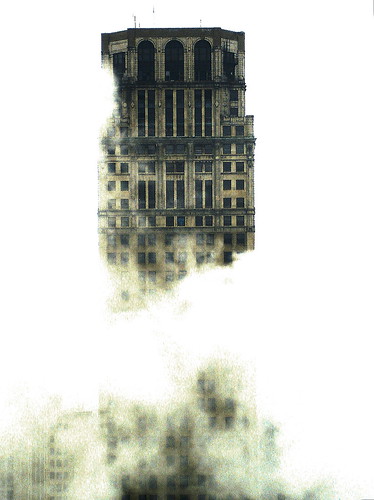
UPDATE: Just realized you can also get great views of a few other ped plazas. Click the thumbnails for full-sizers:

Union Square (with Greenmarket in full-swing!):

Madison Square Park:

(Also: whoever gets rid of these #$&#% borders that magically insert themselves around images on this blog when I've tried everything I can think of to turn them off wins a prize.)