Showing posts with label bicycles. Show all posts

6.15.2009

The Urban Path


Human navigation is a key component in the organization and form our cities take on. Whether we choose to walk, bike, take public transport, or drive, we are making choices that shape our experience of the city and that will transform the city itself over time. Two great examples of this are taking shape in New York right now: the opening of the High Line park and the pedestrianization of Times Square. Both show how infrastructure and space can be transformed over time based on the alternating use and neglect of transient spaces. As we move forward in a period of increasing transportation curiosity and alternate means of transport, these physical experiments become very relevant and thought-provoking. Everyone is eagerly anticipating billions of dollars for infrastructure investment and reconfiguration, but what kind of infrastructure changes should we really seek? Wider bridges and highways, more bike lanes, light rail, pedestrian access?


Alongside these physical experiments lie also a set of mapping or tracking statement experiments which aim to bring attention to the ways in which people use space and how they use that space. One is the Contrail project which aims to apply a line of chalk behind bikers, like a constant skidmark tracing their path throughout the cityscape. On a large scale this could reveal some very interesting patterns as well as draw attention to the number of bikes that actually occupy the roads. It might even encourage people to break out the old two wheeler and go for a spin. In addition to this hack like experiment there is an increasing amount of gps devices floating around our city sidewalks and roadways, all of which can generate useful information about how our current infrastructure is being used. Hopefully, when it really comes time to invest, the powers that be will heed these experiments and gather appropiate information to make informed decisions about the ways in which people will move over the next 50 years...


(Photo from Gothamist and Make. The original full-sized color version can be viewed by clicking the photo.)

1.29.2009

LaHood: Not a Disastrous Pick, After All?

I don't know about you, but after Ray LaHood was tapped to serve as Obama's Secretary of Transportation, most of what I read around the urblogosphere was bad-news-bears. Urban policy wonk Ryan Avent questioned the decision over at Grist, as well as his own blog; over at WorldChanging, Alex Steffen wondered aloud wether Obama had used the position as a throwaway to appease Republicans; and transit blog The Overheard Wire took a padded swipe at the new Sec. Interested in getting the opinion of someone in the transit policy arena from LaHood's home state (which, luckily enough, happens to be my own), I checked in with a friend who's on the board of the Chicago-based Active Transportation Alliance, formerly the Chicagoland Bicycle Federation. He pointed me to an editorial piece in the org's latest newsletter, ModeShift, which paints a much sunnier picture of LaHood than I've become accustomed to reading. According to the ModeShift article, LaHood is a strong and vocal proponent of rails-to-trails programs, and has been twice-honored by the League of Illinois Bicyclists for his efforts on biking issues. So his mass transit record is still murky, but it sounds like LaHood's not all bad news. Just a bit of food for thought.

Edit: all that being said, I'm starting to wish that this Nadler fellow would have been given the nod.

1.22.2009

Wherever you go, there you are.

It struck me the other day, while reading one of Springwise's increasingly frequent posts on the mass customization of travel, that the types of travel apps and sites being developed right now to personalize the urban travel experience could have a profound impact not just on how we visit cities, but on how cities themselves function, as well.

Urban travel has long been a two-sided coin, with time in a new city being divided (in different ratios, depending on the tourist) between the standard landmarks like the Empire State Building or the Forbidden City, and the day-to-day urban world that exists on the edges of guidebooks; think of Brooklyn back in the 1990s, or Beijing's fast-evaporating hutongs today -- places to which people are drawn to observe a quotidian rhythm different from their own: to experience the spectacle of the extraordinary-ordinary.

The Postcard City and the Real City are invariably pitted against each other in a battle for the urban tourist's limited time. But as cities grow bigger and bolder on our increasingly urban planet, it seems fair to assume that greater and greater numbers of tourists will make their way down the streets of cities that they do not call home; as such, the traditional landmarks and attractions will become more and more crowded, making the prospect of tooling around lesser-seen corners of the metropolis an increasingly attractive option for visitors.

The aforementioned trend blog has spotted some real doozies lately: a site that allows you to navigate cities by mood (Could Yelp-like testimonials about certain blocks, streets, parks, or even whole neighborhoods define or even change the mood of a given place?); another that uses personal data to create personalized guidebooks (Would the diversity of interests force travel publishers to re-think the meaning of the term "attraction?" I.E. cyclists' internationally competitive quests to speed up the steepest slopes could reboot the way a whole subculture navigates hilly cities like San Francisco, Pittsburgh, Guilin, and Lisbon); and another that helps you track down a hot scene at the last minute with crowdsourced GPS data (Anybody up for an impromptu, flashmob-style block party?)

By making wandering off the beaten path more enticing, the customization of the urban tourism experience has the potential to distribute visitors more evenly around the city than old-school printed-paper guides, with their restricted map insets and hyper-selective restaurant listings. But does this dispersal of small-time explorers legitimize or cheapen the Real City? It seems to echo ongoing arguments about gentrification; after all, while the presence of individual tourists at specific sites is fleeting, their combined influence can be very powerful over time. And, while the carving of initials into a famous landmark is a time-honored tradition (as old as the very idea of landmarks), tourists will soon be able to carve their very presence into a city in the unpredictable paths that they cut through it, shifting not only the way that other visitors, but the very citizens of the city in question, navigate and experience a place.

(Image from Flickr user LondonSLR. The original full-sized versions can be viewed by clicking the photo.)

Posh to be Poor? Transportation

Over the last few years there has been a surge away from motorcar transportation towards public transportation and the bicycle. This can in part be attributed to the sustainable movement as well as the growth of our urban cores. In 2008, the number of people living in cities eclipsed rural dwellers for the first time. As cities become more dense, the efficiency of traffic becomes increasingly important and for residents, it becomes faster to take public transportation. Now, aside from public transportation, the bicycle is also seeing a boom in popularity as a primary mode of transportation for many city dwellers.


The bicycle is rapidly becoming the popular mode of transportation in large urban cores. It is cheap, you can find a decent used bike for 25 bucks that will get you around the city fairly well. Bikes are easy to maintain and aren't subject to expensive repairs as they age. No need to buy insurance either, or fill up on gas. These qualities make it a very attractive option for those who are strapped for cash. Also, it is environmentally friendly due to the lack of emissions and lower embodied energy than the automobile. So, this is an important turning point as people begin to look away from a more expensive, more convenient mode of transportation, to one that is significantly more affordable. In fact, New York city saw a 35% increase in people biking to work in 2008. Unlike public transportation though, biking has become a trend with thriving organizations such as Critical Mass advocating for increased ridership. It has become cool to ride a bike as demonstrated by the many celebs recently caught on 2 wheels. Lance Armstrong may have sparked a national movement toward road bikes, but the many bike messengers roaming our urban cores have sparked a fixed gear revolution. Once seen as tacky or radical, the bike messenger style has invaded western culture influencing clothing, style (messenger bag anyone??), and heck, transportation!


So why does this mean it's becoming posh to be poor? Well, because it's a move away from expensive transportation options, toward more affordable and accessible option. It's a move away from $30,000 SUV's toward $125 bikes (these are both averages of course.) Low income residence take public transit, they ride bikes, and they hop trains; 3 methods of transportation that will see a steep increase in 2009. As we enter into an age of frugality, where we find pleasure in the simple aspects of life, people will worry less about luxury and more about experience, an idea which has grown in prominence over the past few years.


Posh to be Poor? Introduction

(Photo from Treehugger The original full-sized color version can be viewed by clicking the photo.)
(Photo from SFGate The original full-sized color version can be viewed by clicking the photo.)
(Photo from Wikipedia The original full-sized color version can be viewed by clicking the photo.)
12.22.2008

Interstate Bike Trails


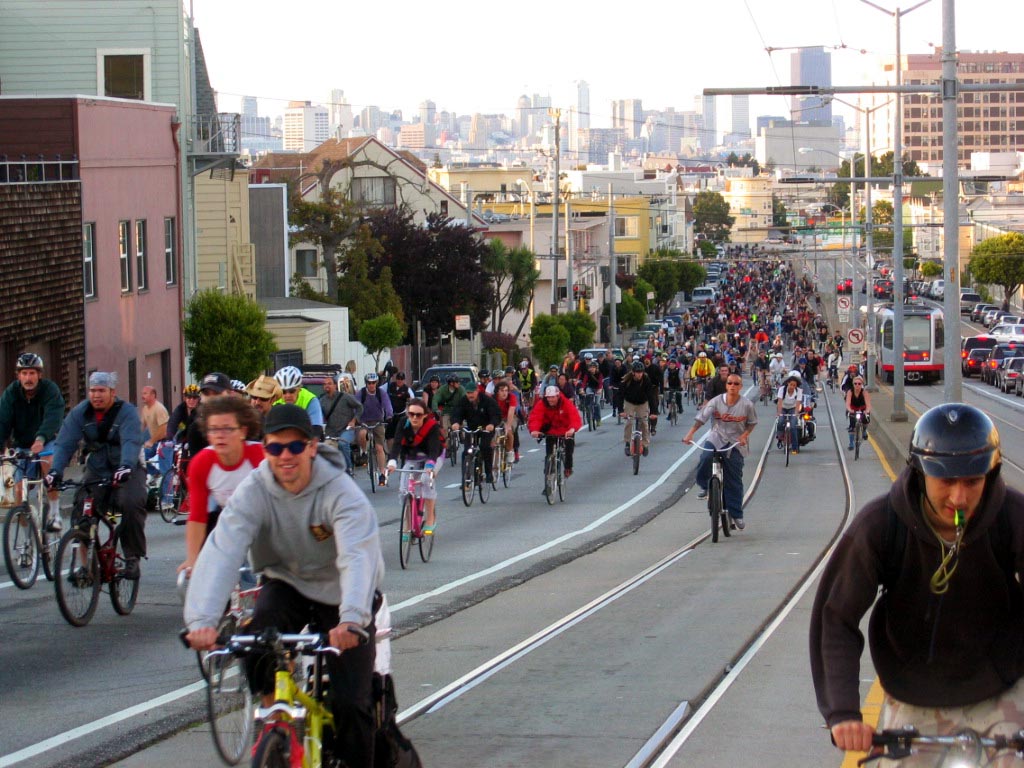
The above is a collaboration between the American Association of State Highway & Transportation Officials and the Adventure Cycling Association, who have created a transcontinental network of interstate bike routes out of more than 50,000 miles of existing trails. From the Baltimore Sun:

The effort relies on cartography instead of construction, signposts instead of earth-movers.

Working from a bewildering tangle of existing roads, planners mapped a web of corridors where the national bicycle system should go. They considered traffic volume, terrain, amenities and ways to link together lightly traveled byways, secondary roads, urban trails and already established transcontinental bicycle routes.

Each corridor on the map they approved is a broad swath 50 miles wide; the precise routes within each corridor are still to be designated, numbered and given signs.


The plan has been under development for four years now; I'm guessing that the AASHTO and ACA are glad to see the political tide turning the way that it is, since construction responsibilities fall to the states (though I'm guessing that the creators will be working hands on, lobbying hard to see things built, connected, labelled, and otherwise completed). Seeing the above makes the relative unanimity of the newly selected Transpo Secretary Ray LaHood, aka Ray LaWho? as most of the planning media has been calling him lately, seem more worrisome. Does anyone know LaHood's record on bike issues?

(Found via).

10.27.2008

Cities Rising

Yesterday's Washington Post talks about the anti-urban bias of American politics:
Is Obama's ascent a further sign...that our cities are back and that the country is making peace with its non-agrarian side? And would a big-city president address as never before the problems of our urban cores -- blighted housing, shoddy public transit, dismal schools?
Well, one can hope, but few of these problems have traditionally been considered national in scope -- the president doesn't build subways or set school curriculum for example.  Of course, the federal government does play an important role in funding local projects, and with economic crisis potentially leading to mass transit cuts, among other things, this role is even more important.

This part is encouraging:
One of the first interest groups [Obama] met with after securing the Democratic nomination in June was an alliance of bicycling advocates. 
Maybe they talked to him about how to make America more French.


(Photo from Flickr user glennharper. The original full-sized color version can be viewed by clicking the photo.)