Showing posts with label food. Show all posts

2.03.2009

Posh to be Poor? Food

Food is a hot topic these days and will continue to be in the next few decades as Earth's population grows to record numbers...every year. Food has taken the spotlight high atop the green podium due to the massive amounts of chemical pesticides used for agriculture as well as the enormous amount of transportation-elated energy that is required to provide us all with raspberries in January. Terms such as organic, locavore, CSA, and most importantly community gardening have become common language for many progressive westerners. Over the last decade there has been an increasing trend toward growing one's own food. This can be attributed to the rising costs of food as well as to light being shed on CAFOs and the massive amounts of media attention focused on the conditions in which our foods are grown and nurtured.

Overall, food prices are rising, which isn't exactly helpful to the middle class worker. This is leading to a movement toward homesteading: if you can't afford to buy food, grow it yourself. Shrinking cities are filled with abandoned lots waiting to be developed; however, seeing the state of economy, one can figure that won't be happening for a while. In the meantime, residents in these neighborhoods can capitalize on this open space by planting and harvesting a garden, thereby reducing their grocery costs. There is a significant movement to convince the Feds to plant a garden on the White House lawn. This symbolizes the American movement toward urban gardening and sustaining oneself with the land that one maintains. You don't even need a lot of land to hop on the garden train: some folks in New York have started a Chicken Coop Co-op in their tiny backyard. It's apparently become quite the hit as the local breakfast spot offers a specialty dish using only eggs from this co-op. According to UrbanChickens.org founder K.T. LaBadie,

Their [eggs] production cost is cheap: you can buy chickens for as little as a couple of dollars, and three hens will likely average about two eggs a day. You can also use their waste to help revitalize a garden...There've been recalls on everything from beef to spinach, and I think people want to have peace of mind knowing their food is coming from a very trusted source.
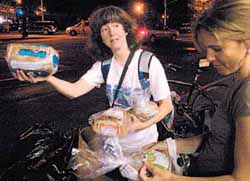

Another trend that has garnished a lot of attention in the last 10 years is the growth of the Freegan Movement. If you aren't familiar, the concept is to eat only what you can find for free. This usually includes scavenging through bakeries' and big box stores' dumpsters for bagged and canned goods. In New York, there was a Freegan group who would throw rooftop parties and everyone was required to bring some found food. I'm not saying it's a great idea, but people are doing it, and loving it. In the western world we tend to undervalue what goes into our bodies. Rarely is a plate scraped clean, and a massive amount of organic waste is created. Likewise, bakeries and grocers overstock, causing outdated items to be pitched. This group capitalizes on the waste of others. For some, dumpster diving has taken on a new image in the 21st century as a rouge sport as opposed to a last resort for the poor. Many of the people taking part in these events have jobs and don't need to dumpster dive. They do it for the experience.

Posh to be Poor? Introduction
Posh to be Poor? Transportation

(Photos from Eat the View, New York Times and Freegan.Info. The original full-sized versions can be viewed by clicking the photos.)


11.27.2008

Happy Thanksgiving


Really my favorite holiday in that it revolves around copious amounts of food.  Go get yourself some stuffed tofurkey.


(Photo from Flickr use JP Puerta. The original full-sized color version can be viewed by clicking the photo.)

11.19.2008

Eat local or eat smart


I love food. I'm a happy eater, and a less-than-happy yet genuinely enthusiastic cook. Only recently, though, have I started gaining a sort of food conscience. Food conscience growing up was more about knowing how to hold up my chopsticks properly, or being able to recognize a shallot, or learning to enjoy gross stuff like ants eggs (yes, we eat ants eggs in Mexico. We call them escamoles, and they're positively buttery and delicious). In any case, conscience was more of a snob thing than an actual curiosity or desire for knowledge about the stuff I was being fed.

Now that I'm older, though, not only do I care about what I cook or eat; I also try to worry about what goes onto my plate and how it gets there. I've tried to go organic, but in Spain it's still virtually impossible (organic food stores or markets rare here, and the prices are simply insane). I've tried to buy fresh produce in markets instead of supermarkets. Barcelona has wonderful food markets. But most of the tomatoes in the markets are also grown in those massive plastic-covered freak farms in Almería, and many of the fruits are imported from Brazil or India and the fish is sometimes frozen. I've begun to wonder how far a conscientious eater can really go, particularly in an urban setting.


Apparently pretty far. Take locavores, or local eaters. Yes, it's a proper word. But what does eating locally actually mean? Originally, it seems locavores should only eat food produced within a 100-mile radius of their home. Details and hidden agendas aside, a very good case has been made against this hardcore notion of eating local, in its own terms. It turns out that eating local can actually be less sustainable than eating food from the other side of the equator (click to read why).

Again, we're faced with one of the distortions of the localist rhetoric. It's one thing to support locally-oriented farmers markets or wanting to eat something that hasn't been radiated and tastes like plastic. I think initiatives like Fritz Haeg's Edible Estates or the various urban-farming movements taking over empty lots and fighting underemployement are great. But this sort of initiative can only cover a fraction of our needs, and can only work under very specific conditions. Why not make a call for eating consciously instead of only locally?

1.11.2008

WEEKEND READING: January 5-11, 2008

While you were proposing the tackiest building ever designed, Detroit, one of these articles was having the BEST WEEK EVER!!

ITEM ONE: Some interesting speculative fiction on the politically autonomous future of North American citystates over at All About Cities.

ITEM TWO: AHI's 2008 list 'o predictions, hot off the presses!

ITEM THREE: A funky video from GOOD Magazine that explores the etymology of conflict-prone caital cities around the world.

ITEM FOUR: Built Chicago points to a provacative new book about the drug trade in the Robert Taylor Homes here in Chicago. (Also: Apartment Therapy Chicago on Cabrini Green, and TNAC on the last season of The Wire).

ITEM FIVE: Colorful photogasm of Dharavi's "13 Compound" neighborhood.

ITEM SIX: Baltimore sues Wells Fargo for predatory lending. This is going to be interesting...

ITEM SEVEN: A guide to web tools for eating locally for all of you New Years Resolutionists. (Via Very Spatial)

Adios, compadres. Hope you have the best weekend ever. ;-) Don't forget to sound off on the Conscious Urbanism Game, if you get the chance.

(Photo from Flickr user ChicagoEye. The original full-color version can be viewed by clicking the photo.)

7.25.2007

Eat Your City


Grist has a fun new city list out this week, and they really rolled the dice on a few of their choices. The eco-zine has compiled a list of fifteen "green" cities -- which the writers readily admit is a figure of speech. Few would argue, after all, that London (#7) is literally a green place, though its environmental efforts are notable. Half of the spots on the list are occupied by exactly who you'd expect to see: Portland, Curitiba, Vancouver, San Francisco, Sydney. Mixed in with these are a number of major players with new green initiatives and enviably walkable cores (Copenhagen, Barcelona). And, certainly, examples of all of these cities' resourcefulness and creativity are given to support their election to the list (which appears to be entirely objective). But the most exciting entries are the dark horses.

The Gristies start things off with an oddball: Reykjavik, Iceland. The chilly city of the north Atlantic has apprently begun powering its public transit system (busses) with hydrogen. Even more interesting, all of its energy comes from renewable sources. Rising star Bogotá makes an appearance, with former Mayor Enrique Peñalosa's traffic-busting garnering heavy coverage.

Easily the most fascinating city on the list, however, is Kampala, Uganda. Kampala is (along with Addis Abeba, I would argue) becoming a city to watch, and its eco-efforts are only helping to build the buzz. In its explanation, Grist highlights the city's agricultural initiatives: "Faced with the 'problem' of residents farming within city limits, the city passed a set of bylaws supporting urban agriculture that revolutionized not only the local food system, but also the national one, inspiring the Ugandan government to adopt an urban-ag policy of its own."

Forgive me if the "city to watch" lable seems a bit crass...it is true that Kampala faces serious economic challenges (around 40% of residents live in absolute poverty), but that's exactly why the city's urban ag efforts are so intriguing. As it turns out, for a long time urban farms were seen as an unsanitary public nuissance. According to an article by the International Development Research Center of Canada, Kampala city administrators had to sell the perceived problem of urban farming as a solution to many citizens. The city even participated in the McGill University-led Making the Edible Landscape project, which aims to turn cities -- traditionally large-scale food consumers -- into centers of food production.

Urban agriculture is a well-documented option for increasing the sustainability of a neighborhood or individual lot. But city-wide campaigns are, I think, almost unheard of in industrialized nations. But recent talk of skyscraping urban farms in Manhattan have juiced the public imagination a bit, it seems, and one Columbia University professor -- err, Doctor -- Dickson Despommier, believes that urban farmscrapers will likely be a reality within the next 10-15 years.

But the possibilities don't stop there. Urban farms could become for the 21st Century what large, elaborate central parks were in the late 19th and early 20th. Frederick Law Olmsted famously described Central Park in Manhattan as the lungs of the city, but with new green technologies these farms could become more than lungs -- they could be the heart and brain of the city as well, collecting and treating runoff and waste water for public use and even pumping clean energy back into the city grid. If Kampala can take its rambling landscape and designate farmland zones, and New York can build towering farms, who's to say where the innovation stops. Indeed, Central Park itself set off a firestorm of park design and construction around the US and the world; what if London took that Trafalgar Square grass stunt from earlier this summer and ran with it, converting large public spaces across the city to farmland? Or if Tokyo retrofitted the upper floors of of all of its buildings to transform the city's roofscape into a massive urban garden? Imagine Los Angeles tearing down its freeways to develop sprawling agricorridors to knit long-torn neighborhoods back together, or Toronto employing a massive network of barges to form a second coastline of floating farmland along Lake Erie, or a stablized Kabul turning rubble piles from American bombings into terraced hydroponic inter-city field networks. The possibilities, as they say, are endless.

At any rate, if Grist is still around in fifteen years, it will be interesting to see whether they still use the term "green city" as merely a figure of speech.

(Photo from Flickr user namayanjaj.)


Links:
15 Green Cities (Grist)

Building an Edible Landscape (IRDC)

Kampala Project Information (McGill School of Architecture)

Press/Media for Making the Edible Landscape

Skyfarming (New York Magazine)

4.04.2007

The Growth of Local Food Production in Urban Areas

"In the distant past, the city functioned more or less as a self-sustaining system. All that now remains is consumption." -- Regine Debatty, Worldchanging.com


Over the past week I've noticed a number of articles popping up about cities and food. The quote above, which I found particularly provocative, came from an article about an exhibit in Maastricht called "The Edible City," which focuses on the role that food plays in contemporary society. I think that line captures the current problem facing metropolitanized areas, especially stateside. Food plays a huge role in our daily lives, and the idea that it could play a role in the reconstruction of urban communities seems powerful to me.

Another article over at AlterNet covered urban gardening efforts around the U.S. Hearing quotes from proud locals reminded me of the stories that I had heard about Victory Gardens during WWII. These gardens not only lessened demand on the industrial community (so that I could focus on weapons production), they provided their owners with a genuine sense of pride. Victory gardens were a symbol of a family's commitment to the nation during a difficult time.

Cities, now, are facing a difficult time. While gentrification is adding cash to the tax base of many cities, huge stretches still remain impoverished, both in the States and around the world. A big part of the solution to urban problems, of course, is the strengthening of urban communities. It seems natural, then, that the creation of community gardens could serve as a big part of the community-building process. A quote from one of AlterNet's urban gardeners highlights one of the major benefits: "Just having face-to-face contact -- that's something that's very positive...It's the kind of thing that feeds your soul."

By getting people together to work on a project that directly impacts their communities, socially and visually, urban gardens can help communities develop their own self-sustaining systems. These gardens have been around for a while, but they don't seem to have caught on as a major trend...yet. The rumblings on the internets seem to suggest a change in that area.


Links:
Urban Farming: Coming to a City Near You (AlterNet)

Edible City: Part I (WorldChanging)

EDIT (4/9/2007 - 7:20 PM): Check out the second (and equally fascinating) part of the Edible City coverage by following this link--and don't miss the part about Fritz Haeg's "Edible Estates" project.