Showing posts with label street art. Show all posts

7.17.2011

When Street Art Is More Than Street Art

Photo credit
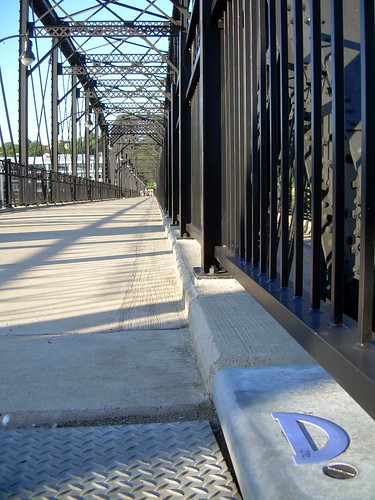
Some clever artist has plastered a series of stylized yellow protractors (or are they bridges?) around Pittsburgh, each with a (presumably) sequential number from one up into the hundreds. Apparently it's the talk of the town--so much so that, in a move truly worthy of the adjective "Keystone," the city's cops are trying to track the mastermind down so that they can charge him with a felony for property damage. In an awesome act of digital defiance, a blogger who was writing about and mapping the bridges has deleted the posts, refusing to allow his blog to be used by the authorities to bring down this gem of a project.

Moving past this dramatic and still-unfolding plot to the project itself: the simplicity of this project is a total joy. Talk about augmented reality these days focuses on digital applications, and it's so easy to forget that there are some very low-tech ways of re-framing the way that people experience the urban environment. In this project, the instigator has used some simple plastic decals and super glue to turn the entire city of Pittsburgh--already pretty fun to wander around thanks to its undulating topography and erratic street grid--into a game platform. As you chase around looking for all of the protractors, you wind up exploring the city, leaving no nook or cranny un-scanned in your quest for detection dominance.

This Pittsburgh project highlights the fact that you don't need mad app-development skillz to augment your city. While tech allows us the opportunity to tweak the urban experience in new wasy, a bit of ingenuity and some art supplies are all you need to re-engage people with the cityscape. On that note--if anyone else knows of some similarly clever interventions in other cities, please share!

5.16.2011

The City is Meant to be Experienced, Not Mourned

As a very new New Yorker last summer, I took to spending extended periods perusing the Census of Places that Matter, a crowdsourced database of significant locations around the five boroughs. When I stumbled upon a promising entry for Florent Morellet's legendarily-eccentric, eponymous diner (founded in the Meatpacking District before it was The Meatpacking District), excitement quickly turned to disappointment when a Google search turned up a New York mag article written just before Florent closed in 2008.

In the article, Morellet is unapologetically forward-thinking. "I came to New York for the reason everyone comes to New York," he explains: "because it is the city of changes. People forget this is what they love about New York. They get old, they get grumpy. They get … nostalgic.” (The article's author notes that 'nostalgic,' here, is uttered "with the same distaste [Morellet] uses when talking about Republicans.")

It is hard to be nostalgic in New York, a city that contains such an intense agglomeration of people, filled with their own desires, beliefs, ideas, customs, and all of the expectations that come with those things. Density creates a permanent sense of ephemerality, and the pace of churn in New York grants the city its most unique characteristics while simultaneously earning it a reputation as a place that renders each individual totally anonymous. To try to hold onto a moment here could drive a person mad.

Still, people try. One can't help but raise an eyebrow upon finishing the article about Florent's closing and reading the first reader comment: "This is why I left New York. Because the great New York that once was is no more." New Yorkers, you see, bemoan their losses as frequently and passionately as they proclaim their love for the city.

I was reminded of Morellet's line about nostalgia by developer Jerry Wolkoff's recent announcement of his plans to raze the building that houses 5Pointz, Long Island City's graffiti mecca, to make way for two condo towers. As 5Pointz is one of my favorite places in the city,  this was difficult news to hear. But Wolkoff has always intended to re-develop the 5Pointz building; the fact that such a place even exists in its current condition is a small miracle in post-Giuliani New York. And while I (and no doubt many others) would like to think I'd choose to preserve the more artistic and culturally-productive use of the site if I were in Wolkoff's shoes, we can hardly hold it against a developer that he is acting like a developer.

The 5Pointz team tweeted a response not long after the news broke that seemed to echo the sentiment expressed by erstwhile MePa scion Morellet: "This is nothing new to us. The show must go on!" And it will. New York has seen countless cultural icons rise and fall. The loss of a cherished community hub is nothing new here, and while it's easy to proclaim the death of the city as we watch individual sites crumble and fade, to do so inevitably robs us of some amount of time in which we could be enjoying the city as it is. While the 'right to the city' is well-discussed, we too often forget that we are not owed anything by the city. We are welcome to take part in it, but we can expect nothing more of it than what it happens to be. The city, as Beaudelaire wrote, "changes shape, alas, faster than a mortal's heart."

How can we ever expect a city to stay the same? It has been pointed out frequently enough that the preservation of the built environment often winds up pricing out the communities that were so strongly associated with them as to make them beloved in the first place. Does it not seem strange that, while we fight to preserve buildings, we experience the city much more intimately in individual stores, galleries, classrooms, temples, and other spaces that are virtually impossible to preserve? And that we then spend a great deal of collective energy mourning those places once they are gone?

Certainly, architectural preservation is not without significant importance. Nor is it possible to totally avoid missing a place that we loved once it is gone. Even the determinedly un-nostalgic Morellet must miss his restaurant and, more importantly, the community that it created. But it is an entirely different thing to miss a place than to mourn it. We can miss something swiftly, but to mourn takes time. The city is unsentimental; it does not mourn us when we leave. Demographics shift; people are priced out, and then back in; everything changes--and in New York, we're surrounded by everything, all the time.

If you focus on the city that was, you will miss the city that is. How we choose to interact with our cities is entirely up to us, but I believe that the city is meant to be experienced, not mourned. The scenery may change, but the show, as they say, must go on.

11.17.2008

The Next, Next Street Art

Street With A View is a performance/digital art hybrid (I know! So rad!) coordinated by a small team of artists, residents of Pittsburgh's North Side, and Google. The artists thought up the idea to create vignettes in the city's streets that would be coordinated with when Google's Street View camera car would drive down those same streets. They tapped local residents to act out a series of scenes, coordinated with the Googleheads, and the rest is history.

SWAV's staged "interventions," as the team refers to them, point out an interesting possibility for street art. Referring to an earlier post on the subject, tech like RFID chips and barcodes will make digital graffiti a more ready possibility in the future. SWAV highlights one of the many ways that this type of art could be achieved: take a 360˚ photo (of which there are plenty freely available through Street View for an enterprising hacker), doctor it, and attach it to an RFID chip installed inconspicuously nearby. Set it up with an automatic trigger, and any passersby with an iPhone or a Blackberry will be treated to an alternate reality version of the place that they're walking through.

Aside from the potential for humor, there is political potential here as well. Think of preservationists looking to impress upon people the importance of preventing the destruction of historic structures; take the current, well-publicized battle over St. Vincent's in Manhattan, for example. A skilled digital artist with a penchant for quirky 1960s-vintage low-rises could create a digital, 360˚ recreation of the intersection of 7th Ave and 12th Street in which to-scale renderings of the 300 and 233 foot towers planned by the adjacent hospital replaced the distinctive O’Toole Medical Services Building. Passersby could get a better sense of the scale and blandness of the new development than they ever could from a wallet-sized picture in the Times.

Inverting the perspective, SWAV says some interesting things about Google's Street View feature as well. When examining the interventions on the Google Maps website, try to imagine what a normal user, unaware of the SWAV project, might think when encountering the digital parade. At the same time that it makes Google Street View more fantastical, SWAV also makes it, in a way, seem a bit more real. Certainly moreso in examples like the moving truck or the garage band practice. Add to that the impromptu "meta-interventions" staged by locals unaware of the project until it was happening, and the lines between reality and digital representation get delightfully blurry.

To ponder: If people become more aware of the Google Street View camera car and scenes like those staged by SWAV become more common (which seems very plausible, I think), what role does the Street View feature take on? Its parallel reality becomes heightened; humor and politics are woven into the scenery, and become as valid as the built environment that the feature was intended to represent. In addition, what does a more theatrical representation on the web mean for the real place being represented? If one were to walk down Sampsonia Way in Pittsburgh -- a charmingly "Pittsburgh" kind of street -- would it seem boring? Less authentic or interesting than its Street Views counterpart? Does the digital city draw from the real city, or add to it?


(Photo from Street With a View. The original full-sized color version can be viewed by clicking the photo.)

6.20.2008

Chicago mourns the loss of a prominent street artist...

(More from Wooster)

(Photo from Flickr user BigPictureProject. The original full-color version can be viewed by clicking the photo.)

4.29.2008

The Next Street Art

Say there was a place that had some special meaning to you. It could be the alcove where you had your first kiss, the alley where you were mugged, the square where you participated in an important rally, or the location of an historic uprising. Good or bad, we all infuse places with our memories. This is what makes physical places so powerful, and why peoples' opinions and experiences of the same place can be vastly different. Places are what people make of them. Now, technology could be making it easier for tech-savvy street artists to etch their own experiences and opinions onto physical places, communicating the artists' own sense of a place to others who pass through it.

Barcodes are most commonly used in retail environments, but their size and informational storage capacities make them ripe for adaptation for more inventive uses. In Japan, barcodes are now being applied to gravestones to store and transmit information, when scanned, about the deceased. The idea here is that family members will, through videos, photos, and stories, be able to reconnect with the deceased in a less mournful, more celebratory way. Imagine "a sort of gravestone based, family fueled, wiki of the dead."

This technology could easily be used in public spaces to represent a political viewpoint or a historical event. Imagine walking down a street for the first time and noticing a bright green barcode sticker affixed to the facade of a building. Using a scanner-enabled mobile device, you could access a website loaded with the history of the building site, or a series of short stories about the surrounding blocks, or photos of a lifechanging event that a stranger experienced in the very spot where you are standing. Reading or viewing material like this would give the place a new gravitas, and would change your perception of what might otherwise be a mundane stretch of asphalt and brick.

RFID tags are another method of remote-storing information that, thanks to increased range, provide the opportunity for a bit more mischief. With the technological know-how, a clever street artist could program a chip to send a text message or photo to any wi-fi enabled mobile device passing by. Imagine again: you're walking down a street and you pass a hidden RFID tag; your phone rings. You answer. An audio recording plays, recounting a woman's personal account of a riot that took place across the street a decade earlier. Later, walking through a park, your text alert sounds. You open the message to find a set of coordinates and the time of an upcoming event, perhaps a flash mob or a constructive riot. Or, perhaps, a photo of the view from the very place that you are standing, hyperlinked to a database of stories and photos of places around the city (along the lines of Invincible Cities, linked below).

While they would only be accessible to those with the proper devices to read the information that they stored, RFID tags and barcodes have distinct advantages over more traditional forms of street art like posters, graffiti tags, and murals. For one thing, they are smaller, and less intrusive. While this could be seen as a weakness (especially for barcodes, which require direct interaction), it is also a strength in that RFID tags and barcodes are less likely to prompt their own removal than more readily noticeable artistic interventions. These tiny storage units can also provide more vivid, personalized accounts of events or viewpoints, and have the potential to be more impactful on their viewers.

RFID and barcode street art has the potential to turn the urban environment into a virtual minefield of information. While the potential for abuse by malicious hackers or marketing drones is there, the idea of being able to literally "tag" a place with multimedia information is an exciting one. Perhaps it's already being done. Anyone know of some examples?

(Photo from Flickr user cloverst. The original full-color version can be viewed by clicking the photo.)


Links:
Barcodes on tombs to connect with the dead (The Inquirer)

Invincible Cities (Thanks, Pete!)

4.13.2008

Urbanffffinds 026

So what I actually meant when I said "no new posts" was "no new long, fancy-pants psuedo-philosophical ramblings." Urbanffffinds is too fun to put on hiatus. Besides, the crop this week is hot. And so:


4.06.2008

Urbanffffinds 025

Urbanism revelation of the week: cities need more giraffes. And camels.


3.14.2008

WEEKEND READING: March 8-14, 2008

Lots of good stuff this week, but Item One is a must-read for everyone.

ITEM ONE: This week marked the (unfortunately early) end of South Central Tour, a fantastic, photo-rich blog documenting an epic trip through South and Central American cities with two infamous street artists, Above and Ripo. Take a look back through the group's stops in Rio, São Paulo, Buenos Aires, Santiago, and a bucketload of other cities. (Photo credit)

ITEM TWO: Speaking of South American cities, here's a great article on the idealism, overpopulation, and developing crime problems of Brasilia.

ITEM THREE: Kazys wins for title of the week -- "Take the bus to the internet." The post doesn't disappoint.

ITEM FOUR: Another literary excerpt from Archidose, this one examining the struggle between technology and nature in architecture and urbanism.

ITEM FIVE: Space & Culture provides some great links about "desire lines."

ITEM SIX: Another eloquent commentary on how cities can be used to combat global warming. (Via Civic Nature).

ITEM SEVEN: Karrie Jacobs goes searching for the soul of Times Square, with interesting (and, of course, beautifully-written) results.

Traffic has been abnormally high lately at Where; thanks for the great week. Now you have a great weekend.

2.22.2008

WEEKEND READING: February 16-22, 2008

You know how once a month or so Weekend Reading starts off with me getting all excited and writing something along the lines of "OMG you guys this week is SO GR8!! Read all of these they are AMAZIN! FURRILZ!"? Well, this is one of those weeks.

Read all of these. They are amazing. For reals.

ITEM ONE: Tijuana's enterprising spirit influences the design of a new affordable housing project in Hudson, NY.

ITEM TWO: Airoots features another great post about resistance to the Dharavi Redevelopmet Project in Mumbai, this time focusing on the efforts of the fiercely independent neighborhood of Koliwada.

ITEM THREE: Hayley Richardson on the obnoxious futility of twenty- and thirtysomethings bemoaning the loss of "authentic New York," a place that most of them never really knew in the first place.

ITEM FOUR: All About Cities pulls some great Lewis Mumford quotes, including the following gem: "The chief function of the city is to convert power into form, energy into culture, dead matter into the living symbols of art, biological reproduction into social creativity."

ITEM FIVE: A spectacular and almost disturbingly detailed map of London, reimagined as an island. (Photo credit)

ITEM SIX: Part IV highlights some recent articles about the Untergunther, a subgroup within les UX, which is itself a group of people "who are on a mission to uncover and exploit the city’s neglected cultural underworld."

ITEM SEVEN: AdaptiveReuse.net is a blog about creative adaptive reuse projects around the world (natch).

See, what did I tell you? That's some good stuff right there. See you next week!

2.14.2008

Conscious Urbanism: Sister Neighborhoods

Happy Valentine's Day. Who's your neighborhood's sweetheart this year? Yeah, you read that right. Who are you and your neighbors sending a gift to? If the answer is "nobody" (and I'm guessing that it is), consider this February 14th a missed opportunity.

There are no shortage of complaints about neighborhood associations and other community groups, the most common being that they tend to be insular, cliquey, out of touch, and outright anti-change. Another major complaint, which results directly from the aforementioned, is that these groups tend to be made up of only the higher end of the neighborhood's age range. Young people, we are reminded time and again, aren't active in their communities. They don't care enough to get involved, or they're too lazy, or they're something else that isn't the fault of the people doing the complaining.

But what if young people avoid joining community groups (as has been speculated before, no doubt) because the community groups just aren't active in a way that appeals to them? Could it be that college students, twenty- and thirtysomethings just aren't interested in joining what they view as stoic, regressive groups with their heads in the sand? I'm betting that, with a bit of elbow grease and some new ideas, we might see people below the age of 40 start to get more involved in their neighborhoods.

There are already examples of this, to be sure. Guerilla Gardening comes to mind, as do organizations like Neighbors Project and Rebar, as well as government programs like City Year. In its own (ironic) way, a lot of street art -- the kind that challenges and inspires, not those aimless spray-paint scribbles -- is evidence of young peoples' interest in their communities and their cities at large. It's not everyone's idea of being involved, but the desire to be involved in the neighborhood dynamic is apparent nonetheless. So what do all of these things have in common? What is it that gets younger generations excited about where they live, and what gets them involved? From the look of things, there is definitely an anti-bureaucratic attitude. These groups and activities are all perfect for someone who's looking to skip the runaround and get involved right away. Access is easy, and the activities are usually very social. In addition -- and more importantly -- these groups are defined more by what they stand for, not what they stand against.

Could there possibly be a way to create that kind of attitude on a larger scale within slightly more traditional community groups -- ones that might actually encourage people on both ends of the age spectrum to work together not just to improve their own neighborhoods, but their city as well? One idea: look at the Sister Cities movement.

While it is not particularly well-publicized (and, thus, utilized), Sister Cities International is an organization that pairs cities with similar economic structures, natural features, or demographics up in an effort to build a worldwide network of diplomatic relationships between urban areas. Cities help each other out by sharing policy ideas, discussing problems, and forging economic and trade agreements. What might this kind of program look like at a more local level?

On the international level, this might be a challenge, since getting people across oceans is much easier with large civic budgets instead of community group coffers (which are never full enough to begin with). But might it be productive to partner with community groups in the same city? Cross-community meetings could be held, local solutions and problems shared and discussed. The residents of a neighborhood across town cease to be faceless, and the city begins to feel smaller, its residents more tightly bound together.

There would be benefits within community groups, as well. The more hands-on, social activity of meeting and working proactively with neighbors-across-town could bring in a younger crowd. The older members of the group would gain new allies, as newly-joined young people will have more of a vested interest in preserving and strengthening their own communities through their involvement with their neighborhood group. As Matias wrote in a recent Airoots post: "[C]ommunity groups...do not defend 'local identity' as much as they create it. In other words, the moment of activism is more meaningful than the cause being defended."

Try getting together with some neighbors to form a Sister Neighborhood-esque relationship with a community group across town. Maybe next year you'll be planting a flower garden for your neighborhood's sweetheart in addition to buying a bouquet for your own. (Unless you live somewhere where it snows in February. Then you'll have to figure something else out).

(Photo from Wikimedia Commons. The original full-color version can be viewed by clicking the photo.)


Links:
Sister Cities International

Guerilla Gardening

Neighbors Project

Rebar

City Year

The Moment of Activism (airoots)

Buy One House Get One Free (Springwise) (Not mentioned in the post, but a cool related idea)