Showing posts with label city of the future. Show all posts

4.06.2009

Is the Past Almost All Right?


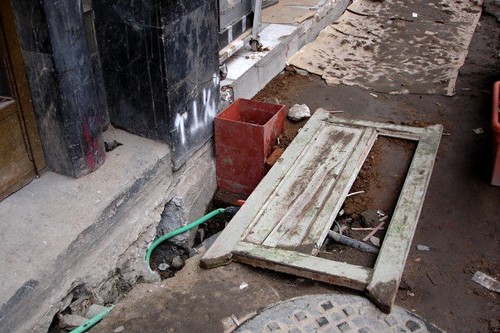
The old proverb, “May you live in interesting times,” is usually interpreted as a curse rather than a blessing. Lately, financial collapse, climate change, and the looming threats of food and energy crises have all done their part to make these times more interesting for cities. As a result, the popularity of concepts like sustainability has never been higher.

The biggest problems for cities today—the ones mentioned above—all stem from humans’ impact on the environments in which they live, and especially their consumption of resources. The term “sustainability” addresses that set of problems, but it’s generally used to mean two vastly different things. The first definition involves consuming resources more efficiently and more cleanly in order to maintain a given standard of living. The second involves cutting society’s resource consumption to a level that won’t exhaust those resources in the long run. The former definition, it seems, is not truly “sustainable”—the more efficiently we can provide ourselves with food and energy, the more food and energy we’re likely to consume. If everyone’s car gets 1000 miles to the gallon, the long distance commute becomes a more attractive option and total fuel consumption does not decrease much (although that consumption would be more efficient).

Reducing resource consumption to a truly sustainable level, however, holds more promise. Environmental problem-solving often takes the form of technological innovation, and such innovation has a crucial role to play. The other side of the coin, though less enticing in many ways, is “old” technology. At any given time, the human race has its entire history at its fingertips, and there’s no reason why a society shouldn’t cherry pick the very best aspects of each bygone era for incorporation into the present world. This is already done to some extent—there are many ways of doing things that never went away—but it’s harder to bring something back once it disappears, and sometimes a new innovation threatens to displace something low-tech that works fine. Why send a Segway to do a bike’s job?

Plenty of new technologies will have instrumental roles in bettering our world, as they always have, but when we talk about sustainability today, we should look to the past as closely as we look to the future.


(Photo from Flickr user lmapix.)

12.30.2008

Resolutions


City stuff to consider in 2009 :

- Urban crises as a prelude to the whole-hog global meltdown

- The downfall of retail urbanism

- Cities as shock therapy

- A switch from the urban explosion of the last century to a wide range of urban implosions, shrinkages and infra-urbanizations

- Suburbia as wasteland and promised land

- Urban politics make a comeback

- Urban rite makes a comeback

- Shift from urban contemplation to urban action

- Small is beautiful, but only with a big mindset

- Think urban sub-unit

- The downfall of multiculty (diversity is recognized as vital yet inextricably conflictive)

- The city and the web come together

- Connected sprawl

- Urbanity detached from lifestyle

- Urbanity reattached to survival strategies

- Luxury deadspace

- Productive squatting

- Protomodernist revival

- The “developed world” dissolved

- “It’s a small world,” on crack

- Tercermundismo

- Technodisurbanism

- Technocumbia

At least we won’t be bored.

6.25.2008

Electri-City

From the look of things, the zero carbon high tech eco-city of 2030 might not really look that different from the boring old present of 2008. Innovative minds are coming up with new ways of harvesting power from just about everything, reducing the need for crazy-looking turbine towers or solar-paneled skylines. What happens if everything becomes its own source of energy? Obviously, this seems like a Green pipe dream, but speculate for a moment. What might humanity do with a global surplus of power?

In the meantime, we can marvel at the creative thinking below and wonder if, one day soon, our curtains might be powering our laptops and televisions.

So where might we be getting our electricity from in the near future?

Our toilets? (Architecture.mnp)

Our walls? (Jetson Green)

Our clothes? (MIT News)

Our curtains? (Electricpig)

Our sidewalks? (core77)

What are some common, overlooked aspects of the urban environment that might be able to generate usable energy if harnessed in a new way? With suburbs densifying and evolving and becoming more self-sufficient nodes in polycentric megacities, the potential seems endless. So many people, so many opportunities for a volt or two.

(Photo from Flickr user Tobers. The original full-sized color version can be viewed by clicking the photo.)

4.29.2008

The Next Street Art

Say there was a place that had some special meaning to you. It could be the alcove where you had your first kiss, the alley where you were mugged, the square where you participated in an important rally, or the location of an historic uprising. Good or bad, we all infuse places with our memories. This is what makes physical places so powerful, and why peoples' opinions and experiences of the same place can be vastly different. Places are what people make of them. Now, technology could be making it easier for tech-savvy street artists to etch their own experiences and opinions onto physical places, communicating the artists' own sense of a place to others who pass through it.

Barcodes are most commonly used in retail environments, but their size and informational storage capacities make them ripe for adaptation for more inventive uses. In Japan, barcodes are now being applied to gravestones to store and transmit information, when scanned, about the deceased. The idea here is that family members will, through videos, photos, and stories, be able to reconnect with the deceased in a less mournful, more celebratory way. Imagine "a sort of gravestone based, family fueled, wiki of the dead."

This technology could easily be used in public spaces to represent a political viewpoint or a historical event. Imagine walking down a street for the first time and noticing a bright green barcode sticker affixed to the facade of a building. Using a scanner-enabled mobile device, you could access a website loaded with the history of the building site, or a series of short stories about the surrounding blocks, or photos of a lifechanging event that a stranger experienced in the very spot where you are standing. Reading or viewing material like this would give the place a new gravitas, and would change your perception of what might otherwise be a mundane stretch of asphalt and brick.

RFID tags are another method of remote-storing information that, thanks to increased range, provide the opportunity for a bit more mischief. With the technological know-how, a clever street artist could program a chip to send a text message or photo to any wi-fi enabled mobile device passing by. Imagine again: you're walking down a street and you pass a hidden RFID tag; your phone rings. You answer. An audio recording plays, recounting a woman's personal account of a riot that took place across the street a decade earlier. Later, walking through a park, your text alert sounds. You open the message to find a set of coordinates and the time of an upcoming event, perhaps a flash mob or a constructive riot. Or, perhaps, a photo of the view from the very place that you are standing, hyperlinked to a database of stories and photos of places around the city (along the lines of Invincible Cities, linked below).

While they would only be accessible to those with the proper devices to read the information that they stored, RFID tags and barcodes have distinct advantages over more traditional forms of street art like posters, graffiti tags, and murals. For one thing, they are smaller, and less intrusive. While this could be seen as a weakness (especially for barcodes, which require direct interaction), it is also a strength in that RFID tags and barcodes are less likely to prompt their own removal than more readily noticeable artistic interventions. These tiny storage units can also provide more vivid, personalized accounts of events or viewpoints, and have the potential to be more impactful on their viewers.

RFID and barcode street art has the potential to turn the urban environment into a virtual minefield of information. While the potential for abuse by malicious hackers or marketing drones is there, the idea of being able to literally "tag" a place with multimedia information is an exciting one. Perhaps it's already being done. Anyone know of some examples?

(Photo from Flickr user cloverst. The original full-color version can be viewed by clicking the photo.)


Links:
Barcodes on tombs to connect with the dead (The Inquirer)

Invincible Cities (Thanks, Pete!)

4.04.2008

WEEKEND READING: March 29-April 4, 2008

First things first: MONU has put out a Call for Submissions for their upcoming issue on "Exotic Urbanism." Sounds freaking brillaint. Now, on to this week's cream o' the crop.

ITEM ONE: New-ish blog Boredom Is Always Counter-Revolutionary with a cutting rant about advertisements, architecture, and envisioning the city of the future.

ITEM TWO: Lee Bey has his own cutting rant this week, this one zeroing in on race, crime, and public housing in Chicago. Spot-on.

ITEM THREE: Switching gears a bit, MNP's post on suburb-eating robots will blow your mind and tickle your funny bone. (Photo credit)

ITEM FOUR: Interchange blogger Scott Page on DIY Urbanism and the upcoming Wicker Park Bucktown workshops in Chicago.

ITEM FIVE: CS Monitor examines Hugo Chavez's plan to build a Venezuelan Brasilia of sorts. Welcome to Caribia, the 21st Century Socialist City.

ITEM SIX: Some eye candy from The Map Room -- a collection of late 19th and early 20th century maps of Latin American cities.

ITEM SEVEN: More humor to cap things off this week. The Onion features an hilarious exposé on the aristocrization of gentrified neighborhoods in American cities (via Super Colossal).

Adios, compadres. See you next week!

3.30.2008

Urbanffffinds 024


If anyone knows the name of the city in the last pic, please share. I can't figure it out for the life of me. (Thanks, Lee!) Also, I've gone back to using the original images; the past three weeks Urbanffffinds was reproducing the repros from FFFFOUND! as a time-saving measure. I realized that the images were distorted on PCs, and switched back this week. Apologies.

3.19.2008

Designing SkyCar City: A Post-Studio History (Guest Post by Ella Peinovich)

Many notable architects and designers throughout history have created transportation-centric city models that represent the future or an idealized present. Historically, architectural movements have used these models to demonstrate their design fundamentals in a pure state to a world that did not, at that time, have the capabilities to achieve such idealistic forms. Each designer, in turn, walked a fine line between reality and fiction.

A few models worth mentioning would be the Futurist Antonio Sant'Elia’s Citta Nuova, and then, within the Modernist movement, Le Corbusier’s plan for Algiers and Frank Lloyd Wright’s Broadacre City. Later, the traditional utopian city changed when the line was officially crossed from being about the study of technological advances to science fiction, with Archigram’s Walking and Plug-in Cities. More recently, the 3D city model has been featured in the work of Dutch firms OMA and MVRDV through designs like the Hyperbuilding and the Five-Minute City.

Taking all of this into account, one can understand how overwhelming -- not to mention exciting -- it might be for a group of young architecture students to be presented with the open-ended challenge of creating such a complex city model by Winy Maas of MVRDV, a veteran to the topic. That was the situation I (and eleven of my classmates) found myself in during the last studio of my education in architecture.

…create a city built for the use of a skycar, a city with 'streets' at any level, or perhaps empty of streets as we know them…
-- Winy Maas, first day of the semester describing our assignment.


My studiomates and I were presented with an experiment: see how far transportation can shape architecture, with one constant variable -- the flying car. Winy had introduced us to a whole new set of Lego pieces; ones that were gravity-defying. We were to design a city that had no specific location, no city boundary, and no technological limits. This is a similar formula to those that have been at the heart of most city models in the past, except for the fact that we (twelve near-strangers) had no pre-established theory to drive the experiment.

We, with the guidance of our studio's co-leader, Grace La, quickly developed a pragmatic methodology of how to approach our design and then applied it to our hypothetical scene, assuming that humans would always be subordinate, or at least married, to our means of travel (this was also in line with the prescribed “sky car”). Ironically, though we were all architects-in-training, little time was spent designing architecture in the traditional sense. During our process, research, and developments we wore many hats: Urban Planner, Product Designer, Civil Engineer, Research Analyst, Historian, Editor, and then Architect. This mash-up of information with the added flavor of democratic group decisions more or less drove our re-imagining of the city form.

During this experience I learned some valuable design lessons. In no particular order of importance:

1) It is our responsibility as designers to address real issues rather than represent feel-good utopias.
A city model that is designed in reaction to current outstanding issues of common society (e.g. waste disposal, greening, traffic relief etc…) will likely get a lot of attention and praise. On the contrary, our city model chose to explore and build up a topic which currently carries a negative stigma. We suggested that, as a society, we accept that every person wants the freedom of having their own car. We chose to assume this desire of every individual and suggest that public transportation has no future. We feel our model holds its clout because it is based on realistic projections of where society IS headed, rather than where it SHOULD be.

2) Design by committee vs. the individual
When an individual is allowed to carry out an idea, they are able to create one conclusive and seamless design in a similarly seamless process. As soon as you allow everyone a voice, all you get is noise -- at least at first. It took my studiomates and I a while just to figure out how we could work together, which inevitably took away valuable design time. Admittedly I, and likely others, caved to the majority vote at different times during the design process just to move forward, and I know that many “place-holders” never got re-”placed”. However, I can confidently say that our design would not have been what it was without any one person in our studio contributing their input.

3) Build from the Bottom-up
I have to believe that the Modernists and Futurists had an idea for the final form of their models before they designed the infrastructure to support it. In my experience, a top-down method can be inefficient, continually having to cover its tracks along the way. Please do not misunderstand me; once a design has been established I think it is necessary to go back and implement the design diagram to every last detail, but I am referring the process of getting to your building diagram. On the contrary, we were very honest in our studies; we did not hide the unpolished edges that are always a possibility of functionally-driven design. Our process was prescriptive and built from the bottom-up.

4) Get Published
The most responsible thing a designer can do is contribute to the Industry by publishing and distributing their work. Being able to show something as a product of thought can create a much larger ripple than just talk, especial in a visually-oriented community. Work should be shared, flaws and all, so that others may see and critique in order to create dissemination.

There may be a conflict of interest for some in the architectural profession that view their work as an artform. But when you think of what has been entrusted to us by the public (e.g. to create efficient systems, reduce environmental impact, ect…) we owe it to everyone to find the best technologies to do the job, regardless of who authored them.

Now, well after the publication of Skycar City: A Pre-Emptive History, the record of my and my classmates' semester of city-building, it is up to the readers to make their own conclusions about the success of our research and model and decide whether it is worth mentioning alongside the great city models of the past.

------------------


Big thanks to Ella Peinovich, a design associate at Skidmore, Owings, and Merrill's San Francisco Office. Ms. Peinovich participated in a mixed studio, led by guest professor and MVRDV founding partner Winy Maas, of twelve undergraduate and graduate students at the University of Wisconsin-Milwaukee's School of Architecture and Urban Planning in the spring of 2006. The participants recorded their process and city model in the book Skycar City: A Pre-Emptive History.

Skycar City Studio co-leaders: Grace La, Winy Maas

Skycar City Studio participants: Bryan Howard, Tony Janis, Nick Moen, Ryan O’Connor, Trevor Patt, Ella Peinovich, Nick Popoutsis, Tarah Raaum, Gloribed Rivera-Torres, Scott Schultz, Tuan Tran, Andy Walsh

Edited 4/12/08 to include full list of studio participants.


Blogger's Note: The original post planned for tonight and announced on Sunday was going to focus on urbanism programs for kids in Singapore and Chicago. This post has been temporarily postponed, and will run at a later date. Sorry for any confusion!


Links:
Skycar City (Powells)

MVRDV-UWM Studio (Warning: absurdly long load time).

3.17.2008

Exploring the City of Tomorrow

A hypothetical Aura Map of Istanbul's Golden Horn.
Google Transit wants your city to get on their bus. At the American Public Transportation Association's recent TransITech conference the web giant's mass trans-tracking maps app (say that five times fast) challenged every transit agency in attendance to upload their schedules and information to the site by Earth Day of 2008. If Google's effort at TransITech is successful, live, up-to-date GPS-powered transit tracking for every major city in the country (and beyond) could be a reality much sooner than one might imagine.

It's a bit freaky at first; there's a whiff of Big Brother, and a dash of 1984. But once the knee-jerk paranoia passes, the benefits begin to sink in. With live-feed transit information, Google Maps and Google Earth could eliminate the need for standing on a windy or snowy street corner for twenty minutes, waiting for a late bus. Outside it could be pouring rain, but you'd know exactly when to leave the house to catch your train. Even making connections could be more easily choreographed. Suddenly, one of mass transit's biggest drawbacks -- unreliability -- is eliminated. Overcrowding becomes less of a problem, and the whole system runs more smoothly. Everyone wins.

Online mapping technology has come a long way since the basic click-navigation maps of MapQuest hit the web back in the 1990s. Nowadays you can easily access street-level views, satellite images, and highly-detailed maps of buildings and amenities of dozens of cities. Certainly, this makes the prospect of taking an exploratory walk through a new part of town less daunting; you can preview your route, get a feel for landmarks, even decide where you want to stop for lunch. But there's still a dimension missing. Online maps are still very much stuck in the 3D-level, at least as far as the masses are concerned. We're still figuring out how to map the most important factor in cities: people. Not individuals (again with the creepy 1984ishness), but crowds, traffic patterns, and even emotions.

Think back, once again, to the SimCity game franchise. In later versions of the game, players could open up maps that charted everything from traffic to crime to the general happiness (aura) of the entire city. Live. Can you imagine the potential of people-mapping technology as a tool for planners and policy-makers?

A scenario: it's 8:00pm on a Friday in the year 2015, and you're looking for something to do. You grab your wi-fone and fire up the GoogleCity live maps app. There are three parties within a ten minute walk of your house being advertised on GoogleSocial (a convenient MeetUp/Bebo-powered mashup), a wifi-gallery showing one of your favorite artists from deviantArt four subway stops to the south, a restaurant opening on the corner where that hookah bar just closed last spring, and a band whose iSpace page you just subscribed to because you heard one of their songs on Pandora's new Loc:Audio channel. There's no excuse to be bored. And oh, look -- if you leave now, you can catch the next bus, but it'll be at least five minutes for a train. Perhaps tonight will be a concert night? The e-stars have aligned...

You're happy. You're entertained. You click a button on the screen that tells Google that someone on your block is in high spirits. The block's aura jumps up one point. At City Hall a few weeks later, the general happiness trend of your neighborhood is noticed to be on the rise. Civic officials study the area to learn why this spike in aura has been occurring, and use this people-powered live information to liven up some less brightly-colored spots on the map. Repeat this process with any resource, tangible or otherwise. The places that need something get it more quickly, and the decrease in wasted funds leaves more tax money to be distributed wherever it's most needed.

Now you, as a citizen, have every right to see this information if your elected officials are looking in. So the aura map overlay is available via GoogleSocial. You tap the screen, pull it up. There's a spike near your friend's apartment building downtown. What's the deal? Street fair. You are so there. You lift the phone to your ear, call the friend, and then check a transit map. You just missed the train, which means 10 minutes of waiting. But oh, there's a cab around the corner. You ping it with the push of a button, and you're on the road a few seconds later.

The next day, you're ready to go for a run. You check out air pollution and crowd overlays. The wind is blowing everything to the south today, so air quality will be best on the north side of town, which is good, because that's where you live. The big orange blob in the middle of the park closest to your house suggests some kind of festival is going on. Not wanting to deal with people-dodging, you check out the riverfront. Clear as crystal. And you're off!

The full potential of maps, in terms of improving the quality of life in cities, is just beginning to be realized. Soon, maps won't just tell you where movie theaters are; they'll tell you which ones are less likely to be crowded, dirty, or noisy. Get ready for the cartographolution.

Links:
Get Your City On Google Transit (WorldChanging)

How Google Earth Ate Our Town (Time)

3.16.2008

Joie de Vivre Urbaine

"...And joie de vivre [joy of living] may be seen as a joy of everything, a comprehensive joy, a philosophy of life..."

Long ago, writers disparaged cities like London, New York, and Paris, labeling them as hives of disease and destitution. But over time, industrialization and economic growth powered by these urban centers lifted hundreds of millions of people out of poverty, creating a prosperous and secure middle class like the world had never seen. Over the past few decades, we have seen this happen again in China and India. With the rise of ideas like common wealth and the urban planet, it seems less naive each day to believe that this trend could continue moving upward, creating a globalized standard of living (not to be confused with a singular global culture, which would be intensely boring).

But the current model of urban living, with its sprawl, auto-dependancy, and tokenization of nature, is unsustainable at best. If economic development in developing world-cities is to diminish poverty at any notable rate, everyone -- in worlds both "first" and "third" -- must work to bring about the evolution of their cities into healthy, green, globally-minded places. The City As Solution to Climate Change and Globalization Pains has been a popular topic of conversation of late. But how can people in developed countries be persuaded to agree?

As we step into this new Urban Age, those of us arguing for the City As Solution must focus on the joie de vivre urbaine. For cities to reach their full potential as engines for change, the urban chorus will need to grow louder and brighter. The masses should be reminded of the joys and conveniences of living in vibrant, eqitable urban neighborhoods, not guilt-tripped out of their McMansions and driven into gentrifying neighborhoods to exacerbate socioeconomic inequality. Only when a person believes that they will enjoy something -- and that they deserve to -- will they make a real effort to change their way of life.

This week, as Where wraps up its first year in the urblogosphere, each day will feature a post that celebrates the excitement, promise, and possibility of the urban environment. It's Urbanism For Fun (but no profit). A preview:

Monday: EXPLORE
We'll start off by looking at how Google Earth and online mapping sites are making urban places more exciting by helping urbanites develop a better understanding of their cities, and how this type of technology could affect urban culture and society in the future.

Tuesday: PLAY
Taking another look at mixed-reality gaming, Where will consider this emerging form of entertainment as a possible catalyst for economic development in the near future.

Wednesday: IMAGINE
If you could rethink how cities are built, how would you do it? It's a question many of history's most famous architects have taken on with relish. In a guest post by SOM design associate Ella Peinovich, who participated in an architecture studio that took on this very daunting challenge, we'll learn more about what it's like to go through the process of radically reimagining the urban form.
(This has been edited to reflect a change in content).

Thursday: LEARN
Thursday will feature Where's full review of the buzz-heavy book The Endless City, compliments of Phaidon.

Friday: CREATE
March 21st marks the 365th day since Where's first post. To celebrate this blog's "birthday," a special edition of Weekend Reading will look back on the top ten posts of the past year.

--

DON'T FORGET
The Blogedanken game will be open to entries through 11:59pm CST, this Saturday, March 22nd. Go play and submit your favorite results for your chance to win a copy of PA Press' Hyperborder.

(Photo from Flickr user Shimrit&Yaar. The original full-color version can be viewed by clicking the photo.)


Links:
Joie de vivre (Wikipedia)

Hyperborder (Princeton Architectural Press)

2.26.2008

Mixed-Use Infrastructure

Cities are extremely complex organisms made up of hundreds of independent and interdependent systems. The most basic and oft-overlooked of these systems are some of the most vital. Sewers, which remove waste and excess water, keep our streets clean and dry. They do this out of sight. Canals, rivers, bridges, and roadways allow for the transportation of goods and people within densely populated urban centers. We take them for granted. We have many large facilities for cleaning our water, recycling our trash, and producing our energy, and we hate it when we have to look at them. We so often forget to appreciate the importance of having a strong network of well-maintained public and green spaces. We get so involved in our own social systems that we forget that the larger framework of the city is there, making it all possible. We forget that cities themselves are living things, and that, ours are just tiny parts of a huge, interconnected process -- of creation, of destruction, of life.

What if more of the overlooked nerves and veins could be brought out into the open, or highlighted in some way? What if we had to interact with filtration systems and electric grids in a more direct way? What if we had to live on and in our bridges and tunnels instead of just passing over and through them. What might our cities look like if none of the processes that supported its existence went overlooked? How could we create an urban environment that helped citizens to better understand how their city works, and how they work within that system?

Bridges like the Ponte Vecchio in Florence, Italy, and the Chateau de Chenonceaux in France are evidence of the fact that bridges can be made into livable, functioning parts of the city. But what of the tunnels? In a twist of radical genius, a firm in Amsterdam recently proposed that the Dutch capital drain its canals and build an entire subcity of public, commercial, and parking (which, hopefully, could later be converted to other uses) under the canal system before re-filling the canals with water. No traffic topside would need to be disturbed, and a huge amount of space would be created, seemingly from scratch. There could be subterranean cafes dappled in light dancing through a glass ceiling open to the canal water overhead, movie theaters buried beneath bustling public plazas, perhaps even underground extensions of the city's many wonderful museums. No need for Renzo or Zaha; just dig down.

If these tunnels were to be dug, and another physical layer added to the fabric of Amsterdam, it would change the way that the canals were experienced by the public. Topside, they would remain serene, almost pastoral. But there would be the new knowledge that, once again, these canals were serving as a major thoroughfare, moving thousands of people through the city. Perhaps a public elevator system could be designed to access the tunnels using canal water in a hydraulic system, even more tightly tying the tunnels, the people, and the waterways together.

Speaking of water, Pruned recently took a detailed look at the work of Kevin Robert Perry, whose project on NE Siskiyou Street in Portland, Oregon, uses a system of landscaped "cells" reclaimed from parking space alongside the road. Water flows downhill into the landscaped areas, which use a series of checkdams to distribute water to the cells and prevent overflow, retaining and cleaning stormwater runoff on-site. While Perry's award-winning system only serves a small corner of the city, imagine the possibilities presented by a city-wide system. Much as Frederick Law Olmsted connected his parks with broad greenways, all of a city's streets could be lined with water retention gardens, with a hierarchical system designed to send all overflow, eventually, to parks specifically re-configured to collect and clean runoff. Think of Urbanlab's winning City of the Future entry, taken even further.

And what of our parks? While we take them for granted as part of the city's infrastructure, we certainly don't forget that parks exist like we sometimes forget about water treatment facilities. But couldn't parks be more than just gathering places? Couldn't -- and shouldn't -- they also be used as teaching tools? These public spaces provide a unique opportunity for showing urbanites how they impact their surroundings, and how their city works. In addition to cleaning wastewater and runoff, what other roles could re-imagined parks serve?

A contest was announced on February 15th by the Design Trust for Public Space and the Grand Army Plaza Coalition to generate ideas as to how Brooklyn's severely underused Grand Army Plaza, at the northern entrance to Prospect Park (which many, this blogger included, consider to be Olmsted's greatest park) could be redesigned as a more lively, energetic public space. The plaza, which sits atop a subway station, provides an excellent platform for any designer interested in creating a space that more clearly and fluidly emphasizes and integrates the transit system with the public space at street level. How do the public (park) and semi-public (subway station) interact, and how can design make this not only more enjoyable, but more informative?

Infrastructure could be an intriguing new frontier for the mixed-use movement. While inhabitable bridges seem long-overdue, there must be a thousand different ways of re-thinking infrastructure. Any ideas?

(Photo from Flickr user Rita Crane. The original full-color version can be viewed by clicking the photo.)


Links:
Gallery of Bridges in ArchitectureWeek (Civic Nature)

Amsterdam Subcity (BLDGBLOG)

Hyperlocalizing Hydrology in the Post-Industrial Urban Landscape (Pruned)

Growing Water (Urbanlab)

Reinventing Grand Army Plaza (Design Trust for Public Space)

1.30.2008

Sustainability and the Unimaginable City

A recent post at WorldChanging offered up for discussion a fantastic Bruce Sterling quote about sustainability: "The ruins of the unsustainable are the 21st century's frontier."

That's a pretty profound statement. To think that the world around us, the things that we consider familiar and take for granted, will be to our great grandchildren what the Roman Aqueducts -- or even British colonial forts -- are to us: relics. Of course, much of our built environment (especially the unsustainable portions) are considerably less visually appealing than crumbling arches and turrets. It's fun to imagine that, somewhere outside Cincinnati in 2108, there will be a tour bus that rolls past long-abandoned McDonald's huts and IHOP psuedo-ski lodges, describing to wide-eyed tourists how these strange buildings used to be used as restaurants back when people were willing to drive twenty minutes for food that had been flown across an ocean. But the likelihood of that scenario is slim.

Most likely, metropolitan regions will adapt to changing conditions, with cities and suburbs both densifying and growing and connecting in new ways. But what will become of the buildings and structures that are left in the sustainability craze's proverbial dust? As people become more educated on and concerned with sustainable buildings and neighborhoods, it seems logical to assume that demolitions will become less frequent than they are now as architects and planners seek to preserve structures with bones worth saving, and to reclaim materials when demolition is required. Politicians will mandate it; high tear-down rates will spell doom at the voting booths.

Even moreso than buildings, large chunks of our infrastructure could very well become obsolete, and will need to be repurposed. A post today at Loud Paper described a recent live design and model-building competition with a very novel premise: the two teams of architects were asked to design futuristic outpost buildings in the Alaskan wilderness, and their primary material was repurposed oil pipeline. Take that general concept to the city; what pieces of our current urban infrastructure -- even, or especially, the invisible pieces -- might we be trying to reuse as a construction materials once the large-scale shift to renewable energy sources has taken place?

And now, another Sterling gem to throw into the mix: "To me, 'sustainability' means a situation in which your descendants are able to confront their own problems, rather than the ones you exported to them. If people a hundred years from now are soberly engaged with phenomena we have no nouns and verbs for, I think that's a victory condition."

Whoa. Kind of re-frames the whole "repurposing" thing, hey?

It is easy (and, I think, quite common) to assume the perpetuation of current conditions. Humans like to think about the future, but we are stuck living only in the present. This means that our experience of the present has a very, very heavy influence on how we envision things ten, fifty, or a thousand years down the line. We live in fairly hectic period, so it can sometimes be difficult to imagine a world where the problems are completely different from those we face today, much less that we don't even have words to describe! My question is (inevitably, if you've ever read this blog before), how will this affect cities?

It's a silly question, really. After all, the very idea being discussed here is that the problems to be faced by a post-sustainability humanity aren't even conceivable to us now, so how the heck do we go about coming up with what those problems might entail? Of course, the answer is: we don't. We can't know what these problems or their solutions will be, but we can use the scenario to appreciate the massive opportunities presented by the challenges of creating a sustainable global society. All we need is a framing device.

Enter: the Air Tree. Madrid's recent announcement that they will be building three of these miraculous little structures (which were originally the result of a design competition in 2004) marks a very important moment in architecture and urban planning that is easy to overlook: the birth of an entirely new building type. The Air Tree is a temporary structure that marks what will hopefully be a permanent change in how cities will be built in the future, since its existence signals the arrival of the building with the sole purpose of acting as a unit of production for Quality of Life. These three futuristic pavilions will create for madrileños gathering places that use natural processes to filter and cool the air. The space beneath the Air Tree is not just social; it's cleansing and renewing.

Many common features of contemporary urban areas -- not in the least the Air Tree -- would have been unimaginable to people living a century ago. Stop and think about that for a second. Now try to imagine the unimaginable city of the future. Pretty thrilling, isn't it?


Links:
The Ruins of the Unsustainable (WorldChanging)

Architecture Gone Wild (Loud Paper)

What we get if we win... (WorldChanging)

The 'Air Tree' (Architecture.MNP) (Photo credit)

1.22.2008

The Future of (Urban) Shopping


"Describe your street. Describe another street. Compare."

That suggestion, originally made by Gorges Perec, is part of a longer quote sourced in a recent post at Pasta & Vinegar by blogger Nicholas Nova. Nova examines Perec's suggestion that we should "question [our] teaspoons," or look critically at things that we consider mundane or take for granted. "Make an inventory of you pockets, of your bag," the quote continues. "Ask yourself about the provenance, the use, what will become of each of the objects you take out."

Nova suggests: "Why is this important, maybe first to highlight how the mundane is intriguing. Beyond the descriptive level, it’s also curious wrt to innovation and design as it allows to ask question and possibly to nurture near future world." A previous Where post speculated on how streetscapes and shopping centers might evolve in a hypothetical, post-retail future. The more pragmatic way to approach this admittedly fantastical scenario would be to question the teaspoons of current retail environments as they exist today and think about how shopping might be a different -- but still essential -- component of urbanism a few decades hence.

A recent post at the David Report describes a design studio and upcoming panel discussion on the Future of Shopping. From that blog, I'll snatch another repurposed quote fragment: "Our culture is experiencing transition at so many different levels that we find ourselves at an unprecedented moment in history where we have begun to realistically re-imagine art, craft and design’s relationship to our culture, and its future...The future of luxury is an open question without obvious answers but it will be the young artists, craftspeople, and designers at Konstfack who will ultimately provide them. What will we be shopping for in the future? Bling Bling? The way things look now, it is more likely to be clean air and pure water."

The suggestion here assumes that the current transitionary period that humanity is experiencing will result in a fairly dire future. The commodification of clean air and pure water (which, to some extent, has already happened) will likely make shopping an even more important part of daily life. Imagine Wal-Mart selling de-particleized oxygen tanks in bulk, for the low low price of $259.99 a pack.

Purchasing essentials is, and will likely always be a tactile experience. It is quite common to buy a book without reading it first, or a CD without listening to it, but we are much more careful about buying things like food and shelter. In grocery stores, fresh produce is left out, unpackaged, to be groped and examined before purchase. Speaking of questioning tea spoons, think about your most recent trip to buy groceries. What was the ratio of things you'd tasted before to things you were trying for the first time when you rolled your cart up to the cashier's station? It's probably a safe bet that most of the food was familiar. And shopping for a new house or condo often takes months, with the buyer wanting to visit and experience firsthand the space that they might be purchasing to make sure that it meets all of their needs. What would the required commodification of air and water mean to urban retail environments?

Now swing the other way; let's end this post with some optimism. What will retail environments look (feel? taste? sound? smell?) like in the future if conditions generally improve for humanity? Retail is the essential element, the primary building block of the current globalized, megapolitan-level urbanism. Our infrastructure -- economic, transportation, and even social -- is largely built around shopping centers and commercial corridors. For better or worse, retail and commerce are often what give our society (and even our lives) meaning. With each successive generation, who you are and what you do are ever more tightly bound. So if our livelihoods and our identities continue to align more closely, it is very possible that urban commercial structures will become more diverse and complex. For retail, specifically, this could mean that shopping will become a much more immersive and meaningful experience, less about materialism for materialism's sake, and more about finding material goods that augment and/or enhance one's lifestyle in a productive way.

We see stores as boxes full of things that we can buy. But a retail environment has so much more potential than that. Rarely nowadays do store environments actually heighten the shopper's understanding of the products on display. If there is an effort to do so, it is almost never done at the middle class, mass market level. So how could retail environments change and adapt as consumers become, for example, increasingly environmentally aware, or as people become more interested in the related DIY movement?

The Reconfigurable House project sheds some light on this: "The project is a critique of ubiquitous computing 'smart homes', which are based on the idea that technology should be invisible to prevent DIY." The Reconfigurable House is an artistic experiment, an environment made up of easily manipulated experiential factors. Walking through the "house," a person can adjust everything from humidity to lighting to noise level. In a retail environment, this kind of technology could be used to expose and test products in an effort to build a consumer's trust. Shopping for a jacket becomes an entirely different experience when fitting rooms allow you to change the weather conditions to see how the garment holds up.

What would such developments mean for cities? It's hard to say. The visual impact of shopping corridors would likely remain the same. But the way that people interacted with stores, and the role that shopping played in daily life, would likely change. This has implied effects on everything from transportation planning to public space. What are some of the mundane aspects of contemporary retail districts that might provide some useful insight upon closer examination?

(Photo from The Style Press. The original full-color version can be viewed by clicking the photo.)


Links:
Question your tea spoons (Pasta & Vinegar)

The Future of Shopping (The David Report)

Reconfigurable House (2007) by Usman Haque and Adam Somlai-Fischer (Rhizome Inclusive)

1.09.2008

Conscious Urbanism: The Game?

I'm toying with an idea for a new feature, and I'm hoping for some reader feedback. If you're a regular, an occasional reader, or even a drop-in checking out Where for the first time, I hope you'll weigh in on this concept, as the reader response will determine its future.

I read posts on two blogs recently that have started my brain a-thinkin' about how effective a good game can be. (Monday's post on the X Prize, and the value of competition, served as part of the inspiration as well). The first post, over at Inhabitat, talks about a new board game called Play Rethink, in which players use a spinner and product cards to create a variety of environmentally-friendly design challenge scenarios which they must then address. The intent is to get normal people (non-professionals) thinking about eco-design and issues like local vs. imported materials, sustainability, and adaptive re-use. It does so, rather ingeniously, I think, by making the process fun and entertaining. It's public engagement through play.

Play is a powerful method of communication. When we are playing (on a playground, a sports field, a computer, etc.) our guard is down. We are having fun, and that makes us more receptive to the ideas that we are being exposed to through the game. Thus, it seems like play would be an excellent way to address seemingly intractable urban problems. Make policy and urban design fun, and we might start coming up with some interesting answers to exhausting questions.

Enter inspiration #2: a recent post at Brand Avenue spotlights a 100-day-long game called "Future City," being facilitated by the Hamilton Spectator, a newspaper in the city of Hamilton, in Canada. In the game, the paper poses scenarios in the city's imagined future and asks readers to vote on the outcomes. There's a fun interactive map of the evolved version of the city that Spectator readers are creating, and the whole thing seems to be quite the little success. It's getting Hamiltonites actively thinking about and participating in their city's future, which will (hopefully) translate to these citizens becoming more politically active and aware at the local level.

Where's "Conscious Urbanism" series has, for whatever reason (I suppose I should know, but I can't come up with anything solid), fallen by the wayside over the past several months. I find this unfortunate, since the discussion of active citizenship and innovative neighborhood-based solutions was part of my original inspiration for starting this blog. As stated in the inaugural post, I have always hoped that Where might be able to spark some interesting conversations about urbanism, but I have admittedly had little success in encouraging such activity thus far.

Thus, Conscious Urbanism provides us with a possible jolt of conversational energy. I would very much like to create some sort of game, as a recurring feature at Where, that takes urban problems found in news items or submitted by readers and challenges readers to create, discuss, and debate potential solutions. The idea is, of course, to start something constructive -- and fun. (It is intended to be a game, after all). But I'm not yet sure exactly what form the game should take...there would need to be some framework of rules and instructions -- nothing too limiting, but enough to give the game some direction. And, certainly, there would need to be a clarification of what, exactly, "Conscious Urbanism" really is. (Admittedly, it's been a bit vague in the past). Whatever it is, it's about people working together, socially, to solve urban problems, so it seems logical to re-think the feature in a more participatory way.

So this brings us to a crossroads, and to an invitation. I hope that you'll sound off on this little seed of an idea. If you have an idea for how the game might be structured, or how participation might be encouraged, or even if you just want to voice your interest in participating once the thing gets off and running, I do hope you'll take a moment to contribute. If you think this sounds utterly inane, say that, too. I'm open to suggestions as to why it shouldn't be done. At this point, I'm open to suggestions, period.

Of course, if there is no response, I'll let this one slip quietly by. There's no need to push the idea if there's no interest in participation, as reader involvement would be critical to this feature's success. Of course, if you have nothing to say, by all means, say nothing! :-) I do hope you'll participate, though. We'll see where things go from here...

(Photo from Flickr user colampearson. The original full-color version can be viewed by clicking the photo.)


Links:
Play Rethink: The Eco-Design Game (Inhabitat)

Dreaming Big (Brand Avenue)

12.28.2007

WEEKEND READING: December 21-28, 2007

Check back on Monday for a round-up of the past year's most interesting Weekend Reading Items. But for now, check out the current crop:

ITEM ONE: WorldChanging on the importance of voluntary simplicity. The article is not directly about cities, but the ideas that it presents are certainly integral to the reimagining of cities as sustainable places.

ITEM TWO: AHI's blog examines a decidedly different vision for the city of the future.

ITEM THREE: Jay Walljasper's new blog, The Ecopolitan, kicks off at National Geographic's site.

ITEM FOUR: TNAC on The Independent's recent list that names London as the current World Capital.

ITEM FIVE: GPS message-in-a-bottle locative art. Pretty cool stuff.

ITEM SIX: The City Room on Hollywood's fascination with the destruction of New York, which Ed Koch cheekily refers to as "edifice envy."

ITEM SEVEN: Lots of dreamy, really wonderful images of the UK over at BLDGBLOG - like the one pictured above.

Have a wonderful weekend, everyone!

11.08.2007

WEEKEND READING: November 3-November 9, 2007 (Guest Post by Colin Kloecker)

Hi, I'm Colin and I usually write over at Blog Like You Give A Damn. But this month you'll find me here, curating Where's Weekly Reading segment. Brendan has graciously allowed me to break from his standard format for something a bit more casual. Let's call it a stream-of-thought meditation on a theme.

This week -- Near future urbanism: how an ubiquitous and multi-layered network might effect our urban environment. Photo: OiMax (via Flickr)

Moore's Law tells us that computing technology is advancing exponentially – essentially doubling every two years. With Rainbows End, mathematician, computer scientist, and science-fiction writer Vernor Vinge extrapolates on Moore's Law and envisions a near future where the physical world can be reinterpreted through "contact lenses that can overlay what the wearer sees with skins that redress the environment to your taste." [Check out this smallWORLD podcast to hear Vernor talk at length about the concepts and technologies behind Rainbows End] A similar concept is explored in William Gibson's recent novel Spook Country, in which locative artists create incredibly complex site specific geo/virtual mashups, tied to specific locations through GPS and wi-fi technologies [see gpsdrawing.com or this video for some real-world examples].

Both of these authors and their recent works are proposing a malleable virtual/ urban environment where user generated content meshes seamlessly with concrete and grass [see CSI:NY's recent foray into Second Life for a not-so-seamless example]. Essentially, if you don't like the looks of that new condo going up across the street - simply design a new facade, upload, and share with your social network of choice.

In a world where the net is everywhere and we are always online, geographic locations will be linked in as well. It won't be long before we are going about life tagging locations with keywords or personal stories like we would a page on the web (imagine geo.del.icio.us or MySpace taken literally). As technology advances and life-caching becomes more robust, you could feasibly go back to the location of your first kiss, bring up the appropriate file, and project that exact moment in real-time. Hackers and artists will upload pirate landscapes, momentarily hijacking reality for thousands of people at a time. Communities with similar belief systems might organize around a shared perception of reality or aesthetic sensibility - and then actually make that their reality.

So all of this speculation begs the question: in this media-rich user-generated landscape, what role is there for the architect and urban planner? Will cities be reduced to the skeletal equivalent of a wire frame 3D model, designed to be dressed up with an infinite and interchangeable architectural wardrobe? This is to say nothing about questions about privacy or invasive marketing strategies... phew!

As you can probably tell, I've been on something of a futurism kick. Check out futuretalks.com if you're digging it too. They recently started broadcasting an interesting series of conversations with futurists Gerd Leonhard and Glen Hiemstra. Until next week, Happy Friday!