Showing posts with label commercialization. Show all posts

5.27.2011

WEEKEND READING: May 21-27, 2011

Photo credit: saracino
Heading into a much-needed long weekend. Memorial Day means extra reading time!

ITEM ONE: Anyone who's familiar with the unique joy of finding an easter egg in a video game will love this week's leader--check out Repudo, a new app that turns the city into one giant easter egg hunt.

ITEM TWO: Humans are just so darned clever.

ITEM THREE: The Space Liberation Manifesto is a call to arms for anyone who wants to see digital public space protected from the kind of every-flat-surface-gets-a-sign mentality that has turned public space in the physical city into one long commercial break. (via @bruces)

ITEM FOUR: Nicolai reviews Rem's Cronocaos show, which is on the Bowery until next Sunday. Choice quote: "In the realm of preservation, as in so much else, we seem to have become a world terrified of too much direct contact with reality."

ITEM FIVE: Michael Maltzan actually makes Los Angeles sound palatable in an essay excerpted from his new book No More Play over at Design Observer. (The Iwan Baan pics don't hurt.)

ITEM SIX: Caleb Smith, aka the man who walked every street in Manhattan, shares one of the most meaningful (and under the radar) historical sites for him on the island he knows so well.

Weekend Reading is very multi-media this week, I'm just realizing. So enjoy the reading...and watching, and listening! Back next week with more urban-y goodness.

12.31.2008

Considering Urban Retail: A Re-post at the Crossroads

As we head into 2009 with economists predicting the closing of as many as 73,000 retail locations across the United States due to dismal holiday sales, it seems like a good time to look back at one of Where's most popular posts from last year, "The Possibilities of the Post-Retail City," originally published in August of '07.


I just had my first exposure to Reverend Billy, the leader of the Church of Stop Shopping. After reading a Polis post about the Reverend's anti-consumerist group, I thought it was an actual church. To which I said: "Oh, excellent.

Of course, the CoSS is actually an act, with the "Reverend" being the stage persona of NYC performance artist Bill Talen. It's a send-up of streetcorner preachers and televangelists, and it sounds hilarious. Better yet, there's a point! Reverend Billy preaches against corporatist architecture and urbanism, advocating for sustainable, walkable communities with local economies. And while the site does pay lip service to independently owned local businesses, it is the Church of Stop Shopping, and one of their taglines is "Love is a Gift Economy!" Obviously, these people think that there are better ways for us to use all of that street-level retail space.

And that got me thinking: if there were no major retail chains and independents had to hold up the local economy, what would we do with all of that ground-floor space? Indeed -- and my upbringing in a capitalist society may shine through right here -- but where would we walk to? Certainly, there are plenty of places that we walk every day, but a large amount of pedestrian traffic is genereated by shoppers. And while it's not a requirement for these ground-level spaces that make up our streetscape be places of commerce, their presence is utterly vital to functioning neighborhoods. Often (these days) even moreso than upper-level residential windows, storefronts are the Jacobsian "eyes on the street" that act as a natural deterrant to crime.

Shopping is also a huge part of the social life in many (if not most) contemporary cities; in fact, that's just what Reverend Billy and his fake church take issue with. And whether or not you agree with the Church of Stop Shopping (or, as I'm sure many do, find it outright offensive), it's interesting to imagine a world in which shopping took a back seat to other social spaces as the dominant street presence. Imagining Paris without the Champs-Elysées or New York without Park Avenue sparks a giddy, no-holds-barred creative energy akin to imagining those cities in a work of science fiction or postapocalyptic literature.

To get an idea of what might fill the void, it might be interesting to see how social space is structured in places where gift economies (or at least barter systems) often already exist and retail strips are few and far between, at least in the traditional sense: slums.

An article from Forbes, mentioned briefly in a previous post at Where, described the socioeconomic situation of many older, established slums in Asia and South America thusly: "Many slum dwellers are in fact entrepreneurs, albeit writ very small. They recycle trash, sell vegetables, do laundry. Some even run tiny restaurants and bars for their neighbors." So while there are no Ginza Districts in the favelas of Rio, there is a social commerce to such places. Restaurants and bars remain important components of the neighborhood, which makes good sense; people have always come together over food and drink, and will continue to do so regardless of any freak evaporations of the retail sector.

Another thing that brings people together is knowledge -- or, more specifically, the exchange thereof. Another recent post covered McGill University's Edible Cities project in Kampala; the site for the students' project "includes a low-lying wetland area...where a youth cooperative practices brick-makings, providing work for otherwise unemployed youth...and a sloping dryland area where farming is [practiced]." While this is a very rural area being discussed (albeit in the context of a larger city), the Kampala site illustrates two more possible uses for a retail-less streetscapes: public workshops (which could cover a variety of topics in addition to brickmaking) and storefront hydroponic community gardens.

Heh.

If the second option seems somewhat far-fetched, the first is hardly at all; in fact, in the face of looming irrelevance in the digital age, libraries around the world are starting to take on a more social role in their respective cities, staging various events and programs to encourage public discourse and teach skills that cannot be learned with a mouse and keyboard. One of the most innovative library programs that I've heard of recently is in Medellín, the second city of Colombia.

Once the so-called Kidnappping Capital of the World, Medellín has made more news recently for building five spectacular modernist libraries (like the one in Santo Domingo Savio, pictured above) in its most impoverished barrios. One of the programs to utilize these new libraries -- which are equipped with computer labs full of brand spankin' new computers -- is HiperBarrio, which teaches teens in the barrios how to use blogging and other social media tools as a creative outlet for self-expression. Juliana Rincon, one of the founders of HiperBarrio, spoke of the program's inspirataion in a recent interview with Global Voices Online, saying, "It was amazing...telling these kids about blogs and finding out that they had no idea that there was something like a blog, that they existed. [Or even] that you could write online and have a virtual space to keep your writing, the videos you like, and pictures." Libraries, in this case, serve not just as containers for information, but as catalysts for the creation of new information and new ideas. Certainly, this kind of social space, the place of public learning, will play an increasingly important role in cities as we continue through the Information Age.

Whatever we come up with to fill storefronts and social spaces, shopping districts and neighborhood retail strips are unlikely to disappear within the lifetime of anyone reading this blog post. Still, imagining a world without retail can tell us a lot about how we use cities, why we do things the way that we do, and how we can improve urban places without courting Starbucks and Barnes & Noble for civic salvation. In fact, picturing your neighborhood without any shops selling anything other than necessities might be a great way to fall in love with the place all over again. That is, of course, assuming that you love your neighborhood -- and that you don't live off Rodeo Drive.

----------

That's all for now, folks. Best of luck to everyone in 2009. Let's hope it's not as bad as we're all worried it's going to be.

(Photo from Flickr user galitagreeneyes. The original full-sized color version can be viewed by clicking the photo.)

10.23.2008

The Ads Are In the Air

In case you were wondering, the answer is no; nothing is sacred anymore. At least not to advertisers. A Dutch company called Geotronics recently launched a re-branding campaign by staging a full-blown musical number in the busy concourse of a train station in Utrecht. While there are plenty of ways to read this (the least entertaining of which is not that we'll finally have an answer for people who say musicals are unrealistic because "no one bursts into song and dance routines in real life"), it seems to set a troubling precedent. Long since unsatisfied by innumerable billboards and neon signs, advertisers have been aggressively acquiring pieces of the cityscape (ceilings, stairs, escalators, trees, sidewalks, benches, busses, etc.) over the past few decades. With this latest move, it seems, even the physical space -- the very air around us -- is fair game for splashy advertisements.


Observe above: an image of Charing Cross Station in London. Below, the same image with green filters highlighting existing advertisements:


Here, as in most contemporary public and quasi-public spaces, people are bombarded with ads for food, real estate, toiletries, and events. The advertising has become so ubiquitous, that it seems abnormal to pass through an urban space without ads on every flat surface (think back to the media bonanza in late 2006 when São Paulo banned all outdoor ads). And now, we can't even count on the people we're sitting next to, or the janitor sweeping up litter a few yards away, not to be a part of some grandiose sales pitch just waiting to erupt. The advertisement space in public spaces starts to look a bit more like this:


There's a fundamental problem with being told by your environment that you are merely a consumer. Yes, we are consumers living in a capitalist society, and I don't intend to argue the merit or value of that. But there is something to be said for maintaining the dignity of public space, and keeping some places free of advertisements. If we merely see each other as fellow consumers we are, in an odd way, pitted against each other. I have to buy what you can't buy if I want to feel successful. Ads do nothing to reinforce the fundamental building blocks of any harmonious human settlement: community, interdependence, and civic engagement. Those are the values that public spaces should strive to promote.

But what's the big deal with the Geotronics musical performance ad, you may be asking? If we are already bombarded by ads everywhere we go, what's the difference adding the occasional flash-mob-esque song and dance routine hawking toothpaste or the newest Barbie doll? It might even be fun -- certainly moreso than any billboard. But advertising has a way of growing, cancer-like, taking over new nooks and crannies without us noticing. In some cities, storefronts are now more profitable with windows boarded up to shoulder more posters and billboards.

Jump ahead a decade or two, to when these performance ads have become more commonplace. What happens when civic officials see more value in a park as a place for elaborate performance ads? Just imagine your city's parks, transit stations, and civic plazas as dozens or even hundreds of little Disneylands. And what would a child who grows up riding the Citibank Train to Coca Cola Park instead of just 'the local playground' think of the city once they were grown? The only value a place has once it's been bought is what the company that bought it was willing to pay for it.

(Original photo from Flickr user annabelb. The original full-sized color version can be viewed by clicking the photo.)

3.18.2008

It Takes a Video Game to Save a Village

Most cities have a love-hate relationship with tourists -- civic officials love them, and residents hate them. Tourism generates billions of dollars in revenue for cities across the globe each year. The number of traffic accidents caused by tourists not watching where they're walking? So far, no reliable estimates have been made.

Still, tourism is a vital part of any urban economy. Even moreso, it can be a powerful factor for a neighborhood that is trying to lift itself up. Tourism As Economic Strategy is a well-worn path. But with all of the emerging technologies related to the web and wireless communication, it seems like the old urban tourism formula (cleaned up historic buildings + quirky neighborhood attraction + Starbucks and/or Cold Stone Creamery and corresponding independent cafe/gelato bar = success!) is due for an overhaul.

Let's start by thinking small, with the traditional Japanese village. Japan's demographic woes have been well-reported over the past few years; indeed, as young residents of this highly urbanized island nation put off having families and move to the cities in droves to pursue fast-paced careers, the raw population number isn't the only thing being affected. Culturally, Japan is seeing the evaporation of its small villages, and the slow death of ancient rural and cultural traditions.

Enter: mixed-reality gaming. An explanation, c/o Very Spatial: "One of the areas of convergence for location-based applications and gaming is the idea of mixed reality, where places in the game correspond to real-world locations, and actions in one lead to events or consequences in the other." A recent Nintendo DS game, Treasure Quest: Enoshima, follows this very blueprint, using a small island north of -- surprise! -- Tokyo as the setting for a handheld video game. Players have to visit and explore the actual island to play the game. The DS unit acts as the mixer, blending the fictional and real worlds, literally with the push of a button.

The problem with Treasure Quest, though, is that it's over. The software could be downloaded off of the internet, and the game only ran until February 19th. Makes sense, considering that Nintendo doesn't own the island, and thus can't stake any real claim to it. But what if they could? What if, as a way to draw in tourists, a rural village somewhere in Japan agreed to sell off a large number of its abandoned buildings to Nintendo in an agreement to become the permanent setting for a mixed-reality video game?

It sounds crass at first, but with the right amount of finesse, it just might be a win-win economic development strategy. For instance, to prepare the town for guests (players), Nintendo would agree to upgrade local utilities. It would also take on the responsibility for upkeep of public areas. Streetscaping, garbage collection, and parks maintenance would be taken care of by the entertainment giant. Villagers would enjoy a higher quality of life at a lower rate of taxation (though I'm assuming the American system there since I know very little about the governance of rural Japanese villages). In return, residents would agree to coexist peacefully with players. A particularly savvy game designer would craft the game as a cultural experience, creating some sort of mystery or adventure plot that made use of the area's native traditions.

The argument could be made that Nintendo (or whatever company helmed the project) was being given too much power over a municipal entity; it could also be said that cultural traditions were being bastardized and pillaged in the name of commerce and fleeting entertainment. But when the options for the village are Sink or Swim, the picture becomes less black and white. After all, don't most -- if not all -- preservation efforts (architectural or cultural), on some level, tokenize the very things that they aim to preserve?

So assume that Nintendo creates a mixed-reality game around a rural Japanese town, and it becomes a wild success. Players start booking rooms at a nearby hotel months in advance for their chance to play. The villagers find new opportunities to pass along their cultural history and traditions. Nintendo makes a buttload of cash. Everyone's happy. A small town in rural Portugal hears of the success and decides to give it a try. Sony's European headquarters gets a call from the mayor...

Ten years later, mixed-reality gaming has become an economic silver bullet. Hundreds of villages in countries around the world have mixed their realities with fantastical virtual counterparts. The trend goes big-time when the city of Detroit sells a square mile of its infamous "urban prairie" to the Walt Disney Co., which painstakingly re-creates the neighborhood circa 1930 to stage a depression-era mob mixed-reality urban epic. The arts & crafts bungalows are the hotel. Visitors live in the game. A month later, Blizzard Entertainment announces a joint deal with CCTV and the city of Shanghai to buy up hundreds of defunct surveillance cameras and create the world's largest multi-player mixed-reality on-and-offline mega-game. The setting? Pudong.

Of course, it must be asked: when is the reality in question no longer considered to be mixed? When does "mixed" become simply "augmented?"

(Photo from Flickr user Mathias M. The original full-color version can be viewed by clicking the photo.)


Links:
Mixed Reality Gaming In Japan (Very Spatial)

1.22.2008

The Future of (Urban) Shopping


"Describe your street. Describe another street. Compare."

That suggestion, originally made by Gorges Perec, is part of a longer quote sourced in a recent post at Pasta & Vinegar by blogger Nicholas Nova. Nova examines Perec's suggestion that we should "question [our] teaspoons," or look critically at things that we consider mundane or take for granted. "Make an inventory of you pockets, of your bag," the quote continues. "Ask yourself about the provenance, the use, what will become of each of the objects you take out."

Nova suggests: "Why is this important, maybe first to highlight how the mundane is intriguing. Beyond the descriptive level, it’s also curious wrt to innovation and design as it allows to ask question and possibly to nurture near future world." A previous Where post speculated on how streetscapes and shopping centers might evolve in a hypothetical, post-retail future. The more pragmatic way to approach this admittedly fantastical scenario would be to question the teaspoons of current retail environments as they exist today and think about how shopping might be a different -- but still essential -- component of urbanism a few decades hence.

A recent post at the David Report describes a design studio and upcoming panel discussion on the Future of Shopping. From that blog, I'll snatch another repurposed quote fragment: "Our culture is experiencing transition at so many different levels that we find ourselves at an unprecedented moment in history where we have begun to realistically re-imagine art, craft and design’s relationship to our culture, and its future...The future of luxury is an open question without obvious answers but it will be the young artists, craftspeople, and designers at Konstfack who will ultimately provide them. What will we be shopping for in the future? Bling Bling? The way things look now, it is more likely to be clean air and pure water."

The suggestion here assumes that the current transitionary period that humanity is experiencing will result in a fairly dire future. The commodification of clean air and pure water (which, to some extent, has already happened) will likely make shopping an even more important part of daily life. Imagine Wal-Mart selling de-particleized oxygen tanks in bulk, for the low low price of $259.99 a pack.

Purchasing essentials is, and will likely always be a tactile experience. It is quite common to buy a book without reading it first, or a CD without listening to it, but we are much more careful about buying things like food and shelter. In grocery stores, fresh produce is left out, unpackaged, to be groped and examined before purchase. Speaking of questioning tea spoons, think about your most recent trip to buy groceries. What was the ratio of things you'd tasted before to things you were trying for the first time when you rolled your cart up to the cashier's station? It's probably a safe bet that most of the food was familiar. And shopping for a new house or condo often takes months, with the buyer wanting to visit and experience firsthand the space that they might be purchasing to make sure that it meets all of their needs. What would the required commodification of air and water mean to urban retail environments?

Now swing the other way; let's end this post with some optimism. What will retail environments look (feel? taste? sound? smell?) like in the future if conditions generally improve for humanity? Retail is the essential element, the primary building block of the current globalized, megapolitan-level urbanism. Our infrastructure -- economic, transportation, and even social -- is largely built around shopping centers and commercial corridors. For better or worse, retail and commerce are often what give our society (and even our lives) meaning. With each successive generation, who you are and what you do are ever more tightly bound. So if our livelihoods and our identities continue to align more closely, it is very possible that urban commercial structures will become more diverse and complex. For retail, specifically, this could mean that shopping will become a much more immersive and meaningful experience, less about materialism for materialism's sake, and more about finding material goods that augment and/or enhance one's lifestyle in a productive way.

We see stores as boxes full of things that we can buy. But a retail environment has so much more potential than that. Rarely nowadays do store environments actually heighten the shopper's understanding of the products on display. If there is an effort to do so, it is almost never done at the middle class, mass market level. So how could retail environments change and adapt as consumers become, for example, increasingly environmentally aware, or as people become more interested in the related DIY movement?

The Reconfigurable House project sheds some light on this: "The project is a critique of ubiquitous computing 'smart homes', which are based on the idea that technology should be invisible to prevent DIY." The Reconfigurable House is an artistic experiment, an environment made up of easily manipulated experiential factors. Walking through the "house," a person can adjust everything from humidity to lighting to noise level. In a retail environment, this kind of technology could be used to expose and test products in an effort to build a consumer's trust. Shopping for a jacket becomes an entirely different experience when fitting rooms allow you to change the weather conditions to see how the garment holds up.

What would such developments mean for cities? It's hard to say. The visual impact of shopping corridors would likely remain the same. But the way that people interacted with stores, and the role that shopping played in daily life, would likely change. This has implied effects on everything from transportation planning to public space. What are some of the mundane aspects of contemporary retail districts that might provide some useful insight upon closer examination?

(Photo from The Style Press. The original full-color version can be viewed by clicking the photo.)


Links:
Question your tea spoons (Pasta & Vinegar)

The Future of Shopping (The David Report)

Reconfigurable House (2007) by Usman Haque and Adam Somlai-Fischer (Rhizome Inclusive)

12.23.2007

Urbanffffinds 010

I had to venture out into a small blizzard to find a wi-fi spot for this week's Urbanffffinds. Now that's dedication!


Have a happy holidays, everyone. Where will be back on December 26th.

12.14.2007

WEEKEND READING: December 8-14, 2007

Oh, this is an exciting week. There is a lot of really fantastic reading for you, if you are interested.

ITEM ONE: A short but stunningly effective piece at Spacing Wire on the need for humanism in the environmental movement proves that, sometimes, you really can say the most with the fewest words. It's a must-read.

ITEM TWO: The Burgh Diaspora puts out a call to all Rust Belt bloggers (and citizens).

ITEM THREE: Critical Spatial Practice takes a look at the history of labor struggles in urban America.

ITEM FOUR: Airoots goes gangbusters on Tokyo retail and high-end boutique architecture. This is another must-read.

ITEM FIVE: Does Marseille hold the key to Europe's future? The Smithsonian mag thinks so.

ITEM SIX: David Adjaye's Whitechapel Idea Store gets the Flickr treatment from Life Without Buildings.

ITEM SEVEN: And to finish up this wonderfully weighty edition of WR, a good, old-fashioned traffic joke that will at least inspire a chuckle.

Have a great weekend, and enjoy the reading!

(Photo from Flickr user hampshiregirl. The original full-color version can be viewed by clicking the photo.)

10.11.2007

Public and Private Spaces

While they are best known for Park(ing), San Francisco group Rebar recently completed another interesting project called COMMONspace in which they visited POPOS (short for Privately-Owned Public Open Spaces) around San Francisco and staged some bizarre stunts in order to highlight the fact that these places were, despite common perception, open for public use, whatever the public determined that to be (within the law). Their self-described objective was to ask of these public places, "How public?"

From a recent article on the project in The Next American City: "'We partnered up with [performance and activist group Snap Out Of It] and said, 'Let’s just get in there and energize these spaces,' which appeared to us to be underused by the public and constrained by the psychogeography of downtown,' says [Rebar member] Blaine Merker -- in other words, the very fact that these spaces are located in the business district gives the public the idea that access and certain behaviors are prohibited."

Security guards, surveillance cameras, and the business attire of the crowds of office workers in San Francisco's financial district had all created the illusion of exclusivity in these decidedly un-exclusive places. POPOS were the result, after all, of a law that aimed take advantage of new commercial construction by requiring developers to include public areas for the enjoyment of all San Franciscans. But citizens were not enjoying these spaces because the physical environment, while perhaps attractive, was hardly welcoming in the way that a park or plaza might be.

I have to wonder, reading this, what effect corporate advertising has on public spaces. This is largely due to a recent post at Spacing Wire that pointed out the absurdity of Canadian communication megacorp Rogers spraypainting advertisements for Myspace Mobile onto sidewalks in public parks.

"Big businesses like Rogers (and the ad company responsible for implementing the campaign) should act like responsible corporate citizens. Sadly, these companies take advantage of [the City of Toronto's] over-stretched staff. They are fully aware that City will not invest the time or energy to prosecute them. But when teenagers get caught with a spray-paint can in hand, they’re arrested and eventually ordered to take part in community services."

The Spacing team also pointed out that this was the same park where Audi placed advertisements thinly veiled as sculptures earlier this year. Rogers and Audi are certainly not alone when it comes to corporations willing to bend the rules in public places in order to create "authentic" or edgy advertisements for their products. (While I can't comment on their legality, I have seen multiple "graffiti ads" around Chicago for various companies). But what do these infringements say about the role of corporations in the public realm?

Whether they are spraypainted on random surfaces or screwed onto fake art, logos undoubtedly have some effect on the psychogeography of a place that is supposed to be the unfettered domain of the common citizen. In the same way that cameras and guards create a "you are being monitored" feel in POPOS, logos and advertisements that encroach on public places seem to say "you are still on our turf." When private corporations take over public spaces and undermine the legal entities that care for those spaces, they claim the public for the private. These seemingly harmless infringements say some disturbing things between the lines.

I'm not trying to sound paranoid, and I am aware that this is a small problem at present. But it is certainly something worth keeping an eye on. After all, when private entities claim psychological domain over public spaces, we start down a slippery slope.


Links:
Challenging the Commons (The Next American City)

Rogers thinks the sidewalk is my space (Spacing Wire) (Photo credit)

10.02.2007

Questioning the Creative Class Logic

Sometimes I can't help but wonder if maybe the whole Creative Class phenomenon is doing more to harm cities than it does to help them. Not in all cases, of course...certainly many cities are benfitting from the investment in their artistic and recreational infrastructure. But the primary purpose of a city is to provide high-quality services to all of its citizens, and at times it seems like this responsibility falls by the wayside as civic governments try to focus on building Creative Class-friendly amenities.

Gentrification happens because neighborhoods throughout a given city are unequally supported. And while this isn't the fault of the Creative Classmates, they appear to be exacerbating the problem by attracting a disproportionate amount of attention -- and funding -- from mayors who think of their presence as a silver bullet. With rich creative people comes an increased tax base, and with an increased tax base, more problems can be solved in less privileged areas, right?

Portland, Oregon, is seen as one of the capitals of the Creative Class. The city's arts and cultural scenes are thriving, with artists flocking to the once-granola metropolis to be a part of the scene. As a recent article in Slate pointed out, "it's rare to meet a young, creative Portlander who's from Portland." Its success in drawing talent from other cities is, in fact, one of the reasons that Portland is held up as model of the Creative Class metropolis. The CC is all about migration, after all; it could not exist without the internet, which allows for artists to live in cheaper cities while still participating in the larger artistic fields in which they are interested and/or employed.

Jump to the other side of both the country and the spectrum, to New York City. Manhattan and Brooklyn (and, to some extent, Queens) have become inordinately expensive. The city -- or The City, with caps, as it's known Stateside -- has become what airoots recently described as "a networking platform and marketplace for established creative people from all around the world, [but not] much of a place for emerging artistic production within the city." NYC is a popular city with the Creative Class as well; in fact, it is the sun to their universe, around which all things (in some way) orbit. In effect, New York has become the City of Art, while the artists have fled to the hinterland.

But what has made Portland -- or Boston, or Boise for that matter -- a hub of activity for those who have fled New York's rising rents? One of the things that a large chunk of the Creative Class' centers of production share is a strong public services network that pre-dates the city's popularity. They are cities with well-maintained parks, strong transit systems, and clean and affordable utilities (water, electricity, etc.) Cheap space must be available -- again from airoots, the new creative cities "are open and messy enough to provide artists with interstitial spaces they can takeover and make their own."

Walkability, density, urban character -- all of these things are supposedly important to the Creative Class. Yet there are cities much closer to New York (aka the Center) than Portland that offer all of these things in larger helpings yet have failed to tap into the Creative Class boom as effectively as the Rose City. To name a few: Philly (which is starting to benefit from NY's overflow but is still limping considerably), Washington DC, Pittsburgh, Cleveland, Cincinnati, Milwaukee, Richmond. It seems to me that the advantage that Portland had over these places was strong, well-maintained infrastructure. After all, if you don't want to live in New York but you can live pretty much anywhere else, you're going to choose a city that can provide you with the most comfortable life with the lowest amount of stress.

Milwaukee is a perfect illustration of the benefits of maintaining strong basic urban infrastructure -- and what happens when that maintenance falls by the wayside. The city managed, against all odds, to remain in the black into the 1930s while other cities across the US struggled with the Great Depression. This was largely due to the civic integrity of the city government (socialists, for the record) and the fact that they had not been extravagant in their spending during the Roaring Twenties. Milwaukee eventually suffered from the depression like the rest of the country, but anyone who has followed the history of the Midwest can tell you that the Brew City never suffered the kinds of blows sustained (or not) by Saint Louis, Detroit, and Cleveland. After the depression passed, the industrial city roared, and its services remained strong and well-maintained until the 1980s. Slowly over the past twenty-five years, the city and county have been chipping away at Milwaukee's utilities, infrastructure, and once-legendary bus and parks systems. Even with the Creative Class leading a renaissance in parts of the city, crime is at an all-time high and the racial segregation is some of the worst in the nation.

The importance of creativity in the modern economy is nothing to sneeze at. While basic services are something that cities need to focus more heavily on, it is important that they bolster the creativity of their populace. But it seems to me that spending city funds on cultural amenities, building artist housing, and hosting snazzy (and pricey) festivals might not be the best way to go about incubating a culture of innovation and artistic aspiration. If anything, they seem likely to create a dangerous "us and them" tension between the Creative Class and their fellow city-dwellers. In a way, this could even be seen as the institutionalization of the overprofessionalization of art.

So how can cities create a dynamic, creative culture without overreaching? I have some ideas, but this post is starting to get long, so I'll save them for tomorrow.

(Photos from Flickr users gonebiking and Digital Trav.)


Links:
The Indie City (Slate) (via Brand Avenue)

New York Rollercoaster City (airoots)

Urban Fictions: The Toolhouse (airoots)

8.13.2007

The Possibilities of the Post-Retail City


I just had my first exposure to Reverend Billy, the leader of the Church of Stop Shopping. After reading a post (over at Polis) about the Reverend's anti-consumerist group, I thought it was an actual church. To which I said: "Oh, excellent.

Of course, the CoSS is actually an act, with the "Reverend" being the stage persona of NYC performance artist Bill Talen. It's a send-up of streetcorner preachers and televangelists, and it sounds hilarious. Better yet, there's a point! Reverend Billy preaches against corporatist architecture and urbanism, advocating for sustainable, walkable communities with local economies. And while the site does pay lip service to independently owned local businesses, it is the Church of Stop Shopping, and one of their taglines is "Love is a Gift Economy!" Obviously, these people think that there are better ways for us to use all of that street-level retail space.

And that got me thinking: if there were no major retail chains and independents had to hold up the local economy, what would we do with all of that ground-floor space? Indeed -- and my upbringing in a capitalist society may shine through right here -- but where would we walk to? Certainly, there are plenty of places that we walk every day, but a large amount of pedestrian traffic is genereated by shoppers. And while it's not a requirement for these ground-level spaces that make up our streetscape be places of commerce, their presence is utterly vital to functioning neighborhoods. Often (these days) even moreso than upper-level residential windows, storefronts are the Jacobsian "eyes on the street" that act as a natural deterrant to crime.

Shopping is also a huge part of the social life in many (if not most) contemporary cities; in fact, that's just what Reverend Billy and his fake church take issue with. And whether or not you agree with the Church of Stop Shopping (or, as I'm sure many do, find it outright offensive), it's interesting to imagine a world in which shopping took a back seat to other social spaces as the dominant street presence. Imagining Paris without the Champs-Elysées or New York without Park Avenue sparks a giddy, no-holds-barred creative energy akin to imagining those cities in a work of science fiction or postapocalyptic literature.

To get an idea of what might fill the void, it might be interesting to see how social space is structured in places where gift economies (or at least barter systems) often already exist and retail strips are few and far between, at least in the traditional sense: slums.

An article from Forbes, mentioned briefly in a previous post at Where, described the socioeconomic situation of many older, established slums in Asia and South America thusly: "Many slum dwellers are in fact entrepreneurs, albeit writ very small. They recycle trash, sell vegetables, do laundry. Some even run tiny restaurants and bars for their neighbors." So while there are no Ginza Districts in the favelas of Rio, there is a social commerce to such places. Restaurants and bars remain important components of the neighborhood, which makes good sense; people have always come together over food and drink, and will continue to do so regardless of any freak evaporations of the retail sector.

Another thing that brings people together is knowledge -- or, more specifically, the exchange thereof. Another recent post covered McGill University's Edible Cities project in Kampala; the site for the students' project "includes a low-lying wetland area...where a youth cooperative practices brick-makings, providing work for otherwise unemployed youth...and a sloping dryland area where farming is [practiced]." While this is a very rural area being discussed (albeit in the context of a larger city), the Kampala site illustrates two more possible uses for a retail-less streetscapes: public workshops (which could cover a variety of topics in addition to brickmaking) and storefront hydroponic community gardens.

Heh.

If the second option seems somewhat far-fetched, the first is hardly at all; in fact, in the face of looming irrelevance in the digital age, libraries around the world are starting to take on a more social role in their respective cities, staging various events and programs to encourage public discourse and teach skills that cannot be learned with a mouse and keyboard. One of the most innovative library programs that I've heard of recently is in Medellín, the second city of Colombia.

Once the so-called Kidnappping Capital of the World, Medellín has made more news recently for building five spectacular modernist libraries (like the one in Santo Domingo Savio, pictured above) in its most impoverished barrios. One of the programs to utilize these new libraries -- which are equipped with computer labs full of brand spankin' new computers -- is HiperBarrio, which teaches teens in the barrios how to use blogging and other social media tools as a creative outlet for self-expression. Juliana Rincon, one of the founders of HiperBarrio, spoke of the program's inspirataion in a recent interview with Global Voices Online, saying, "It was amazing...telling these kids about blogs and finding out that they had no idea that there was something like a blog, that they existed. [Or even] that you could write online and have a virtual space to keep your writing, the videos you like, and pictures." Libraries, in this case, serve not just as containers for information, but as catalysts for the creation of new information and new ideas. Certainly, this kind of social space, the place of public learning, will play an increasingly important role in cities as we continue through the Information Age.

Whatever we come up with to fill storefronts and social spaces, shopping districts and neighborhood retail strips are unlikely to disappear within the lifetime of anyone reading this blog post. Still, imagining a world without retail can tell us a lot about how we use cities, why we do things the way that we do, and how we can improve urban places without courting Starbucks and Barnes & Noble for civic salvation. In fact, picturing your neighborhood without any shops selling anything other than necessities might be a great way to fall in love with the place all over again. That is, of course, assuming that you love your neighborhood -- and that you don't live off Rodeo Drive.

(Photo from Flickr user galitagreeneyes.)


Links:
Rev. Billy Ready for Close-up (Polis)

The Church of Stop Shopping

Two Billion Slum Dwellers (Forbes)

Kampala Project Information (McGill School of Architecture)

Red de Bibliotecas (en español)

HiperBarrio: Local Stories, Global Audience (Global Voices Online)

5.22.2007

Conscious Urbanism: Slowing Down Our Cities


I grew up in Suburbia, and my mother once asked me, "Why on earth would you want to move to the city? It's so busy and noisy and crowded." To which I responded: "I love it when you answer your own questions."

Still, there are times when the urban environment can get a little overwhelming. While I love it dearly, I'll be the first to admit that the nature of a dense environment can be -- and is -- exploited on many levels. Take, for example, advertising. The high concentration of people in high-density city neighborhoods provides advertisers with a sizable market for visual ads. High-traffic transit lines and highways provide the same kind of mass viewership. Think, for a minute, about how many billboards you pass on your walk, ride, or drive to work each morning. Try actually counting them tomorrow.

This visual noise has been attracting a lot of attention lately, it seems. Beijing's mayor, for example, is speaking out against proliferating ads for high-end luxury goods in the growing Chinese capital. Meanwhile, on the literal opposite side of the globe, Sao Paolo made headlines by enacting an ordinance that forced the removal of all of the city's outdoor advertising. The massive billboards that once formed the city's urban landscape -- even served as its landmarks -- have fallen like scales from the city's eyes, to paraphrase one NPR commentator's description. Now, apparently, the city has been exposed to some of its more unsavory elements; the 'boards dispensed with, impoverished favelas have been exposed along high-traffic routes. (And you'll have to forgive me this indulgence, but knowing the very vertical nature of Sao Paolo, I keep picturing stacked slums sandwiched between office towers. It's a bit fantastical, and neither here nor there, but I wanted to share nonetheless.) According to one reporter from the city, it's like walking through an entirely new city.

The fight against excessive urban ad-age is taking place Stateside as well. Los Angeles' famously commercialized cityscape is littered with illegal ads that were recently legalized due to some shady political maneuverings. Meanwhile many of New York's rapidly gentrifying neighborhoods are seeing their historic charm "draped like a giant burrito in enormous vinyl signs" in the words of Kevin Fry, the president of Scenic America.

This brings us to the issue of visual noise, a highly potent but often overlooked piece of the overstimulation experienced in cities. Many of us take the sinage around us for granted; in a hypercommercial society, it's hard not to. But the effect of all of this sinage is a decreased capacity for independent thought. We are constantly bombarded by images of things that we should want, near-subliminal messages (thanks to the aforementioned taking-for-granted) that hold us in a state of distraction. The mayor of Beijing's argument illustrates the deeper problem associated with this phenomenon: increased advertising, especially for high-end goods and services, increases tensions between social classes, the haves and the have-nots.

Vinicius Galvao, the aforementioned Paulistano reporter, describes the current situation in his city thusly: "It's amazing, because people on the streets are strongly supporting that. The owner of the buildings, even if they have to renovate a building, they're strongly supporting that. It's a massive campaign to improve the city. The advertisers, they complain, but they’re agreeing with the ban." And while it's impossible to say for sure without being there, his description makes it sound like the urban pulse of the city has been calmed somewhat. Perhaps, even, slowed.

Part of the fear of density in people comes from a fear of intensity. Cities are busy, noisy, crowded places. And while some people will always thrive on that, modern cities are large enough to provide a wide variety of different environments. Density, however, is an extremely important part of creating sustainable, high-quality urban environments. Thus, it is inspiring to see support growing for "humane density." Neither Too Slow Nor Too Smart, a paper by Richard Bender and John Parman, calls for a sensible, regional approach to population density. Another quote for you: "[We need to] fall in love again with a region that, for many of us, captured our hearts when we first set eyes on it, tasted its delicious food, savored its wine, walked its captivating streets. We know what it is and what it can be. Something this beautiful demands our indulgence, our generosity, and our commitment. We know how to treat it well, and yet we have so often failed to do so. Time to change."

While these words were written about the SF Bay Area, they can easily be applied (perhaps with a few alterations) to most major cities in the world. People choose to move to cities for many reasons, but they generally have the same reason for staying (given the option to leave): they fall in love with the place. And while there will always be a high concentration of activity in urban centers, cities extend far beyond their cores. Residential neighborhoods could benefit greatly from a general calming; be it through the removal of visual clutter, or just more careful planning. There is no reason that density cannot be calm and enjoyable; we just have to slow it down.

(Photo from Flickr user H111.)


Links:
Beijing mayor blasts billboards promoting luxury (Breitbart.com)

Clearing the Air (NPR)

Billboards vs. A 'Greener' America (Washington Post Writers Group)

City of Panic (Occupied London)

Neither Too Slow Nor Too Smart

5.17.2007

Community 2.0 and the Built Environment: Neighborhood Futurism

"The Long Tail may prove to be a problem for another reason, what Robert Putnam calls 'cyberbalkanization'...Given the vast number of possible clusters one can associate with, it becomes possible, ultimately, to find a comfortable niche with people just like oneself, among other individuals whose views merely reinforce one' own. If the Internet is hardly responsible for this condition, it can exacerbate it while giving us the illusion that we are connecting with others. Through portals like news.google.com or my.yahoo.com and, even more so, through RSS readers, Nicholas Negroponte' vision of a personalized newspaper freshly constructed for us every morning, tailored to our interests, is a reality. Even big media, under pressures of post-Fordist flexible consumption, has itself fragmented into a myriad of channels. But this desire for relevance is dangerous. It is entirely possible to essentially fabricate the outside world, reducing it to a projection of oneself. Rather than fostering deliberation, blogs can simply reinforce opinions between like-minded individuals. Conservatives talk to conservatives while liberals talk to liberals. Lacking a common platform for deliberation, they reinforce existing differences. Moreover, new divisions occur. Humans are able to maintain only a finite number of relationships and as we connect with others at a distance who are more like us, we are likely to disconnect with others in our community who less like us. Filters too can lead to grotesque misrepresentations of the world, as in the case of happynews.com ('Real News. Compelling Stories. Always Positive.')."

This passage, from the conclusion of Kazys Varnelis' forthcoming book The Rise of Network Culture, absolutely sets my brain on fire. The (theoretical) process examined here -- this "Cyberbalkanization," as it were -- strikes me as having the potential to cause one of the most radical and fundamental shifts in urban demographics over the coming few decades. Human beings have always formed local communities by seeking out familiar neighbors. In America, the ethnic clustering caused by massive waves of immigration in the eighteen and nineteen-hundreds carved the social geograpies of major cities into the familiar, nationality-coded neighborhoods that now serve, more often than not, as tourist attractions in a country that is increasingly obsessed with the "other." We have a whole slew of Chinatowns and Little Italys scattered across the nation that allow us safe passage to foreign countries without ever requiring us to bother getting a passport. Or actually leave home.

It seems very possible to me, then, that as Community 2.0 technology creates increasingly mobile and focused networks of people, it has the possibility to shift the emphasis from ethnic demographics to lifestyle-based demographics. Think "Gayborhoods" multiplied on a massive, society-wide scale. Imagine Lower Manhattan, the proverbial "melting pot" of ethnic neighborhoods, reorganized into new, hyperbranded communities: the Bowery as a center of the Dungeons & Dragons community; Little Italy as a robust enclave of Birding-types; the streets of Chinatown filled with immigrant Map Enthusiasts digging through bins of fake antique sextants and folders of illegal knockoff designer topographic charts to decorate the exposed-brick walls of their loft apartments.

If the internet and C2.0 tech turn out to be the great economic equalizers that some hope they are, our city neighborhoods could become intensely focused, dismantling the current, socioeconomically segregated landscape in favor of these types of interest-based communities. Marketing would become less about influencing decisions and more about directing entire social networks (which is already happening, in some ways.) As culture was sliced and diced into ever-smaller, more specified pieces, block numbers would become the new brands. To be from the 300 block of Broome Street in Manhattan would make one instantly identifiable as a Level Three Dungeon Master of Fire...or something. (My apologies to D&D enthusiasts.)

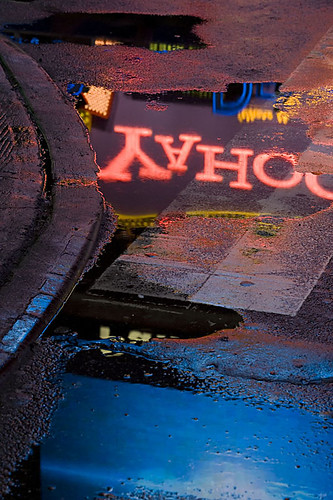
Or think about the potential nightmare of the post-net neutrality real estate market in a world of internet-organized neighborhoods, with users living in server- or website-centered communities. New Yorkers might choose to live in TriBeYa (Triangle Belonging to Yahoo!); San Franciscans could buy trendy lofts in The ComCastro; across the pond, Londoners would flock to the clean-scrubbed, hypernetworked streets of Mayfairspace. Just imagine the advertising fustercluck...no, on second thought, don't.

All of this fantastical speculation leads me to this question: if the internet has the power to reshape urban demographics, what power, if any, does urban design have to combat this kind of ideological, hypercommercialized isolation? I should probably have at least some semblance of an answer to close out this post. But I don't.

Any ideas?

Series Posts: Introduction; The New Agora; Communeconomics; The Phil Tadros Interview


Links:
Conclusion to Networked Publics (Varnelis.net)