Showing posts with label los angeles. Show all posts

7.23.2011

What Color is your City?

I found thecolorof.com this evening (via Curiosity Counts), which layers recent images from Flickr sharing a common tag over each other to create swatches that resemble abstract impressionist paintings. Naturally, I spent a bit of time trying out various cities. Many wind up very similar--red/gold on the bottom, bluish on the top--which I'm guessing has something to do with the preponderance of skyline photos. But the results for some are spot-on, and even downright gorgeous. A few favorites:


What color is your city?

5.27.2011

WEEKEND READING: May 21-27, 2011

Photo credit: saracino
Heading into a much-needed long weekend. Memorial Day means extra reading time!

ITEM ONE: Anyone who's familiar with the unique joy of finding an easter egg in a video game will love this week's leader--check out Repudo, a new app that turns the city into one giant easter egg hunt.

ITEM TWO: Humans are just so darned clever.

ITEM THREE: The Space Liberation Manifesto is a call to arms for anyone who wants to see digital public space protected from the kind of every-flat-surface-gets-a-sign mentality that has turned public space in the physical city into one long commercial break. (via @bruces)

ITEM FOUR: Nicolai reviews Rem's Cronocaos show, which is on the Bowery until next Sunday. Choice quote: "In the realm of preservation, as in so much else, we seem to have become a world terrified of too much direct contact with reality."

ITEM FIVE: Michael Maltzan actually makes Los Angeles sound palatable in an essay excerpted from his new book No More Play over at Design Observer. (The Iwan Baan pics don't hurt.)

ITEM SIX: Caleb Smith, aka the man who walked every street in Manhattan, shares one of the most meaningful (and under the radar) historical sites for him on the island he knows so well.

Weekend Reading is very multi-media this week, I'm just realizing. So enjoy the reading...and watching, and listening! Back next week with more urban-y goodness.

5.25.2011

Cartographic Diversion: An Illustration of Density

With 166 people per square mile, Honduras is in the middle of the pack as far as national population densities are concerned. But what would it look like if you packed every single Honduran into one city? As it turns out, it might look a lot like New York: both contain approximately 8.2 million people. Below are images of the administrative borders of the five largest cities in the US mapped onto the nations that most closely mirror their populations, all at the same scale. No big point to be made...just an interesting distraction for a Wednesday afternoon. Enjoy...

New York City: 8,175,133 -/- Honduras: 8,249,574

Los Angeles: 3,833,995 -/- Congo: 3,686,000
Philadelphia: 1,526,006 -/- Gabon: 1,475,000

Chicago: 2,695,598 -/- Oman: 2,845,000

Houston: 2,099,451 -/- Lesotho: 2,067,000

10.22.2008

The Valley Does Watts

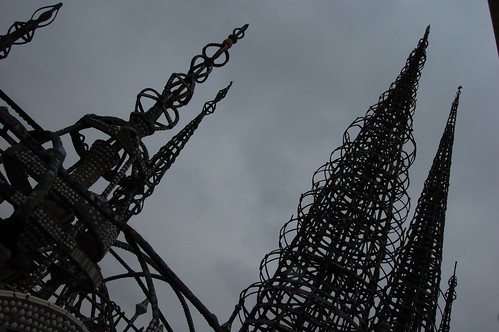
Pickle and Cake has this great video of a field trip of suburban LA residents to another suburb that happens to have this famous piece of outsider architecture. Of course, the trip is only noteworthy because of the "whites visiting the ghetto" angle, and the visitors to their credit are very honest about race and their perception of danger.

However, I was struck by something more trivial -- that as recently as 1994, when the video was made, people were still fascinated by light rail lines. So fascinated, that LA's (admittedly new) Blue Line shared top billing with the Watts Towers as the trip's main attractions. Even the ticket machines are an exciting and confusing part of the experience! And ticket machines, I think we can all agree, are really boring.

It's as if the scores of midwestern immigrants who settled in LA actually managed to produce children less urbane than they were. Reluctant metropolis indeed.


(Photo from Flickr user amycqx. The original full-sized color version can be viewed by clicking the photo.)

9.17.2008

A F%@$ing Break: Give me one, Please

It seems like every couple of weeks there's another city ranking list, and the extremely flawed methodology of each one is ever more extremely flawed than that of the list before it. Add to the pile: Forbes' recently-vomited-up list of America's Most Stressful Cities.

Obviously, I'm being melodramatic. And obviously, this means that I have some emotional stake in the results. So let's be done with it: Chicago topped the list. Which...I'm sorry, I have to laugh at that. Hard. Just last week, I was talking to a close friend about my growing desire to head out East, because Chicago has such a relaxed atmosphere. It's very casual here, and thus harder to get things done. A bit of procrastination is built into the way of life. Thus, working on more than a couple of projects at once gets more difficult. You feel almost pressured, in a weird way, to do less.

The merits and problems associated with this way of life are fodder for another discussion, but help to frame my reaction to Forbes' list. How, I wondered upon reading the article this morning, could this possibly be? And then, there it was, in the list of reasons Chicago placed so highly: "rising unemployment rate, expensive gas, high population density and relatively poor air quality."

I'll give them the rising unemployment. I'll even toss in an E for Effort on the air quality, even though it's really not that terrible. Wind blows a lot of our air pollution up to my good ole' hometown to the north, Milwaukee, giving the metro of only 1.7 million some of the worst air quality for a city in its size range. Milwaukee, in turn, dumps sewage into Lake Michigan, which then floats down to Chicago and closes our beaches (though this has been happening a lot less in recent years thanks to the Deep Tunnel project...but again, I digress).

Rising gas prices I had to roll my eyes at, because crowding issues on the CTA and Metra have been evidence of the fact that people are taking advantage of alternate options here. If anything, transit ridership should have been taken into account for determining stress in Chicago. Though it appears that these are metro area rankings (something Forbes is continually foggy about with its lists), so whatever.

But density?? This is a negative factor in determining stress? For my official position on this criterion, please refer to the title of this post.

I will grant -- as any pro-density advocate worth their salt will -- that there is such a thing as an unhealthy level of density. Chicago, my friends, comes nowhere near that level. There are plenty of residential high rises springing up around town, but it's hardly anything that you can compare to, say, the high-rise blocks of Hong Kong. Chicago has wide streets, many of them lined with trees. There is plenty of parkland, much of it well-maintained and relatively safe. As a friend once noted when visiting from New York, "My God, you can actually see the sky here."

Forbes' list is blatantly skewed toward older, more densely-populated cities (more commonly referred to by those with sense as "real cities"). Chicago is followed by New York, Detroit, Los Angeles, and San Francisco, with San Diego, Cleveland, Salt Lake City, Providence (yes, seriously), and Philadelphia finishing things out. Only one of these cities, you'll note, is not located in the older, more highly-urbanized Northeastern and California Coast regions.

Density wasn't the only thing to play a part, but it had a noticeable effect on the outcome. At any rate, this seems to be a better indicator of stress levels. I'll take living in a high-rise over living on the freeway any day of the week. Now excuse me, I have to o relax.

8.23.2008

3000 Broadway

Sure, all major cities look big and dense at their cores. But how do they compare a bit further out? Where's got some (admittedly loose) comparative urbanism for ya's today: aerial images of the address 3000 Broadway in America's nine largest cities -- #10 San Jose has no like-named street. (For the record: Philly's is from 3000 Broad Street, and Dallas' is from 3000 Broadway in the suburb of Garland, since the address does not exist in The Big D proper).

New York City, NYLos Angeles, CAChicago, ILHouston, TXPhoenix, AZPhiladelphia, PASan Antonio, TXSan Diego, CADallas, TX

7.08.2008

Kotkin Kabob'd

On principle, Where does not link to any article containing Joel Kotkin's canned, willfully ignorant whinnying about how cities suck and suburbs are, like, totally awesome, bro. But Where does link to Bill Fulton's skillful and thorough skewerings of said whinnying. In fact, it does so with great aplomb.

And now I'll stop writing about this blog as if it's a sentient being.