Showing posts with label rio de janeiro. Show all posts

10.15.2011

A Modest Proposal...


A few years ago I made a series of hackmaps, using Google Earth to cobble together a few visualizations of alternate urban realities. I'd always planned to post some of the better ones to Where, and never got around to it. Recent events, however, made me think that there was one  in particular that was worth sharing.

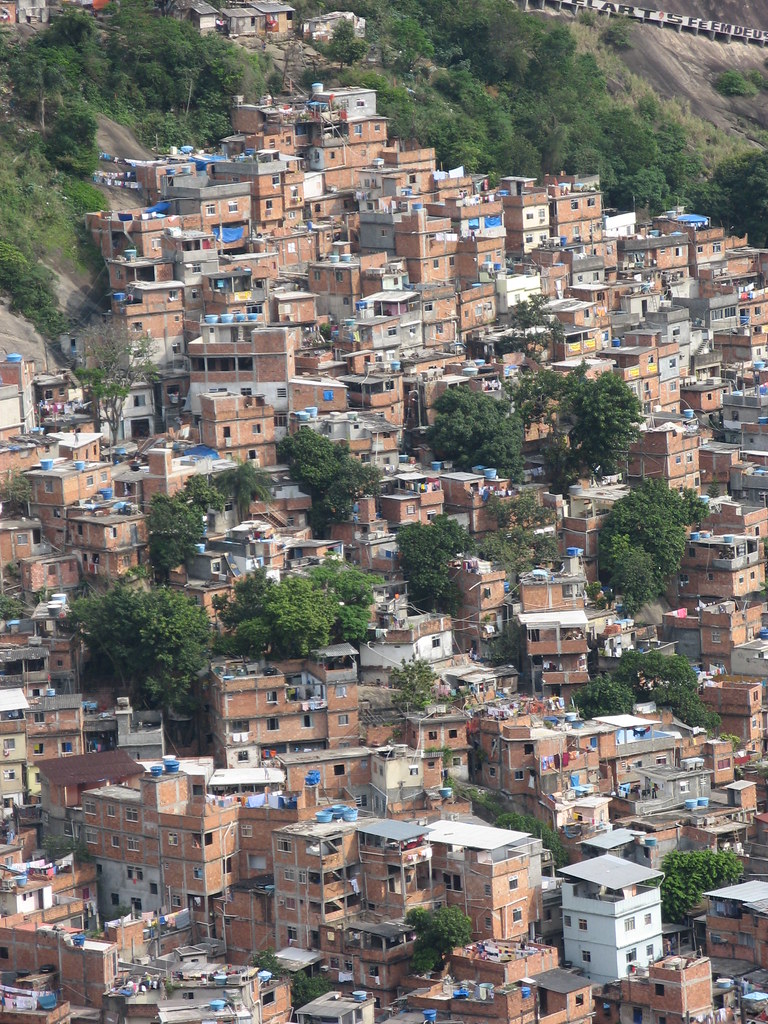
The image above was created in the fall of 2008, right as the financial meltdown was getting white-hot. The idea that the wizards of Wall Street should share their posh financial district with a Rio-style favela seemed fitting, given the number of people who were suddenly finding themselves homeless. Luckily, there was a huge hole in the ground right next door.

The site may have been overly ambitious, but it's good to see that some people have been feeling the same way.

12.31.2008

Considering Urban Retail: A Re-post at the Crossroads

As we head into 2009 with economists predicting the closing of as many as 73,000 retail locations across the United States due to dismal holiday sales, it seems like a good time to look back at one of Where's most popular posts from last year, "The Possibilities of the Post-Retail City," originally published in August of '07.


I just had my first exposure to Reverend Billy, the leader of the Church of Stop Shopping. After reading a Polis post about the Reverend's anti-consumerist group, I thought it was an actual church. To which I said: "Oh, excellent.

Of course, the CoSS is actually an act, with the "Reverend" being the stage persona of NYC performance artist Bill Talen. It's a send-up of streetcorner preachers and televangelists, and it sounds hilarious. Better yet, there's a point! Reverend Billy preaches against corporatist architecture and urbanism, advocating for sustainable, walkable communities with local economies. And while the site does pay lip service to independently owned local businesses, it is the Church of Stop Shopping, and one of their taglines is "Love is a Gift Economy!" Obviously, these people think that there are better ways for us to use all of that street-level retail space.

And that got me thinking: if there were no major retail chains and independents had to hold up the local economy, what would we do with all of that ground-floor space? Indeed -- and my upbringing in a capitalist society may shine through right here -- but where would we walk to? Certainly, there are plenty of places that we walk every day, but a large amount of pedestrian traffic is genereated by shoppers. And while it's not a requirement for these ground-level spaces that make up our streetscape be places of commerce, their presence is utterly vital to functioning neighborhoods. Often (these days) even moreso than upper-level residential windows, storefronts are the Jacobsian "eyes on the street" that act as a natural deterrant to crime.

Shopping is also a huge part of the social life in many (if not most) contemporary cities; in fact, that's just what Reverend Billy and his fake church take issue with. And whether or not you agree with the Church of Stop Shopping (or, as I'm sure many do, find it outright offensive), it's interesting to imagine a world in which shopping took a back seat to other social spaces as the dominant street presence. Imagining Paris without the Champs-Elysées or New York without Park Avenue sparks a giddy, no-holds-barred creative energy akin to imagining those cities in a work of science fiction or postapocalyptic literature.

To get an idea of what might fill the void, it might be interesting to see how social space is structured in places where gift economies (or at least barter systems) often already exist and retail strips are few and far between, at least in the traditional sense: slums.

An article from Forbes, mentioned briefly in a previous post at Where, described the socioeconomic situation of many older, established slums in Asia and South America thusly: "Many slum dwellers are in fact entrepreneurs, albeit writ very small. They recycle trash, sell vegetables, do laundry. Some even run tiny restaurants and bars for their neighbors." So while there are no Ginza Districts in the favelas of Rio, there is a social commerce to such places. Restaurants and bars remain important components of the neighborhood, which makes good sense; people have always come together over food and drink, and will continue to do so regardless of any freak evaporations of the retail sector.

Another thing that brings people together is knowledge -- or, more specifically, the exchange thereof. Another recent post covered McGill University's Edible Cities project in Kampala; the site for the students' project "includes a low-lying wetland area...where a youth cooperative practices brick-makings, providing work for otherwise unemployed youth...and a sloping dryland area where farming is [practiced]." While this is a very rural area being discussed (albeit in the context of a larger city), the Kampala site illustrates two more possible uses for a retail-less streetscapes: public workshops (which could cover a variety of topics in addition to brickmaking) and storefront hydroponic community gardens.

Heh.

If the second option seems somewhat far-fetched, the first is hardly at all; in fact, in the face of looming irrelevance in the digital age, libraries around the world are starting to take on a more social role in their respective cities, staging various events and programs to encourage public discourse and teach skills that cannot be learned with a mouse and keyboard. One of the most innovative library programs that I've heard of recently is in Medellín, the second city of Colombia.

Once the so-called Kidnappping Capital of the World, Medellín has made more news recently for building five spectacular modernist libraries (like the one in Santo Domingo Savio, pictured above) in its most impoverished barrios. One of the programs to utilize these new libraries -- which are equipped with computer labs full of brand spankin' new computers -- is HiperBarrio, which teaches teens in the barrios how to use blogging and other social media tools as a creative outlet for self-expression. Juliana Rincon, one of the founders of HiperBarrio, spoke of the program's inspirataion in a recent interview with Global Voices Online, saying, "It was amazing...telling these kids about blogs and finding out that they had no idea that there was something like a blog, that they existed. [Or even] that you could write online and have a virtual space to keep your writing, the videos you like, and pictures." Libraries, in this case, serve not just as containers for information, but as catalysts for the creation of new information and new ideas. Certainly, this kind of social space, the place of public learning, will play an increasingly important role in cities as we continue through the Information Age.

Whatever we come up with to fill storefronts and social spaces, shopping districts and neighborhood retail strips are unlikely to disappear within the lifetime of anyone reading this blog post. Still, imagining a world without retail can tell us a lot about how we use cities, why we do things the way that we do, and how we can improve urban places without courting Starbucks and Barnes & Noble for civic salvation. In fact, picturing your neighborhood without any shops selling anything other than necessities might be a great way to fall in love with the place all over again. That is, of course, assuming that you love your neighborhood -- and that you don't live off Rodeo Drive.

----------

That's all for now, folks. Best of luck to everyone in 2009. Let's hope it's not as bad as we're all worried it's going to be.

(Photo from Flickr user galitagreeneyes. The original full-sized color version can be viewed by clicking the photo.)

4.13.2008

Urbanffffinds 026

So what I actually meant when I said "no new posts" was "no new long, fancy-pants psuedo-philosophical ramblings." Urbanffffinds is too fun to put on hiatus. Besides, the crop this week is hot. And so:


3.14.2008

WEEKEND READING: March 8-14, 2008

Lots of good stuff this week, but Item One is a must-read for everyone.

ITEM ONE: This week marked the (unfortunately early) end of South Central Tour, a fantastic, photo-rich blog documenting an epic trip through South and Central American cities with two infamous street artists, Above and Ripo. Take a look back through the group's stops in Rio, São Paulo, Buenos Aires, Santiago, and a bucketload of other cities. (Photo credit)

ITEM TWO: Speaking of South American cities, here's a great article on the idealism, overpopulation, and developing crime problems of Brasilia.

ITEM THREE: Kazys wins for title of the week -- "Take the bus to the internet." The post doesn't disappoint.

ITEM FOUR: Another literary excerpt from Archidose, this one examining the struggle between technology and nature in architecture and urbanism.

ITEM FIVE: Space & Culture provides some great links about "desire lines."

ITEM SIX: Another eloquent commentary on how cities can be used to combat global warming. (Via Civic Nature).

ITEM SEVEN: Karrie Jacobs goes searching for the soul of Times Square, with interesting (and, of course, beautifully-written) results.

Traffic has been abnormally high lately at Where; thanks for the great week. Now you have a great weekend.

11.08.2007

World Urbanism Day

In honor of World Urbanism Day (aka Town Planning Day), I thought it would be interesting to take a look at what might become of some of the world's great cities if global warming's worst case scenario came to pass. Scientists estimate that, were all of the ice caps and snow pack on earth to melt, the sea level would be somewhere between 230-260 feet (70-80 m) higher than it is today.

While no one reading this post is likely to see this kind of damage, it's interesting to imagine what today's cities would look like in such a radically different world -- but the scale is so vast that it's hard to fathom. The following is a simple visualization of the landscapes of twelve major coastal cities around the world in three imagined futures: red overlays represent areas that will be submerged after a 50 foot (15.2 m) sea level rise; orange overlays represent areas submerged after a 150 foot (45.7 m) rise; and yellow overlays represent areas submerged after a full 250 foot (76.2 m) rise. The colors represent the fire-like spread of the ocean inland. Take these pictures for what you will; they are what they are.

While many of the cities represented were included for their global importance today, the visual impact of the colored overlays played a big part in determining what cities made the list. The numbers below each square image describe the approximate length of one side in miles/kilometers.


New York City, United States
(74.5/120)


Montreal, Canada
(54.7/88)


Rio De Janeiro, Brazil
(26/42)


Abidjan, Côte d'Ivoire
(28.6/46)


London, Great Britain
(16.8/27)


Stockholm, Sweden
(22.4/36)


Istanbul, Turkey
(22.4/36)


Mumbai, India
(53.4/86)


Sydney, Australia
(22.4/36)


Hong Kong, China
(18.6/30)


Pyongyang, North Korea
(20.5/33)


Tokyo, Japan
(83.9/135)


------------------------


The images above were created using Google Maps and a filter from Hey What's That dot com.


Links:
World Urbanism Day (Wikipedia)

Google Maps

HeyWhatsThat.com (EDIT: I found a direct link to the tool that I used.)

8.13.2007

The Possibilities of the Post-Retail City


I just had my first exposure to Reverend Billy, the leader of the Church of Stop Shopping. After reading a post (over at Polis) about the Reverend's anti-consumerist group, I thought it was an actual church. To which I said: "Oh, excellent.

Of course, the CoSS is actually an act, with the "Reverend" being the stage persona of NYC performance artist Bill Talen. It's a send-up of streetcorner preachers and televangelists, and it sounds hilarious. Better yet, there's a point! Reverend Billy preaches against corporatist architecture and urbanism, advocating for sustainable, walkable communities with local economies. And while the site does pay lip service to independently owned local businesses, it is the Church of Stop Shopping, and one of their taglines is "Love is a Gift Economy!" Obviously, these people think that there are better ways for us to use all of that street-level retail space.

And that got me thinking: if there were no major retail chains and independents had to hold up the local economy, what would we do with all of that ground-floor space? Indeed -- and my upbringing in a capitalist society may shine through right here -- but where would we walk to? Certainly, there are plenty of places that we walk every day, but a large amount of pedestrian traffic is genereated by shoppers. And while it's not a requirement for these ground-level spaces that make up our streetscape be places of commerce, their presence is utterly vital to functioning neighborhoods. Often (these days) even moreso than upper-level residential windows, storefronts are the Jacobsian "eyes on the street" that act as a natural deterrant to crime.

Shopping is also a huge part of the social life in many (if not most) contemporary cities; in fact, that's just what Reverend Billy and his fake church take issue with. And whether or not you agree with the Church of Stop Shopping (or, as I'm sure many do, find it outright offensive), it's interesting to imagine a world in which shopping took a back seat to other social spaces as the dominant street presence. Imagining Paris without the Champs-Elysées or New York without Park Avenue sparks a giddy, no-holds-barred creative energy akin to imagining those cities in a work of science fiction or postapocalyptic literature.

To get an idea of what might fill the void, it might be interesting to see how social space is structured in places where gift economies (or at least barter systems) often already exist and retail strips are few and far between, at least in the traditional sense: slums.

An article from Forbes, mentioned briefly in a previous post at Where, described the socioeconomic situation of many older, established slums in Asia and South America thusly: "Many slum dwellers are in fact entrepreneurs, albeit writ very small. They recycle trash, sell vegetables, do laundry. Some even run tiny restaurants and bars for their neighbors." So while there are no Ginza Districts in the favelas of Rio, there is a social commerce to such places. Restaurants and bars remain important components of the neighborhood, which makes good sense; people have always come together over food and drink, and will continue to do so regardless of any freak evaporations of the retail sector.

Another thing that brings people together is knowledge -- or, more specifically, the exchange thereof. Another recent post covered McGill University's Edible Cities project in Kampala; the site for the students' project "includes a low-lying wetland area...where a youth cooperative practices brick-makings, providing work for otherwise unemployed youth...and a sloping dryland area where farming is [practiced]." While this is a very rural area being discussed (albeit in the context of a larger city), the Kampala site illustrates two more possible uses for a retail-less streetscapes: public workshops (which could cover a variety of topics in addition to brickmaking) and storefront hydroponic community gardens.

Heh.

If the second option seems somewhat far-fetched, the first is hardly at all; in fact, in the face of looming irrelevance in the digital age, libraries around the world are starting to take on a more social role in their respective cities, staging various events and programs to encourage public discourse and teach skills that cannot be learned with a mouse and keyboard. One of the most innovative library programs that I've heard of recently is in Medellín, the second city of Colombia.

Once the so-called Kidnappping Capital of the World, Medellín has made more news recently for building five spectacular modernist libraries (like the one in Santo Domingo Savio, pictured above) in its most impoverished barrios. One of the programs to utilize these new libraries -- which are equipped with computer labs full of brand spankin' new computers -- is HiperBarrio, which teaches teens in the barrios how to use blogging and other social media tools as a creative outlet for self-expression. Juliana Rincon, one of the founders of HiperBarrio, spoke of the program's inspirataion in a recent interview with Global Voices Online, saying, "It was amazing...telling these kids about blogs and finding out that they had no idea that there was something like a blog, that they existed. [Or even] that you could write online and have a virtual space to keep your writing, the videos you like, and pictures." Libraries, in this case, serve not just as containers for information, but as catalysts for the creation of new information and new ideas. Certainly, this kind of social space, the place of public learning, will play an increasingly important role in cities as we continue through the Information Age.

Whatever we come up with to fill storefronts and social spaces, shopping districts and neighborhood retail strips are unlikely to disappear within the lifetime of anyone reading this blog post. Still, imagining a world without retail can tell us a lot about how we use cities, why we do things the way that we do, and how we can improve urban places without courting Starbucks and Barnes & Noble for civic salvation. In fact, picturing your neighborhood without any shops selling anything other than necessities might be a great way to fall in love with the place all over again. That is, of course, assuming that you love your neighborhood -- and that you don't live off Rodeo Drive.

(Photo from Flickr user galitagreeneyes.)


Links:
Rev. Billy Ready for Close-up (Polis)

The Church of Stop Shopping

Two Billion Slum Dwellers (Forbes)

Kampala Project Information (McGill School of Architecture)

Red de Bibliotecas (en español)

HiperBarrio: Local Stories, Global Audience (Global Voices Online)

7.13.2007

WEEKEND READING: July 7-13, 2007


Took me a while to get to it this Friday, but here they are: little cures to the boredom of that hour between when the hangover-related nausea wears off and when you have to get ready to go out again.

ITEM ONE: A rosy review of The Great Neighborhood Book: A Do-it-Yourself Guide to Placemaking, which has quickly jumped to the top of my reading list.

ITEM TWO: BLYGAD gives a damn about the Clean Hub.

ITEM THREE: NYC considers a closed-circuit surveillance network for the city modelled after the one credited with thwarting the London bombers.

ITEM FOUR: Wallpaper* has come up with the coolest architecture site on the internet (via Archidose)

ITEM FIVE: Even more exciting architecture-related news -- the world may be getting another Louis Kahn building. (There are far too few.)

ITEM SIX: NewScientistTech speculates on the importance of preparing for the coming hoardes of urban migrants in Asia and Africa by installing infrastructure before they show up.

ITEM SEVEN: Rio's infamous favelas are getting an overhaul. (There might be an upcoming Conscious Urbanism post on this...in the meantime, here's another great article on the subject.)


Oh, what a week this was. It's time for some R&R, right? See you next week!

(Photo from Flickr user joleetraveller.)