4.09.2009

The Image of the (Failed) City


With all due respect to Mr. Raymond Chandler, everyone knows Tijuana is Mexico. In fact, Mexico itself is turning into something of a Great Big Tijuana. Tijuana has gone from nasty spot on the National Conscience to pin-up city for the postculturally advanced. The term tijuanización, or tijuanization, became popular in the 1930s, as a slur against whatever had become Americanized and thus uglified. Tijuana, nonetheless, has turned its ugliness into an asset. (If you don’t believe me, just do a search on this blog for Teddy Cruz).

This is not the case of Ciudad Juárez, though, the oldest of the Mexican border cities. No one refers to Juárez as CJ. Juárez is Tijuana without the sites. Ciudad Juárez has to be the most infamous of Mexican border cities (it doesn’t get much worse than that). Throughout its history, the town had thrived on a seedy reputation, but in the 1990s Juárez found itself overwhelmed by an apocalypse-now, scarier than fiction whirlwind: bodies of hundreds of murdered women dotting its barren outskirts, sprawling slums (sardonically nicknamed Cartolandias, Cartonlands, with a distinctively Disney ring), extralegal radioactive waste heaps and random killings at narco-clubs and midday drug-related violence. Common knowledge has it that the city is one big wreck; consumed by rampant corruption, poor planning, environmental degradation, and social fracture.

Robertos Bolaño’s 2666—which Time magazine named “best book of 2008” (I myself described the novel as “ball-grabbing”)—has recently put Juárez in the limelight:

The city was very poor, with most streets unpaved and a sea of houses assembled out of scrap…they discovered rail lines and slum soccer fields surrounded by shacks, and they even watched a match, without getting out of the car, between a team of the terminally ill and a team of the starving to death, and there were two highways that led out of the city, and a gully that had become a garbage dump, and neighborhoods that had grown up lame or mutilated or blind, and, sometimes, in the distance, the silhouettes of industrial warehouses, the horizon of the maquiladoras. The city, like all cities, was endless.


Local authorities and planners have been dealing this sort of bad press (usually it’s less exquisite) for quite some time now. A couple of years ago, Juárez’s Tourist and Commercial Development Secretary launched a “Juárez Presentations Network”, a tour of promotional talks and events, as the latest of a long chain of strategies to revert the city’s “bad image”. The campaign was to present “the best of the town” in order to attract tourists by highlighting Juárez’s “values” and “cultural attractions”. For city leaders, Juárez’s main problems are conveniently reduced to a perception issue. The image of the city—not in the classical sense, in terms of readability or spatial recognition proposed by Kevin Lynch, but in terms of more recent, superficial, “urban marketing” trends—has become the pet cause and the focus of practically every policy instance.

This obsession with the image of the city has become evident in all sorts of urban actions, that range from the absurd confiscations of banned videogames that fail to show the “true values” of the city, to the serious and cynical discrediting and blaming of the families of murdered women and various social organizations for “promoting a degrading vision” of the city. What is most disturbing and revealing, though, is that this visual consumption strand of local urban policy is actually deep-rooted, that it has been at the center of planning in Juárez for decades. In my next couple of posts I’ll try to untangle the logic behind this focus and shed some light on the reasons for the supposed failure of urban “rescue” efforts in the city.


(Photo from Flickr user detritus. The original full-sized color version can be viewed by clicking the photo.)

4.08.2009

The Problem in the Process


It seems as though there is little or no innovation in architectural and urban design representation in a period where new mediums are changing everything, everyday. Graphic designers are having a field day, but architects and planners can't seem to kick the tired tools they have been using for decades. Sure, we've got animations and digital collages, but rather than experimenting with these new forms of presentation and creating new avenues of communication to further the technique, we simply perfect it and replicate it. In every office, there is the rendering guy, who pumps out the same graphic everyday using the same technique, same scale figures, same trees.

It makes me tired; tired of looking at renderings, tired of seeing the same thing over and over. I understand that architecture and planning are businesses, so efficiency is important. But while it's efficient to do the same thing over and over, few realize (or seem to care) that it comes at the cost of creating new things. We are creative professionals, and our job is to create new things. And yet, we've been backed into a corner where we continually provide regurgitations of our past work. The motto has become: figure out what works, then rinse and repeat. Isn't this new "creative class" just a revamped industrial working class? Go to work in a factory, put wheel on car, put wheel on car, put wheel on car. Go to studio (aka trendy cubicle), attach your ideas to things, make graphic, make graphic, make graphic.


We live in a time where the creation of NEW ideas is more important than trying to spread them. Last century I would have to write 11 books and build 20 buildings to voice an idea. Today I can create a completely new genre of video and by Friday half the world could see it. I can come up with an idea, and tomorrow it could stream across an LED screen in Tokyo. Every single day I watch a new music video that was made using a completely different technique that I've never seen before, and it amazes me.


One might suggest that urban design has a far greater effect on humanity than a music video, and therefore requires much more research and dependency on what we know works, but this also suggests that the future will bring the same problems that yesterdays tools solved. Do you believe that? We cling to new types of networks, social and professional, exalting their efficiencies, but don't ourselves, become networks. Networks pull from many different inspirations, and like a concert conductor, creating an ever-changing rhythm that intensifies and fluctuates. We don't do this; we still act like grids. We pull from one set of ideas, we use one process, one set of tools, and then we repeat.


One can't deny that there is innovation in Arch and Urb. Cutting edge firms are collaborating with ecologists, programmers, and other professionals to create new work. But these firms are the exception, not the rule, and the majority of them are spawned by the same two or three camps (guess who.) Out of a hundred competition entries, 99 of them are the same crap. An earlier post about the competition to design a new building for the Smithsonian Museum of African American History and Culture, and when I looked at all the entries, none of them struck me as new or unique, or innovative. Kahinde Wiley burst onto the art scene a couple years ago, skyrocketing to stardom, changing the art game by depicting hip hop figures in a whole new light using a medium that has been around for centuries. And all of these competition entries seem to miss that in their representation. The representation should not just be a firm branded technique, but it should be dictated by the project and should illustrate the same values and ideas that went into the project. Photoshop and 3DS aren't the only tool imaginable to do this? In design studios, professors structure their classes in accordance with the techniques and process they've dictated as the best for representing an idea. "First we're going to make diagrams like this, than we are going to build a model using these materials, then we are going to make drawings that look like these drawing here, then you'll make a poster that looks like these posters I did a few years back. Here is a list of architects who you should imitate because they are doing it right." Why are these the rules? Is there only one way to solve a problem and represent a solution? I understand it's valuable to learn a method of representation however Studio is about learning to develop a project and the process for each project should not be dictated by a method or a pre-determined process but a process that grows out of the project context. This is where innovation lies waiting. The biggest complaint I hear from urban designers is the lack of a defined tool set because the profession is so young. In reality, there isn't a toolbox, everything is a tool and there are infinite uses for each one. I'm sick of hearing "this is what firms want, this is what clients want," none of us are getting jobs in the next 10 years unless we create something new.


(Photos from HMS Europe, Ancestry, Tedtalks Ning, Washington Post and the Columbus Museum.)

4.07.2009

Slumchitecture

While policymakers — backed by real estate developers, the development industry, and the pressures of global capitalism — are pushing slum redevelopment models that replace informal settlements with high-rise blocks, some urban practitioners are using slums as models for redeveloping decaying neighborhoods in the West.

Architect Teddy Cruz drew on design elements he observed in the shantytowns of Tijuana to inform a redevelopment plan aimed at reintegrating poor immigrants into the fabric of a gentrifying town in Hudson River Valley. He previously incorporated Tijuana's lessons into a design for a residential complex for Latino immigrants near San Diego.

Cruz is one of a growing number of architects and other professionals looking to informal settlements for lessons on good urban design. These practitioners point out that, for all their deprivations, slums exemplify many of the textbook qualities that make up strong urban environments: low-rise, high-density, mixed use. They are home to well-functioning public spaces, heterogeneous communities and aesthetically interesting spaces. They promote safety by channeling "eyes on the street."

In an age where sustainability is the keyword, slums are "green" in their efficient use and reuse of materials for construction and livelihood activities. They are highly walkable, often represent optimal utilization of space and are easily adaptable to changing user needs.

Some have also argued that the decentralized, informal production processes and blending of live-work spaces that slum typologies allow represent a restructuring in line with the demands of a post-industrial economy.

In February, no less than Prince Charles lauded Dharavi — a vast slum in central Mumbai that he visited in 2003 and has since become the focus of a multi-billion dollar redevelopment plan — as a healthy antidote to built environments created through a "brutal and insensitive process of globalisation." He suggested that "it may be the case that in a few years’ time such communities [as Dharavi] will be perceived as best equipped to face the challenges that confront us because they have a built-in resilience and genuinely durable ways of living.”

It seems that slums are the new utopian landscapes — and they couldn't be more different than the neat segmentation and uniformity of the previous generation's suburban and modernist dreams.

While the West is trying to recapture something lost, many slum inhabitants can't wait to get out. Slum residents who are relatively wealthy, better educated and young and who live in well-developed slums in cities where building-living is the norm (which are also the ones that designers are emulating) often strive for the privacy, social mobility and security that high-rise buildings connote. On one hand, you can argue that their face-value aspirations are unreliable because they have not been presented with another version of what it means to be modern, middle-class and legal. But all of our preferences and judgments are similarly socially conditioned. Is this a case of "you don't miss it 'till it's gone"? Or is the grass always greener?

Equally eager to leave slum settlements are those on the other side of the spectrum from Dharavi, where there is no public space to speak of, no more than half of the family fits in the house at a time, and you risk getting hit by a train or falling off a water pipe when you go outside. Although such places remind us of people's capacity for ingenuity and survival and can be aesthetically interesting, no one actually wants to live here.

There are many places in between, and overall, I would guess most inhabitants of slums would prefer to preserve their current settlements and stay in ground-floor structures that they can increment over time. And there's a lot to learn from these well-functioning, organic neighborhoods.

Those who use "slum" as a blanket term to connote blight and justify self-serving solutions ignore the diversity among slums and the strengths that many already possess. However, those admiring the forms of certain types of slums should also not glaze over the diversity of slum environments — as well as the people who live in them — to make their point. Let's hope that this wave of excitement about "slumchitecture" does not lead to superficial conclusions, but rather that it energizes debates and generates perspectives that can create better cities in both proverbial hemispheres.

(Photos by Katia Savchuk. Image of Teddy Cruz's model from the New York Times.)

4.06.2009

Is the Past Almost All Right?


The old proverb, “May you live in interesting times,” is usually interpreted as a curse rather than a blessing. Lately, financial collapse, climate change, and the looming threats of food and energy crises have all done their part to make these times more interesting for cities. As a result, the popularity of concepts like sustainability has never been higher.

The biggest problems for cities today—the ones mentioned above—all stem from humans’ impact on the environments in which they live, and especially their consumption of resources. The term “sustainability” addresses that set of problems, but it’s generally used to mean two vastly different things. The first definition involves consuming resources more efficiently and more cleanly in order to maintain a given standard of living. The second involves cutting society’s resource consumption to a level that won’t exhaust those resources in the long run. The former definition, it seems, is not truly “sustainable”—the more efficiently we can provide ourselves with food and energy, the more food and energy we’re likely to consume. If everyone’s car gets 1000 miles to the gallon, the long distance commute becomes a more attractive option and total fuel consumption does not decrease much (although that consumption would be more efficient).

Reducing resource consumption to a truly sustainable level, however, holds more promise. Environmental problem-solving often takes the form of technological innovation, and such innovation has a crucial role to play. The other side of the coin, though less enticing in many ways, is “old” technology. At any given time, the human race has its entire history at its fingertips, and there’s no reason why a society shouldn’t cherry pick the very best aspects of each bygone era for incorporation into the present world. This is already done to some extent—there are many ways of doing things that never went away—but it’s harder to bring something back once it disappears, and sometimes a new innovation threatens to displace something low-tech that works fine. Why send a Segway to do a bike’s job?

Plenty of new technologies will have instrumental roles in bettering our world, as they always have, but when we talk about sustainability today, we should look to the past as closely as we look to the future.


(Photo from Flickr user lmapix.)

4.04.2009

Regional Distributions

Photo of suburban housesMuch has been made of suburban change in light of the subprime mortgage crisis. Articles such as What Will Save the Suburbs? and The Next Slum? offer new ways of looking at suburbs, with important implications for cities. A post at Design Observer by Andrew Blauvelt (co-curator of the Worlds Away: New Suburban Landscapes exhibition currently on view at the Yale School of Architecture) offers an interesting perspective on these issues.

Blauvelt finds that suburbs are taking on qualities commonly associated with cities, and vice versa. For example, suburbs see increasing diversity, congestion, and poverty as cities experience gentrification, detached housing, and chain stores. Blauvelt considers cities and suburbs mutually dependent, both from physical and psychological perspectives. He explains that "[c]ity dwellers and suburbanites need each other to reinforce their own sense of place and identity despite ample evidence that what we once thought were different places and lifestyles are increasingly intertwined and much less distinct."

While ideas about cities and suburbs take many evolving forms, their spatial relationship is fairly constant. At a basic level, suburbs are defined by their location on the outskirts of cities. They could be thought of as a gradient between areas of more and less human density. Modern transportation spreads this gradient, like spray-painting a dot on the wall from a distance. What if the density equation were inverted to resemble a spray-painted ring? Or if we were dispersed like stars across the sky? What cultural and ecological changes might take place in the absence of dense urban centers?

(Photo credit: East Hampton Historical Society)

4.02.2009

Technology: Personal or Public?


“Any technology tends to create a new human environment... Technological environments are not merely passive containers of people but are active processes that reshape people and other technologies alike.”

Marshall McLuhan

* * *

It’s a worthwhile exercise to periodically consider why the much-maligned personal automobile is, in fact, maligned. The effort will likely yield such adjectives as expensive, dangerous, pollutant, isolating, frustrating and sprawl-inducing. Amazingly enough, however, the advantages of cars used to get all the attention. One hundred years ago, the car’s invention started a transportation revolution while becoming the symbol of American freedom, convenience and progress.

Today, most people have been around cars their whole lives. The magic has largely worn off and the auto industry currently epitomizes the deepest woes of the US economy. Computers and their accompanying innovations, on the other hand, have seized the mantle of progress that cars once proudly possessed. The benefits of computing, and especially the Internet, have produced a worldwide cultural shift that’s at least as enormous as the one cars created.

Computers and cars have plenty in common. Both have an isolating effect—one removes the traveler from the public realm while the other replaces (and simulates) many forms of face-to-face contact. Both cost plenty of money—a lump sum for the initial purchase and a limitless series of repairs, upgrades and modifications. And finally, both became, in different eras, a form of personal expression and a virtual extension of self for their owners.

Cities can’t avoid expressing the effects of widely-adopted technologies. The impact of cars on cities is obvious and well-documented; the impact of computers and global connectivity less so (interest in the latter is booming, though—see Kazys Varnelis and his Network Architecture Lab, for example). Despite their behind-the-scenes nature, one manifestation of computers in urban landscapes seems more visible than the rest—the internet café.

Internet cafés abound in European, Asian and Latin American cities, but are curiously scarce in the United States. They offer a bustling, communal (if not exactly social) alternative to a city full of people inside their homes, alone in front of their computers. It’s a bit of an exaggeration to say, but the internet café’s urban presence appears inversely related to individual car ownership and usage. In a society as affluent and individualistic as the United States, it makes sense that many would prefer owning something and fully controlling it instead of paying to use it in public. Like mass transit, internet cafés offer the benefits of use without demanding the steep costs of ownership or the hassle of maintenance, and in a public setting to boot. Reaping those rewards just requires that we relinquish total control of the item in use. In an age when a single hard drive, iPod or email account can store all the data most will ever amass on their computers, we’d do well to recognize that ability as the privilege that it is.


(Photo from Flickr user thw05.)

3.30.2009

The Value of Scarcity

Urbanization is caused, at least in part, by scarcity. Certain resources are limited, and thus more efficiently used in a communal setting. Through urbanization, more people have access to these resources than would if settlements were less densely populated. This is true of everything from intangibles like creativity to more solid things like water and electricity, which are more cheaply and easily distributed to dense urban areas than rural places. Cities are often trumpeted these days as "the solution" to the challenge posed by global climate change because of this very phenomenon; as energy sources become more scarce, the efficiency of densely populated cities becomes the most viable way for developed nations to maintain a high standard of living while simultaneously reducing energy usage.

A recent article by Thomas Friedman gave me pause because of its implications for the scarcity of energy. Two weeks ago, Friedman wrote about a laboratory in the Bay Area that is optimistic about its ability to make cold fusion power a reality within the next decade. This claim has, of course, been made before, and as Friedman quips, such revolutionary technologies tend to be "20 years away and always will be." The successful commercialization of cold fusion would, at least in theory, solve the problem of the scarcity of energy once and for all; assuming that it were actually only ten years away, what would this mean for cities? How would patterns of urbanization change if energy were not an issue?

On the one hand, an endless supply of cheap, safe, clean energy would make currently-cost-prohibitive technologies like mag-lev trains and supertall skystrapers (we're talking about the kind of buildings that would make the Emirates blush) much more feasible. Mag-lev trains, in particular, would present an interesting challenge to cities by opening up an even more vast range of the exurban hinterlands to development. With the density-related benefits of energy rendered moot, how would urbanists need to re-think their arguments in favor of high-density urban cores?

On the other hand, it could be argued that the end of energy scarcity would make developed world-conditions in currently-developing countries much, much easier to achieve. This would be a massive economic boon to lower-income and impoverished people around the world, freeing up people previously locked into cycles with few or no opportunities for advancement, greatly accelerating the growth of the Creative Class across the globe. Innovation-intensive fields tend to encourage clustering, as Richard Florida has argued so thoroughly in his books, meaning that a massive shift like the advent of cold fusion power might actually be a boon to urbanism.

Whether or not cold fusion is possible within the foreseeable future, the idea that it is challenges some of the most basic tenets of urbanist thought. What might we learn about how contemporary cities work if we were to give such a seismic technological shift some serious thought? What value does the scarcity of energy -- or any resource -- have for cities?


(Photos from Where@FFFFOUND!. The originals can be viewed by clicking the photos.)

3.27.2009

Thinking Outside of the Box on the National Mall


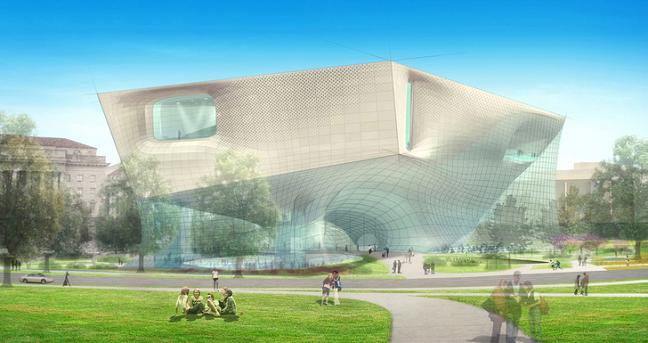
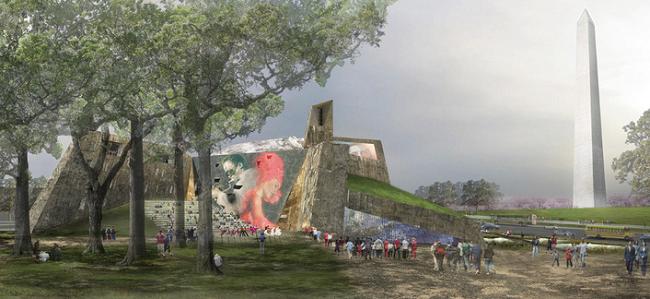
Submissions have just been unveiled this afternoon for six innovative entries in a competition to design the planned Smithsonian Museum of African American History and Culture, a $500 million project scheduled to open in 2015. The six competing teams are: Devrouax & Purnell with Pei Cobb Freed & Partners; Foster and Partners with URS; Diller Scofidio + Renfro with KlingStubbins; the Freelon Group, Adjaye Associates and David Brody Bond with SmithGroup; Moshe Safie and Associates with Sultan Campbell Britt & Associates, and Moody Nolan with Antoine Predock Architect.

Above is a rendering of Diller Scofidio + Renfro and KlingStubbins's avant garde submission; a rendering of Moody Nolan and Antoine Predock's proposal is below. Looks like the Smithsonian -- a fairly traditional institution, when it comes to architecture -- is planning to give the National Mall a bit of archi-juice. And we thought the National Museum of the American Indian's building was a departure!

It's always refreshing when, once in a blue moon, all of the entries in a competition are genuinely interesting, no?

(Photos from the Washington Post.)

Rickshaws and Good City Form

There is no more recognizable symbol of urban India than the rickshaws that crowd and crawl through the city like yellow-and-black insects. Although the vehicles themselves are ubiquitous and uniform, each rickshaw has a small hand-painted sign on the back that says "Stop," and this comes in endless flavors — from Retro Bollywood to Arabic Chic to American Graffiti Besides the amusing redundancy (would anyone really not stop?), for me these signs represent diversity within order, surprise within standardization, the organic within organization. Within the regulated urban system that rickshaws conform to, these signs are an element of the unpredictable, something that doesn't quite make sense. Against the uniform structure of the rickshaws, they are individualized and reveal a human hand.

It seems to me these signs say something about good city form: about the need for a well-functioning, utilitarian system to make room for difference within the order, a touch of color and a human scale.

My delight at these signs reminds me of the fascination that many from the heavily ordered environments of the West have with habitats that emerged out of more informal, decentralized processes, of which slums are the most obvious expression in an urban context. It's simplistic to write this off as romanticism. Without minimizing the deprivations that most slum residents suffer, I think it's a natural attraction to places that are designed at a human scale, reveal individual creativity and give a sense of the distinctly local. Although there is clear, tacit order that any inhabitant would be attuned to, this is more organized chaos than top-down regulation. Just like rickshaws squeeze their way through the crevices of Mumbai traffic, space is tight but there's room for maneuvering — and you'd never get anywhere if you followed the rules.

On the other end of the spectrum are environments manufactured at a grand scale, driven by the heavy hands of impatient capital or grandiose master-planning. These are sterile places with assembly-line fixtures and repeating forms, where the human hand is invisible and every movement is predicted by a sign.

Of course, this is an extreme, and the other extreme — anarchy — is equally undesirable. Although they may not carry out their ostensible role in directing traffic, rickshaw signs do give a clue about how to strike a balance in terms of what makes an efficient but rich urban element.

(Photos by Katia Savchuk.)

3.26.2009

StimulusWatch and the Real American Housing Crisis


A couple of weeks ago, Drew posted about StimulusWatch, a site that lists all of the local projects in the United States that have been publicly announced as candidates for federal stimulus funds and lets the public vote on each project's merit. As luck would have it, my job involves researching construction projects, and I've been spending almost a month now combing through SW for several hours a day, looking for potential building projects. From what I've observed, it seems doubtful that the site will have any major impact on how stimulus dollars are spent ("Pork" is probably the most-used word in the very angry, uninformed comment sections no matter what state or city you're viewing). But SW does provide an opportunity for people working on the local level to gauge how their neighbors feel about a wide variety of public projects and services.

In the Energy category, for instance, one can see how effective the green movement has been on public opinion. Whereas a few short years ago Energy projects would undoubtably have been fewer in number and much lower in popularity, the Energy category seems to be one of the most popular, regardless of state or city, with the +/- ratio around half and half -- about the same as the ratio for Streets & Roads! Folks in small towns seem just as likely now to favor energy retrofits to their town hall and the addition of solar panels to school and library rooftops as urban and suburban Americans. People are still skeptical of hybrid vehicles, though, with many requests for money for hybrid or alternative energy-fueled municipal fleets meeting staunch resistance. But overall, the mainstreaming of energy efficiency efforts seems to have been a wide success.

It is seeing this shift that makes me hopeful that we can reverse what is undoubtedly the ugliest trend that I've noticed from coast to coast: the outright rejection of Housing projects. Items with "senior" or "demolition" in the title notwithstanding, Housing projects receive negative vote ratios so consistently that it's as if there was some sort of unspoken rule barring people from voting anything but "No." Even more disturbing than the negative vote ratios are the comments left by mostly anonymous posters at the bottom of each page. Affordable and public housing is called some terrible things, and there is more than anyone's fair share of racism, classism, and willful ignorance. Public housing in America, it is plain to see here, has still not recovered from the havoc wreaked by the slum-clearance-brought tower projects of the 1950s and 60s. Much like with Wall Street, American public housing is experiencing a crisis of confidence.

It would seem that, as much as we need the money to build units for the thousands of people who have lost or are about to lose their homes, it might not be a terrible idea to spend some of HUD's budget on increasing public awareness of the different kinds of housing available nowadays. Stigma attached to terms like "public housing" and "affordable housing" undoubtedly hampers efforts to create sustainable mixed-use communities, a contemporary goal of most major urban housing authorities, by keeping middle- and upper-income residents whose presence facilitates that integration at bay. The focus for housing advocates and agencies is no longer on concentrating poverty, but on economic integration -- and if it's not, it damn well should be. Without changing the conversation, attempts to tackle America's shortage of affordable housing will likely be uneven at best.

For anyone interested in transportation issues (Transit, Airports, Streets & Roads, Amtrak), Community Development, Energy, Housing, Public Safety, Schools, or Water infrastructure, StimulusWatch provides an opportunity to better understand the challenges facing those fields. Whether you're for or against the federal stimulus package, that opportunity shouldn't be missed.


(Photo from Flickr users TheeErin and andyandrew. The original full-sized versions can be viewed by clicking the photos.)

3.25.2009

Q&A with the “Mayor” of Opportunity City


MILWAUKEE, March 32, 2010 (IP*) – Ronald Dykes is executive director of Opportunity City, a non-profit organization dedicated to fighting poverty in Milwaukee. Housed in what was once a sprawling steel fabrication plant in the heart of one of the city’s poorest neighborhoods, the organization is generating lots of buzz in policy and academic circles across the country for its innovative initiatives.

Q. Opportunity City isn’t a city; it’s a non-profit group. Everyone calls you “mayor,” but your title is executive director. What’s up with the city shtick?

A. We are like a city. Inside this old factory space, we house staff for the 27 different anti-poverty programs that we run. A few are big programs; many are small. About 475 people work here, and we get about the same number of clients and visitors coming through every day. There’s a lot of human bustle in here. The office cubicles are arranged in blocks like a street grid. There’s a big thoroughfare we call Main Street, and there’s Coffee Alley and an area we call The Park where we have big staff meetings. And…


Q. So, you’re like a city because you’ve arranged your cubicles a certain way? That’s a pretty shallow metaphor isn’t it?

A. Well, if you’d let me finish…We don’t just look like a city; we act like one in some important ways. We intentionally created Opportunity City to try to capture the agglomeration effects that flow from the concentration of resources and functions in cities. Everyday, there are lots of low-income people here. Everyday, there are lots of people in here helping them directly or indirectly. In house, we’ve got people working on solving child care, transportation, housing, food and health care problems for individuals. We’ve got labor market analysts, administrators and support staff, employment recruiters, job trainers and representatives from apprenticeship programs working with individuals and on policy-level changes. There are also policy designers, grant writers, program evaluators and various academic interlopers. They’re all here, everyday. In close proximity. Trouble-shooting problems. Bouncing ideas off each other. Able to shout over the cubicle wall to get help. Coordinated complexity happening in close quarters is not a bad description of what a city is, and it’s what we are doing at Opportunity City.


Q. Agglomeration effects. Coordinated complexity. Fancy talk. Please tell us in plain English what the hell you’re talking about.

A. It’s simple, really. It’s just what I said a second ago: if you can get a lot of people working closely together on a set of related problems, you can be more effective at solving problems, at being productive. Density and proximity make it easier, more likely for people to problem-solve effectively in real-time. That’s the essence of these concepts. They’ve been at the heart of understanding why people and firms locate in cities.

Q. For a non-profit, you seem very well funded indeed. Where does all the money come from?

A. We’ve been blessed with very extravagant donations from a few wealthy benefactors in town. Our policy innovations have attracted grants from national foundations. And, of course, we’ve been fortunate to get funding from the new federal block grant programs for workforce development and affordable housing.

Q. You sound excited. Knowing the history of anti-poverty efforts, aren’t you setting yourself up for disappointment?

A. First, hold on a minute. Anti-poverty efforts often get a bad rap they don’t deserve. Social Security keeps lots of elderly folks out of poverty. If that’s a failure, give me more. The Earned Income Tax Credit has helped millions of low-income working families make work pay enough to afford housing and groceries. That’s a success story in my book, and so is the fact that many low-income folks have gotten good jobs through some of the better job training and placement programs. So, no, I don’t think we’re setting ourselves up for disappointment. In fact, this is one of the most exciting times in American history to be involved in the fight against poverty. Thanks to the new national health care program, every American now has affordable health insurance. This is a huge boost to low-income people. And there’s the new Skill Net program. Under this program, every American worker gets financial help to keep their job skills up-to-date and, when a job is lost, gets decent wage insurance payments to bridge over periods of unemployment without having to plunge into poverty to qualify for help. For struggling low-income workers, this new program will help keep them attached to jobs and prevent them from cycling in and out of poverty and low wage work.

Q. You like what the Obama administration has done to help fight poverty. Understood. But what are you doing locally at Opportunity City?

A. What the feds are doing is really important to our efforts. Because federal efforts will help keep many low-income families and workers from falling back into poverty so easily, at the local level we can focus on harder problems like helping people with few skills and little-to-no job experience get jobs and rebuilding distressed neighborhoods. That’s what we’re doing at Opportunity City.

Q. Nice generalities. Any specifics?

A. Sure. We’ve just launched an experimental program called Project Search and Employ. Basically, the program aims to create a group of companies with a strong profit incentive to recruit poor people with few job skills and successfully place them in real jobs with good wages and benefits. It works like this. There’s a big pot of money—all from a very generous private donor—controlled by a team of investors. The investors are a bunch of experts—experts in things like training workers, analyzing businesses, understanding industry sectors and supply chains, poverty policy, mentoring and coaching, and program evaluation. What they do is invest in proposals to create what we call search and employ companies or SECs. The SECs—each using different strategies, but all working within the same set of very high poverty census tracks—go out and find poor people who don’t have much work history, but are able to work, and hire them for a job with the SEC that involves them being trained for a real job. The SEC job is real enough, too. The recruits get paid a decent wage and benefits, and pay taxes and can be fired at the will of the employer. Anyway, if and when the SEC gets the recruit a real job—not with the SEC—then, our investors pay the SEC a big bonus. And if the recruit stays employed long enough, they get an even bigger bonus. If the SECs don’t get people good jobs for long enough, they’ll fail as businesses. Even though a program like this will work best when the labor market improves, we’re excited to get started on it because it not only gives a lot of poor people jobs right away—the SEC training jobs—but it also incentivizes lots of creative thinking about how to turn low-skilled people into stable employees.

Q. Profit from poverty. Isn’t that morally yucky?

A. Don’t try to be cute. The profits come from increasing employment and reducing poverty.


Q. Fair enough. What else are you doing?

A. Running programs is not all we do. We also try to push larger systems—like schools, chambers of commerce and city governments—to do things that help fight poverty. For example, we’re trying to create a fairly dense walkable low-income neighborhood where there are currently lots of boarded-up houses and very few businesses. To do this, is going to require help from everybody. We’ll need good schools. Grocery stores and other businesses willing to look with fresh eyes on the economic prospects in low-income neighborhoods. New zoning ordinances allowing for mixed use. And more.


Q. Now, it’s your turn to hold on a minute. Isn’t “walkability” code for gentrification?

A. It can be, sure. But first you need to understand that walkable neighborhoods can really help make life much easier and more affordable for low-income people. Think of the transportation costs and life-hassles you can avoid if child care, schools, grocery stores, places of employment, government offices, parks and transit stops are located within walking distance. The gentrification concern comes in because more and more of what we used to call yuppies like this stuff too and are willing to pay a premium to live in such places and drive up costs for everybody. But our plan is keep these neighborhoods affordable for the people who already live there. And we’re doing that with a range of programs including generous low income housing tax credits, land trusts, and value-latching which taps into any rise in property values to pay for programs that keep housing affordable. We’ve structured all this so that, over time, property values will be able to return to their real market values but only as long as the neighborhood maintains enough affordable housing capacity, too.

Q. You’re smiling. How is that possible with all the misery, all the failure of the American Dream you see every day?

A. Yes, poverty is terrible. And, yes, it’s heartbreaking to see what it does to people. But as I said before, this is a very promising moment for America. There’s a new sense that we’re all in this together, and a new willingness to work for the common good. For me, in the context of the fight against poverty, it’s especially wonderful to see Americans rediscover the natural strengths of cities, to see cities once more as the engines of growth and opportunity they are.

Interview confabulated, condensed and edited by Dan Lorentz.

*IP is an acronym for Imaginary Press, a wire service providing factually dubious news and feature stories to credulous media outlets worldwide.

--- --- ---


Note:
This will be my last post as a regular Where contributor. My experience here has inspired me to continue to blog about city issues, except that now I want to concentrate on a more local project. In mid-April, I hope to launch My Athens, a blog about my new hometown, Athens, Georgia. [Note: This note and the note it’s embedded in are true, unlike most of the fiction that precedes it.]

(Photos--in the order they appear--from Flickr users craigallyn, opendemocracy, Matthew Shelley. The original full-sized color version can be viewed by clicking the photo.)

3.24.2009

Earbud Urbanism


I was walking down the in downtown Chicago recently wearing my white earbuds, loud tunes pumping out of my iPod into my head, and it got me thinking. When you have earbuds in, it's almost as if the music is inside your head. It overtakes your thoughts. Ok, maybe not completely, but it would be hard to deny the fact that what we listen to affects our mood and our perception of our surroundings.

On this walk, I started to become aware of how many people were walking around with one of their five senses -- hearing -- completely disconnected from their environment, and I thought to myself: how does this disconnection alter our perception of the urban condition as we experience it? I wonder how many urban designers take into consideration the fact that people are walking around detached from their environment, being highly influenced by a source that the designers themselves cannot control. Personal technology is taking over how we interpret our surroundings and changing the way we feel about places, and this should be considered as we move further and further into interactive technologies.

So, imagine: your music is playing in your ears, and you're walking down the street with a certain demeanor dictated by the recent events in your life, the weather, and of course your music; what's the last thing you notice? Advertisements. Ironically, the ads placed all around the city to get you to buy devices with white earbuds are suddenly ineffective, blending into the grey zone of focus deprivation caused by the mood enhancing device sending electrical waves to your brain. In the end, it is the corporation, the large companies that build and control our urban experiences. Storefronts are often completely detached from the context of the buildings they are plugged into, creating a street level experience dictated more by the corporate retailers than the architect or planner. So it is fair to say that these businesses have a significant stake in our urban experience, and will not keep pumping money into failing advertising mediums but will instead resort to new mediums, capitalizing on our newfound technological dependency.

I can imagine, in the near future, holding your electronic device up to a window display and downloading music from a record store. The technology is already here; its just a matter of how that tech is eventually used as a marketing tool that will change the way we experience the city and our daily life. Instead of billboards, there will be giant digital displays. Using the technology showcased in the Mini ad a while back, called "augmented reality,"  these displays will reflect you as you walk by, but will project a certain brand of clothing onto your image, detecting your body size and instantly altering the clothing image to fit you using a complex algorithm. These displays will show you in real-time with a Snickers and a Coke in your hand asking "Why Wait?"

So I wonder: how much of what we experience is predetermined by a planner, an architect, or a corporation, and how much of it is dependent on sources we create and introduce ourselves? My guess is that we will increasingly be adding our own sources and corporations will tap into this and use it to promote their agendas, thereby creating a new urban condition.  Earbud Urbanism, anyone?  


(Photos from Apple and Designboom. The original full-sized color version can be viewed by clicking the photo.)

3.22.2009

The Magic Bus?

Photo of Green Bus to Green AcresThe recent plans for metropolitan Paris include many interesting ideas for using trains to integrate outlying neighborhoods into the city. They also helped change my perspective on urban transportation.

I've always favored streetcars, trains, and subways. Maybe it's the poetic qualities alluded to by Mario, or that they move so many people efficiently, with fewer negative ecological impacts than gas-powered autos. It's also nice to be able to relax on the way to work instead of negotiating rush hour traffic.

However, trains aren't available in many areas and new systems require massive political and economic backing. While I agree with Burnham, Brendan, and others who encourage planners to think expansively, small changes can generate momentum behind larger changes. When it comes to public transit, we might start with the city bus.

Buses generally lack the poetry of railways. This may be why there hasn't been a Bus Named Desire or a Soul Bus. I tend to associate buses with congestion, exhaust, delays, noise, and advertisements. They kind of look like giant loaves of Wonderbread. These impressions aren't necessarily justified, but I think they're fairly common. At the same time, bus systems are less expensive and more flexible than trains. If we can make them more appealing, they might become a popular alternative to private vehicles.

Photo of San Francisco streetcarsImprovements to buses can take many forms. Assuring that they're ecologically friendly is essential, and may be less prohibitive than laying new train tracks in dense urban settings. As for delays, programmed traffic lights and dedicated lanes might allow buses to pass quickly through congested streets. There could also be smaller buses with more frequent and extensive routes. Comfort should be a top priority, along with wireless Internet, as found on Google's buses. Great artists and designers could be commissioned to turn buses into beautiful parts of the urban environment, like the vintage streetcars of San Francisco.

Photo of Corgi 1:50 scale Green BusCompared with the rail projects proposed for metropolitan Paris, improving buses can be accomplished swiftly by local government. So why not make them as efficient as trains, comfortable on the inside, and attractive on the outside? This may help reinvigorate public transportation and lead to more expansive change.

(Photo credits: Green Bus to Green Acres by Frank H. Jump; San Francisco streetcars by Will aims to rage; Corgi 1:50 scale Green Bus from JB Diecast)

3.20.2009

Grand, Gai Paris


Ten years ago I was eighteen and living alone (off of my parents) in Paris. Ah… youth, treasure only gods may keep… Anyhow, Paris was a dream city; not the darkish, seedy Baudelarian urban dreamscape, or even the fleeting Benjaminian fancy. New Millenium Paris for me was a fleshy and flushed Disney-musical-featuring-Julie-Andrews kind of day to day rêverie: absurdly lovely and innocuous. I remember early morning strolls and limestone and birds chirping and leaves turning red and buttery pastries that literally melted in your mouth. Since I was eighteen, I had to feel alienated too, so I wore black all the time and grew my hair long and put on a sullen face every time I went out. I listened to Fiona Apple and sat on bridges alone for hours till my ass froze. That was pretty much it.

I guess for the untrained eye it’s really difficult to notice how Paris can be alienating. First, just because it’s so f-ing beautiful. Second, because central Paris is caught up in a solipsistic detachment that only fluctuates between the gentle, romantic silliness of Amélie Poulin and the voluptuous, tragic silliness of Juliette Binoche in Trois Couleurs: Bleu. Third, because for all of its rocking political heritage, Paris seems convinced it has done enough for the improvement of mankind, content with milking the glories of yesterday and keeping the nasty spots well hidden under the rug. Those daily demonstrations on the Place de la République were just a great big hoax to me, particularly when my famille d’accueil kept a picture of the long-lost family country estate hung over their kitchen table, and they excused themselves for how rundown the street had become since all those “blacks” moved to the neighborhood, or when friends they had over for dinner tried to convince me that the very best thing that could’ve ever happened to us Mexicans would have been to spare Maximilian and remain a French protectorate. Never mind the horrid soirées rallye, pure pre-revolutionary pop.

Paris is patrician, classist, and reactionary to the pretty core, and Parisians know it. It has to be one of the most seamlessly segregated cities in the world. So, even though M. le Président’s call for a “Grand Paris” has tinges of boldness, the plot to make metropolitan Paris (tout compris, meaning the burning banlieus too) more sustainable, livable and equal by way of architectural and infrastructural Grands Travaux amounts to little more than Sarkozy trying to get his game back after loosing the title of young, brazen, charming guy-in-charge to Obama, or simply following Barack's lead of announcing great things and then scaling back. In the long run, marrying Carla Bruni might have a greater impact on the collective conscience of the French.

It's not that the proposals are necessarily poor or perverse in themselves. It's not that green belts and vegetable growing buildings and "urban substance stimulatrors" and techno-infrastructural corridors and a polycentric café-centered urban culture are necessarily bad things. Heck, some of the proposals are indeed quite poetic (even explicitly, calling for "poetic" tram-oriented transport to complement high-speed transit). It's just that in Paris, poetry is more than often a trap.

Despite Roland Castro's and the rest of the teams' good intentions, even the grandest of urban desgin schemes wouldn't be enough to pull Paris together. Not by a long shot. More than an urbanistic version of Paris je t'aime, what planning in the city needs is a François Bégaudeau-type urban antihero. The genius of Entre les mures is that it demonstrates that good intentions never cut it. There are no truly appalling conditions shown in the film. No poverty porn. The setting is a decent, modern, clean, multiculty high school (no graffiti or obtuse racial prejudice or vicious decay one can fight against and prove oneself against and overcome. This is no Stand and Deliver, certainly not Dangerous Minds), and the students are clearly well fed and surprisingly well-dressed. The teachers seem to be doing pretty okay too. Still, there is an unbreachable divide between the two groups, growing deeper by the minute as the movie rolls on. The kids find it impossible to cope with life, and the teachers can't do anything about it. Nothing. They are left to themselves, to their false yearnings and comings of age and their fake (urban) tribal belongings and their sense of needing something else but not knowing where to find it or even where to start looking. We're not faced with a purely outward, practical, spatial, functional problem here; but rather an all-encompassing malaise, a case of cultural exhaustion. It's not only that Paris is broken and divided: the real problem is that it's children are lost.

3.17.2009

Rustbelt to Weedbelt

SO did anybody catch the article last week in the Economist about the legalization of marijuana in the states? If not, I'm amazed because it burned through the blogosphere like a wildfire in July after a severe drought. The article, or issue rather, was no doubt spurred on by severe drug wars going on in Mexico and South America right now, the Economist offers reasons why marijuana should be legalized and regulated in the States. Now I"m not going to offer my opinion on this because frankly I don't have one, I could really care less either way. However what really interests me, are the consequences of marijuana legalization on our urban fabric, particularly that of the Rustbelt city and other inner city locations.

We all know Urban Agriculture is the big thing these days, hailed to save our urban youth by offering values, safe havens, and job training. My question is, what will happen to these urban farms when we legalize marijuana. I don't know the answer, and I am not implying there is one answer, I just think it's an incredibly interesting question, and so I thought I would poss it to the community here at Where. I mean, the inner city has historically been plagued with drug crime and addiction but perhaps the legalization of marijuana could offer a way out? I mean, the urban farms, the knowledge of agriculture is already there, and certainly the abandoned lots are there, and the drug colonies are there. On the other hand, maybe it would be a terrible thing leading people to dependency and bigger addictions. Either way it's a compelling situation to ruminate on. Rustbelt - Weedbelt. Discuss.


(Collage created by author from online media. The original full-sized color version can be viewed by clicking the photo.)

3.08.2009

A Planner's Fetish


What do tourism and slums have in common? Besides the recent "Reality Tours" trend, not much! That's not what the Government of India thinks, though. This year, its national survey department has apparently decided to combine data collection on domestic tourism with that on housing conditions and slums. This means a surveyor "may be visiting you to collect data on your various travels," and "you may be also asked about housing conditions and slums."

So, are they going to ask a middle-class Indian about his last trip to Goa and the condition of his spacious flat in a Mumbai suburb, and then about the needs of slums (in which he's never set foot)? Or are they going to approach a slum household and ask them about their next weekend getaway destination? According to the notice announcing the survey, the government will use this data for planning. I can only imagine the enlightened policy India is in for.

My Indian colleague thinks that this comical combo was the result of a misguided cost-cutting measure, but I think it also says something about the relationship between statistics and planning more generally.

Like most of us in the mainstream, which rational thought has steadily colonized since Descartes, planners have a fetish for numbers. They're easily digestible. They sound important. And supposedly they don't lie. Except that statistics are not neutral, and what you ask determines what you get. If you only ask middle-class Indians about slums, you're going to get a very skewed picture. In fact, even asking about "slums" implies that such a characterization is accurate, even though the term is problematic because, among other reasons, it has strong connotations and imposes a false dichotomy on what is really a complex map of spaces and levels of informality.

Statisticians don't really measure truths, so much as create them by deciding what to ask and of whom. Although the questionable assumptions behind surveys are rarely as egregiously obvious as in this case, surveys are never just a technical exercise — and planning shouldn't be either.

(Thanks to Indu Agarwal, who made my morning when she showed me the notice.)

(Incredible India image from www.indian-tourism.us.)