Showing posts with label placemaking. Show all posts

11.14.2007

Medellín: a City Planned for the Other 90% (Guest Post by Juliana Rincon)

Medellín, Colombia, is a city that I've fallen in love with, and it loves me back. Whenever I walk its streets, ride the metro, or take a bus, I feel that the city was planned with me, and with all the thousands of others who, like me, don't own a car and depend on public transportation to move around, in mind.

An example: Carabobo used to be a chaotic avenue full of seedy joints and the constant rumble of old buses expelling diesel fumes. The beautiful art deco buildings along the avenue were left unnoticed as people rushed to their destinations enclosed in the safety of a vehicle. At the far end of the street was a no-man's land where you could see homeless people warming their hands with bonfires made in steel drums, and where everything and everyone had a price. Beautiful buildings were abandoned, scavenged and then abused as crack houses, businesses where struggling to maintain customers, and something had to be done.

Nowadays, no buses run through this main avenue; only people are allowed here. Instead of the sky being overcast by clouds of combusted fuels, it is shaded by trees and palms. The former crack house is a cultural and educational center, and the architectural jewels along the way are lit up to showcase their details, while thriving businesses inhabit their spaces. It is a complete pleasure to travel up and down this public space, designed to be fully accessible for every type of citizen.

Walking down the paved walkway, you can see people sitting on park benches and resting their tired feet, bags and bags of purchases from a variety of stores sitting beside them. Textured bricks mark pathways for the blind to follow with their canes, traffic lights with sound and vibrations assist the pedestrians who might not be able to hear or see the lights change color. You don't need to step off the curbs and onto the street -- they are both at the same level, making it easy for people in wheelchairs to enjoy this space as well. No bicycles are allowed, but riders are welcome to dismount and walk their bikes through this area if they wish to.

It seems that common sense solutions are usually completely ignored by governments in Latin American cities, and it is refreshing to see that this isn´t the case with Medellín. The government is rebuilding its city for the inhabitants: they have discovered that when people have public spaces they can enjoy and where they can relax, breathe in clean air, and stretch their legs, they work harder, better, and are generally happier. The poorer inhabitants of the city don't have time or money to take vacations to the rural areas; they don't have the means to visit beaches and certainly don't have membership to country clubs...so the city decided to give them spaces where they could take their families, where they could lay on the grass, sit on a bench and kick back on a Sunday.

The city has placed trust in the people, with the firm belief that if you make citizens take ownership of these new spaces, they'll take care of them and make sure others respect the spaces as well. Store owners and workers down Carabobo street signed an agreement stating that they would take responsibility in keeping their surroundings clean, reporting uncivilized behaviors and vandalism if, in exchange, the city would do maintenance and have enough policemen in the area to ensure shoppers' safety. These store owners now thank this project for their new situation: they have a lot more clients and shoppers now that people can walk at their leisure and window shop; they have met other store owners in their block; they don't have to deal with car fumes and the noise from honking vehicles and motors; and they have come together as a community, united with one goal: to keep Carabobo looking clean, safe and beautiful for many other generations to enjoy.

However, this didn't happen overnight. The business owners in Carabobo at first were terrified that once no vehicles could come by and park in front of their stores, sales would plummet. They didn't want to deal with the months of construction, not knowing if their businesses would survive this metamorphosis. The government decided to include these concerned entrepreneurs in the discussion and planning process so they could become involved with the project and take ownership of it. On October 27th 2006, an agreement was signed, and they first saw the butterfly emerge from its cocoon.

Last week the Hiperbarrio team headed downtown to record a little bit of our experience walking down Carabobo. We took pictures, shot videos and then sat down on one of the many benches to enjoy the day. It was a wonderful way to spend a Saturday morning, and if you ever come to Medellín and visit, I would definitely recommend for you to do the same.

If you want to learn a bit more about Carabobo, you can see the government's plan for Carabobo Street with pictures of the transformation, before, during and after, or look through the pictures we took that day with the Hiperbarrio team. Below, you can watch a YouTube video where the Carabobo community celebrates one year since the cooperation agreement was signed. (The narration is in Spanish).


------------------


Big thanks to Juliana Rincon, one of the organizers of Medellín's HiperBarrio project, for writing this guest post! Photo credits go to her group and the government plan sited in the post, in that order.

11.07.2007

Review: The Tennessee Valley Authority (Guest Post by Chris Timmerman)

As a child, architect Tim Culvahouse looked forward to the weekly drive to his grandparents' house, particularly the part where the landscape began to change ever so slightly:

Around one bend -- the one I looked for, my signal -- the ragged cuts gave way to gentle, carefully tended grass slopes, slipping smoothly into the dark pine woods. The road rose to the left, cruved back to the right, over and down the hill, then up and down again in long sweeps through the tidy forest. Rounding the final hill, we dropped down between concrete retaining walls, through the face of a bluff, and out into the open…We were in The Country.

Riding in the back of that 1959 Ford...I enjoyed the gentle roll and curve of the road into Watts Bar Dam. It did not occur to me then, and not for thirty years after, that the curves and the ups and downs of that road were
designed.

Culvahouse grew up in and around the landscape of the Tennessee Valley as it was progressively altered by the plans of the Depression-era Tennessee Valley Authority, and it is his family’s story that forms the starting point for the book The Tennessee Valley Authority: Design and Persuasion, for which Culvahouse served as editor. The book’s essays offer a fascinating look at the development of America’s largest modern-day electricity provider through the lens of regional planning and architecture.

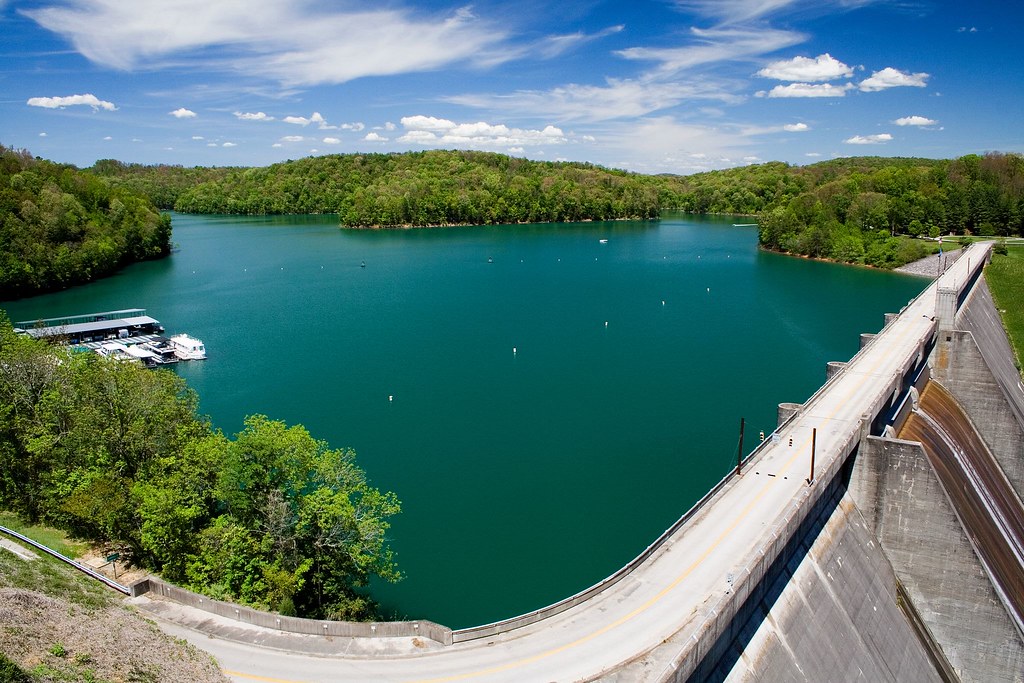
Spanning seven states and 24 dams, the development of the TVA was a massive project affecting millions of people. Not just a feat of engineering or America’s grandest planning effort, the TVA sought to bring economic development to one of the country’s poorest regions, through flood control and the generation of electricity.

The aims of TVA administrators and designers were equal parts heroic and problematic, globally aware and regionally sensitive, and these impulses bear themselves out architecturally -- in the unrepentant Modernism of dams themselves; the eclectic architecture of the thousands of homes required to house those displaced by the flooding of the Tennessee River’s bottomlands; and the graphic standards developed for all TVA materials. Steven Heller’s chapter on TVA graphics and Todd Smith’s chapter on the TVA’s visual art campaign are particularly compelling in their descriptions of the complex charge behind the aesthetics of such a massive undertaking. A look inside the TVA’s architects offices in Knoxville by Christine Macy illuminates a productive tension between local and global design considerations, while Jane Wolff’s discussion of the TVA’s transformation of the Tennessee Valley landscape underlines the fact that the land itself was intended to become, through clever manipulation, what would transform the region, physically and culturally:

[The TVA] reinvented the Tennessee Valley as a collection of idealized scenes—rustic, pastoral, and monumental. The places that the TVA created argued for its agenda. Meant to look as though they had always existed, they declared that progress was not at odds with tradition, that old images and new technologies could be integrated, and that history and geography were continuous and coherent. The agency’s terms for the landscape were so internally consistent and so convincing that its rhetoric was barely questioned.

Culvahouse points out that this wholescale approach to regional development was not without its flaws:

Of course, not everyone was convinced. The intricate weave of people’s lives in the landscape does not readily admit comprehensive visions or earthly utopias….Resentment of the TVA’s reengineering of the region lingers there. But just as certain are the benefits to the region, rich in new ways of intertwining our lives with the land.

The book is valuable reading for any design professional who thinks they can foresee the ramifications of any grand transformation, and is particularly apt in an age of new regional transformations from Dubai to Shanghai; grand civic schemes like the 2008 or 2012 Olympics; new parks from New York to Toronto to LA; and of course, the fervent, ongoing, perpetual search for more energy.

------------------


Big thanks to Chris Timmerman, the blogger behind Brand Avenue, for writing this guest post! Check out Chris' blog for more great insights on "place, space, and identity."

(Photo from Flickr user Robby Edwards. The original full-color version can be viewed by clicking the photo.)

10.16.2007

New City, Old Urbanism

Cities in the New World followed a relatively simple logic that involved gridded streets and a central public space. In both North and South America, the evidence of this development pattern is most readily apparent in smaller towns and cities, where grids remain regular and humanly scaled, and town squares and plazas mayores are alive and well. Urban development has largely erased or obscured the original layouts of larger cities on both continents, but the real difference between the impact that the form had can best be seen in how they build cities today.

In North America, for instance, the meandering suburban road, splintered with cul-de-sacs, has become the favored layout, while South American suburbs often maintain the urban grid, often extending the original further and further into the hinterland. Even more than the grid, though, the plaza mayor is encoded in the DNA of Latin American cities. Since the conquests of the Portuguese and the Spanish began reshaping the continent through colonization and subsequent urbanization, every settlement -- from the smallest of towns to enormous cities like Buenos Aires and São Paulo -- has been centered around one of these compact public spaces. So while contemporary North American towns and neighborhoods are usually built around retail clusters, when it is time to build a new city down South, the plaza mayor remains the central feature.

The image at the top of this post is an aerial photograph of the central area of Palmas, Brazil. Founded in 1989 after Brazil created the new state of Tocantins by separating the northern and southern territories of Goias, everything about this city is new. Still, as the aerial shows, the central feature of this rigidly-plotted micropolis (pop. 187,000) maintains the traditional form of the South American city, with an unrelenting grid and a visibly dominant central plaza that plays host to several important government offices.


It is, by all photographic accounts, a very green and spacious place. By all written accounts, it's also one of the most economically robust cities in the country at the moment. But cashflows and palm fronds aside, what earns Palmas its reputation as a modern-day Brasilia are its public buildings. Hubris is immediately visible in Palmas' architecture. The government house and administrative buildings spaced evenly across the massive plaza mayor are a delightful and at times shocking mix of modernist elegance and Las Vegas kitch. In short, the Brazilians have done it again: they've built a capital from scratch.

As an outside observer, it seems to me that Palmas might be the most Brazilian of Brazilian cities as this southern juggernaut enters the 21st century struggling to gain more than just a regional foothold in the global economic/power structure. After all, Palmas is a city that remains true to tradition while making it seem distinctly modern. The eccelctic plaza and broad, tree-lined avenues look fresh and exciting, even though they are variations on a theme started in the 1500s (or earlier, depending on how you look at it). The architecture and the sheer expansiveness of the place are daring and ambitious in and of themselves. Palmas is a city with something to prove, and a plan on how to do it.

Really...just look at it.


(Photos from Panoramio users jpncerrado, GILMAR QUEIROZ, Rodrigo Goncalves Luz, and Ronaldo Mitt. Don't forget -- clicking on the images takes you to the full-color originals.)


Links:
Palmas.org

Boom time in Brazil (BBC News)

10.12.2007

WEEKEND READING: October 6-12, 2007

It's been a busy week for this blogger, so the Weekend Reading list will be a bit shorter than usual.

ITEM ONE: Part IV, aka "The World's Worst Blog," put up a public poll to determine the three Best Archiblogs of 2007. Where has been nominated. Feel free to vote for it, if you so choose. ;-)

ITEM TWO: The new issue of The Next American City features this great article about the ripple effect war causes on crime, which happens to be available online.

ITEM THREE: City of Faded Elegance points us to the new edition of the Virginia Quarterly Review, which has a ton of great content on contemporary South America.

ITEM FOUR: Aussie blog Pigs Will Fly reports on so-called Sustainability Streets. The formula is quite fun: Mulch (learn), Sow (plan), Grow (do), Harvest (teach).

ITEM FIVE: Planetizen features a great post about a new museum in Salt Lake City that focuses on the ever-changing nature of the city.

Have a great weekend!

(Photo from Flickr user LeggNet.)

10.01.2007

Opening Planning

"[A] problem I think we have in the arts is the over-professionalization of art. What I mean by that is, it is the ethos of the professional artist to present the final piece, with no warts, no rough edges. This is the art. We do not allow you backstage to see the process. I think Americans, and people in every culture, want to see the creative process. And I think professional artists have alientated their publics by not allowing them in...You don't have to change the art form, but the audience should know how hard it is to perform a new piece of orchestral music, and they should see the first violins struggling, having to do it over and over again. There has to be a way to allow our artists to be more vulnerable and to open up the creative process and invite people in." -- Steven Tepper on Smart City Radio

Hearing this quote from the September 13th edition of SCR (I'm a bit backed up on my podcasts this month) made me recall an art project I'd read about in dezeen a while back. The project, called If Gio Only Knew..., was a design/build-reuse-performance-art thingy (if you will) in which the artist (Martino Gamper) took classic pieces of Gio Ponti-designed furniture and took them apart to refashion them into new pieces of furniture. The results were uneven and sometimes downright ugly, but the project stayed in the back of my mind.

It was hearing Tepper opine about the overprofessionalization of art that made me realize what I had really liked about Gamper's little adaptive reuse experiment: he let his audience backstage. Even if you weren't at Design Miami/Basel, where the Pontis were refashioned into Gampers, you can watch a video of the re-design process. Even while the results of each reconstruction may not have been aesthetically pleasing, someone who is interested in furniture design can watch the video and learn about Gamper's creative process, and try to come to some better understanding of how and why he rebuilt the pieces as he did.

Of course, my brain started to try to translate this Aha! moment into urban design, which is one of the most underappreciated artistic fields. How cities could benefit from a more open planning process was obvious; people who understand why something in their neighborhood is changing are more likely to approve of it and, if they don't, are able to offer more focused critique of why the change is inappropriate. But how could such understanding be achieved? Even with public hearings and meetings and partnerships, there still seems to be a very negative attitude toward planners, at least in the US.

It's a public relations problem, when you boil it down. Not the evil kind of PR that tells lots of happy little lies to obscure a big ugly truth, but plain old-fashioned direct communication. It has been well-lamented that civic engagement is lacking in the twenty- and thirtysomething crowd that carries the bulk of the weight of gentrification on their shoulders. Whole groups have been formed to address this very problem (see Neighbors Project in the sidebar for a good example). The PR issue is twofold, then: older urbanites know too much about old-school planning from the 1950s and 60s to trust contemporary planners, and younger urbanites (often suburban imports with little to no understanding of how cities are shaped) who know too little about planning to care.

Planetizen's Interchange blog had a great post last week from Scott Page, a planner himself, that discussed the urban planning field's apparent identity crisis of late. In it, he laments what is essentially the overprofessionalization of the planning field. "In this process of defining who we are, are we not" he asks, "leaving out people that are, in fact, planners but not trained as such?...Let’s champion planning as an art that merges vision with pragmatic thinking. And let’s find a better way to define our community which, ironically, is precisely what we are trained to do."

The need for a more inclusive and open planning community -- in which there is plenty of room for professional planners -- is apparent as cities begin to acknowledge that, in the face of increasingly complex problems, solutions must come from all corners. But what can break down this overprofessionalization? How does the audience (the citizenry of a given metropolis) understand how planning works, and how small changes (and even inconvenient ones) can contribute to a larger solution? How do planners "open up the creative process and invite people in?"

(Photo from Flickr user seanfrom.)


Links:
Urban Innovations (Smart City Radio)

If Gio Only Knew... (dezeen)

Our collective identity crisis (Interchange)

9.04.2007

The 21st Century Park

“A 21st-century park is something very different from what Frederick Law Olmsted imagined when he won the competition for Central Park in the 19th century. We have the Internet, we have computer games, we have people flying to Hawaii for vacation, so a park in the 21st century has to be a wholly new kind of thing...I hope that we cast a wide enough net to get truly the first park of the 21st-century. Shelby Farms is certainly big enough to be something very special.”

This little nugget of hubristic bombast comes from Alex Garvin, a former LMDC official (*ding*, red flag), in reference to his current project: a revamp of Shelby Farms Park, currently a twinkling RFQ in Memphis' eye. As it stands, the 4,500 acre park is currently used for a variety of recreational activities, as one might expect for such a huge space. The Shelby Farms Park Alliance describes the park as encompassing "lakes, paved and unpaved trails, forests, meadows, an Agricenter, a farmer’s market, a horse arena, a visitor center, rental horses, skate boarding, disc golf, dog off-leash area, senior gardens, a natural area with a river running through it, a restaurant, government offices and even a prison."

Heh...someone really knows how to end a list and start a party.

At any rate, Garvin was originally brought in to develop a master plan for the park that one can only assume was originally intended to have some sort of developed component. But Garvin's suggestion was to shape the rough natural spaces into the majestic, high-tech Versailles of the Future described at the start of this post. So now the RFQ is calling on L-archies big and small to come up with a way to turn a subdivision-ringed area that claims to be the largest urban park in America into a fully-functioning greenspace-masterpiece-extravaganza. Sounds like a thunderous disappointment waiting to happen, no?

There is naked ambition evident in Garvin's blustery prophesy of trailblazing landscape architecture; the Shelby Farms Park being (vaguely) envisioned is grand, expansive, and very, very important. Yet the conflict of a park five times the size of Manhattan's Central is inherent in Garvin's own description of the challenge. The internet, computer games, and increasingly affordable transoceanic flights are all smaller pieces of the larger problem of technology's tendency to pull or even drive us apart. The logical solution to this problem, in terms of parks and other public spaces, would be to create engaging and inviting parks that, by design, bring people together. To achieve this, theoretically, a designer would need to work on a very human scale, focusing on details that would inspire interaction. To suggest that this can be done over a stretch of 4,500 acres implies a fairly rosy tint to one's glasses.

In fact, "humanly scaled" is most commonly used to describe the very un-grand side of urban design. The human scale is best suited to smaller spaces: pocket parks, plazas, paseos, grottos, playgrounds, and neighborhood gardens. These small spaces very frequently serve as local gathering places, reinforcing the importance of community in the larger context of the sprawling, technologically advanced megacities of the 21st century. They provide a sense of scale (there's that word again), reminding city dwellers that they are a part of something smaller than the cities in which they live. This is vital to city life, and these places are well-used because they are easy to fill up. That sounds a bit circuitous, but the fact is that the places most enjoyed in cities are the places where there are a lot of people around. A healthy amount of people-traffic makes us feel safe, and smaller public spaces are easier to keep busy, plain and simple.

That's not to say that large parks can't work. Central Park in Manhattan, Lincoln Park in Chicago, Hyde Park in London -- all of these are wildly successful urban parks not merely because of their beauty, but because of the high density of the neighborhoods that abut them. These parkside neighborhoods generally hold at least 50,000 people per square mile, roughly the density Jane Jacobs suggested as ideal. But this is yet another example of proper scaling: huge numbers of people require more space to spread out. If, following conventional wisdom, the Upper West Side is the traditional town writ large, then Central Park is the resulting exaggeration of courthouse square.

In addition to the incompatibility of Shelby Farms Park with its surroundings (in terms of creating a great urban park) there are issues of accessibility. The 754 square mile Shelby County, in which the majority of the Memphis area's residents reside, has a population density of just over 1,100 people per square mile. In short, the Memphis area is fairly spread out. With Shelby Farms Park located at the eastern edge of the metro -- 10 miles from downtown Memphis at the closest point -- the only access to the park for almost everyone in the region will be by private automobile. Even ignoring the implicit socioeconomic segregation, this location fails, through inaccessibility, to address any of the problems brought on by increased technology. It is merely a sprawling green space surrounded by sprawl. No matter what the park looks like, it will be accessible only to select people, and is unlikely to encourage an increased sense of community.

A few hundred miles to the north, another Mississippi River metropolis is struggling with an exacerbated version of the problems facing the Shelby Farms Park redesign. Mayor Slay and other residents of Saint Louis made news recently by suggesting that some of the national park surrounding the Gateway Arch -- the city's greatest landmark and monument to Manifest Desitny -- be redeveloped by reinstating the street grid that once ran right up to the riverfront and building a New Urbanist-style extension of downtown, complete with walkable condo-and-coffee-shop neighborhoodlettes. The merits of this project aside, it is interesting to note what the mayor and other St. Louisians describe as the somewhat infamously placid park's greatest problems: it's hard to get to, and there is not much to do.

In a park as large as Shelby Farms, a solid and cohesive landscape is next to impossible; any attempt would create extreme monotony. There will inevitably be a mix of landscapes surrounding specialized areas of activity. No matter how interesting or innovative they are these scattered points of interest will, at best, see the same fate as the Gateway Arch: they will become islands in an ocean of unused open space. But when all is said and done, what is most irritating about Shelby Farms Park is not that it will be nothing particularly special; there is no rule against gargantuan suburban parks. What is truly frustrating is that ths park claims that it can address the critical issues of landscape and public space in the 21st century, when at the most fundamental level, it cannot. Just call a spade a spade.

***

As we struggle to first define and then combat sprawl in the coming years, it will be interesting to see what kind of meaning that wretchedly overused and woefully misunderstood term -- "open space" -- takes on. It seems important to make some distinction between well-designed parks and public places (streets, riverfronts, plazas, etc.) and rural areas, and the wasted and/or misused areas that are so frivolously and irresponsibly labeled "precious open space" by reactionary neo-NIMBYs. Henceforth, "open space" will be used accordingly in posts at Where, while the well-designed places will be referred to either as "green space" or "public space," depending on their intended use.

(Photo from Flickr user motus media.)


Links:

Shelby Farms to Be a "21st-Century Park" (Architectural Record)

America's Great 21st Century Park (CEOs for Cities)

Shelby Farms Park Alliance

Should the Landscape at the Arch Change? (STLtoday.com)

8.27.2007

Conscious Urbanism: The Heidelberg Project

As the city that has fallen on the hardest times (in America, at least), Detroit has the most potential as a proving ground for new solutions. The city is a massive laboratory for urban theorists, developers, and boosters alike. How, many wonder, can Detroit be saved? Or can it be saved at all? Certainly one of the more interesting answers to these questions has come from Tyree Guyton, the man behind the Heidelberg Project, which has appropriated several blocks of the city's near east side into a spectacularly off-the-wall community art project/revitalization effort.

It's certainly not what you'd traditionally refer to as "revitalization," but that's kind of the point. On its website, the Heidelberg Project explains its vision thusly: "The Heidelberg Project envisions neighborhood residents using art to come together to rebuild the structure and fabric of under-resourced communities and to create a way of living that is economically viable, enriches lives, and welcomes all people." What this translates to in the physical environment of Heidelberg Street is a collection of abandoned houses -- and their surroundings -- covered in murals, knick-knacks, mannequins, coins, pie tins, pieces of repurposed trash, stuffed animals, and (literally) just about anything else you could think up. It's like the Watts Towers, but even more organic.

The Heidelberg Project teaches people who live and have grown up in desolate surroundings how they can change the public spaces that make up their neighborhood and how this change can affect them. It serves as an inspiration and a source of hope. So, of course, the city government has tried to kill the project several times. It has demolished a number of homes that were a part of the project on several different occasions, even though Heidelberg Street is an internationally-recognized project that attracts 275,000 visitors each year. As the project's Executive Director, Jenenne Whitman, observes, the fact that the city tried so hard to “squash the project … shows how powerful art can be." Indeed.

In contemporary society, public places themselves are not often thought of as art; actually, they are more often viewed as containers for art. The design of high-end contemporary places is sometimes considered artistically merited, it's true. But the more interesting and subtle artistic expression in the public realm is community usage. The creation of great places, after all, absolutely requires heavy human interaction. This is usually considered a confirmation of the artistic integrity of the place's design, but is it not an art form in and of itself? After all, don't communities transform unplanned spaces into vibrant public places as frequently if not moreso than they do planned places?

The bustle of urban streets and other public spaces in the city is sometimes refered to, quite poetically, as a great pedestrian ballet. And if this is true, it can be logically assumed that, while policy and planning choreograph parts of this ballet, each individual person moving through the city takes part in its choreography by making their own independent choices. People go to parks and plazas and promenades for so many reasons: to eat, to play, to run, to chat, to meet, to dance, to stroll. And by doing so, each person becomes an artist, taking part in the endless urban ballet. Simply to use the city, to exist within it, is a work of art. It's a lovely idea, no?

The Heidelberg Project is a very concrete visual manifestation of this ballet. It teaches the disenfranchised and the isolated how to shape the world around them into something beautiful. In a way, it is the most public kind of public place: the kind where the planned social infrastructure failed, and the people moved in, did what they do, and created something really useful.

Links:
The Heidelberg Project

Heidelberg Turns 21 (Model D) (Photo credit)

8.24.2007

WEEKEND READING: August 18-24, 2007

It seems like things are really hit-or-miss on the online urbanism media circuit. Some weeks are golden, and others about as interesting as watching paint dry. Luckily, this week was definitely the former.

ITEM ONE: Airoots has a great story on a pretty unconventional "artist village" development in Mumbai. (Photo at right)

ITEM TWO: Some great observations from The Economist on the past and present of one of the world's most fascinating cities, Beijing.

ITEM THREE: Want a unique way to tell your neighborhood's story? Life Without Buildings has found a fun example of how to do so...

ITEM FOUR: Want some geopolitics and developing world perspective with your architecture and urbanism? Check out Candyland, a blog from a former resident of Mexico City now living in Barcelona.

ITEM FIVE: Over at Plasticbag, one of the most interesting posts I've read on place branding.

ITEM SIX: Bill Fulton of the CPDR has no patience for Joel Kotkin. (Right on!)

ITEM SEVEN: New -- and pretty jarring -- info on the relationship between homeownership and economic success via CEOs for Cities.

ITEM EIGHT: Spacing Wire's post about psychadelic radio programs, urban soundtracks, and aimless Sunday strolls. (Conversation starter: What's the soundtrack to your city?)

So in a week overflowing with good stuff, this blogger would strongly recommend all of the above. But if you just have time to read one, make it either Item One or Item Five. And have a great weekend!

4.28.2007

Bureaucracy in Urban Placemaking is the Very Definition of Corruption: A Rant


I'm going to break with my system and put the link to my subject at the top of the post. Please read it before you read anything else.

That being read: I have reached a point in my life where I no longer watch or read the mainstream news. The internet, fabulous social tool that it is, allows me to stay aware of what I can do to help create change at the local level. Beyond that, I very strongly believe that the best way for me to be a productive member of society is to stick to my own specialized interests and work toward making one facet of the human experience a little more enjoyable. In other words, most of my media consumption is focused on architecture, planning, placemaking, geography, and related fields. I love places; they are my passion. The politics of place are more than enough to raise and rile me every day.

So I always see red when this type of fussy, petulant, bureaucratic bullshit bleeds into the physical environments of cities like a vile pus. True, all we're talking about here is a mural being painted over. But it's the reaction of the people at Transport for London that is so fundamentally disturbing. The Banksy mural was a local landmark. It was part of the character of the neighborhood, and it was appreciated by locals and tourists alike. To suggest that the mural created a "general atmosphere of neglect and social decay which in turn [encouraged] crime," or that its removal "makes the transport system safer and more pleasant for passengers" is a joke. What would make London safer and more pleasant is, apparently, a regime change at TfL. Or, at the very least, the hiring of a few of the "art critics" that the spokesperson's comments are so blatantly distainful of.

Cities are messy places. They are the most fantastically, gloriously frenetic environments on the face of the planet. This is true because they are simply built representations of humankind. And we, as a species, are messy and frenetic. It is the diversity of cultures and interests and habits and all of our trillions of idiosyncrasies that makes our lives--and, by extension, our cities--so full of vitality. To try to regulate and standardize the urban environment is an outright crime against humanity. It denies the human nature of cities, and creates a general atmosphere of spiritual neglect and social decay which in turn encourages mass apathy.

(Photo from Flickr user melfeasance.)

4.13.2007

WEEKEND READING: April 7-13, 2007


I read a lot of stuff, okay? And until I started Where, I never understood why so many of the blogs that I read every day put up those weekly link pages. I always thought it was lazy. Now I know better.

There is just too much going on in the wide world of placemaking, so I'm going to start putting up links to what I don't get around to discussing during the week. Hopefully you'll find these lists, which will appear on Friday or Saturday, useful for those lazy weekend afternoons when you have nothing to do but sit around and read articles on the internet. You know those afternoons. Sure you do.

Springwise, Trendwatching.com's blog, had an article on a new service in San Francisco that's easily adaptable for any city--a green version of those coupon books every city's tourism department puts out. This fantastic resource for San Franciscans (The Green Zebra Guide) has the dual purpose of making life easier (and a little cheaper) for people who've already made the decision to "go green," as well as encouraging the decision in other people by making the transition less daunting. Check out the guide at www.thegreenzebra.org.

Much noise has been made about the Creative Class since Richard Florida hit the scene a few years ago with his theories about the modern boho crowd. Now, while he draws up pretty (and mildly offensive, in a weird way) charts that show how gay people affect real estate values, some people are actually trying to figure out how to use the internet to turn creativity into a real asset instead of a tool for gentrification. CEOs for Cities announced a new study with Charles Leadbeater on Tuesday, which you can read about here.

Speaking of creativity, the New York Post brings us a story about some art students who turned an MTA train car into a cozy living room, complete with welcome mats. As is often true about places, it's most interesting to read peoples' reactions, which include this comment "This is criminal...It may be beautiful, but that's not the issue. They are obstructing the subway." Iiiiinteresting...

BLDGBLOG brings us this blurb about plant life on other planets. It's nothing I'll ramble about...it's just really freakin cool.

As you may remember, I'm not such an optimist about congestion pricing. The other four transit concepts presented in this article on decongestion over at Good Magazine are pretty interesting, though. I love seeing Curitiba continue to gain more attention for it's brilliant and innovative BRT system (which I think would work particularly well in American cities, which have ample road infrastructure.) The Naked Streets concept is new to me...it seems pretty innovative, too. (The image above came from this article, for the record.)

To bring this list full-circle, "going green" seems to have really, truly gone mainstream in the States. Over the past few weeks I must have read that slogan a hundred times, in publications as diverse as an independent Atlanta weekly (can't recall the name) and Vanity Fair. Interchange has a post about smart growth and urban placemaking very quietly hitting the mainstream as well. It's short and sweet, and while I think that there's still a ways to go in getting the average American to give up their sacred fear of urbanity, it does seem like we're hitting a sort of critical mass.

There are also a few new links up on the Otros Blogos side bar, including Pruned, Inhabitat, and things magazine (all of which I discovered while reading Geoff Manaugh's profile at BLDGBLOG for the first time.) I'm eventually going to get around to creating a list of websites as well, so if there are any kickass suggestions drop me an email or comment on this post.